
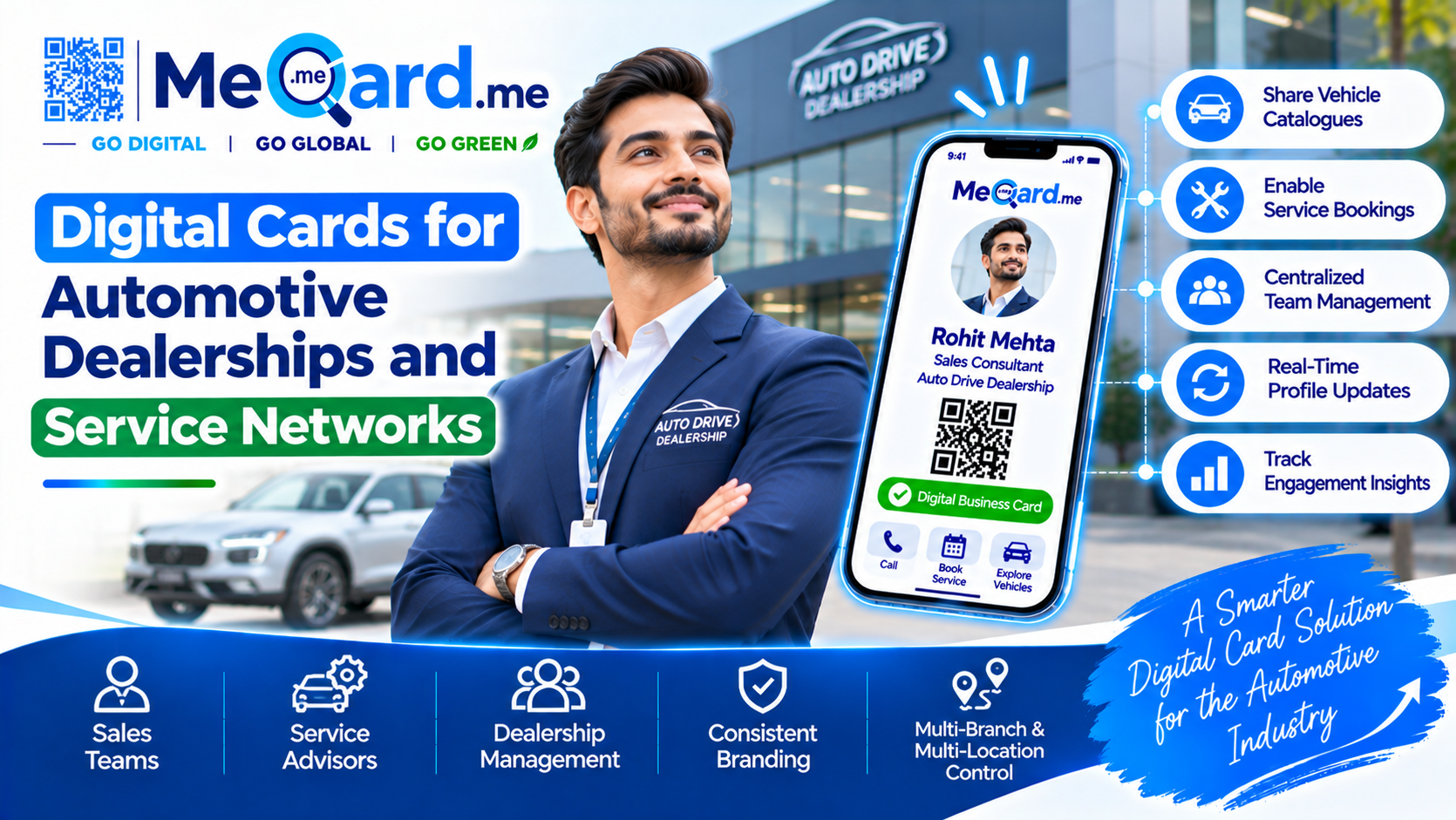
The automotive industry is evolving beyond traditional vehicle sales and service experiences. Customers today expect faster communication, convenient access to information, personalized interactions, and seamless support throughout their vehicle ownership journey.
Automotive dealerships, authorized service centres, multi-brand workshops, spare parts distributors, and automotive service networks interact with customers at several touchpoints. From the first showroom visit and vehicle enquiry to test drives, service appointments, insurance renewals, roadside assistance, and post-sales support, every interaction creates an opportunity to build customer relationships.
However, managing these interactions across multiple employees, departments, branches, and service locations can become challenging.
Sales executives may exchange physical visiting cards during showroom visits. Service advisors may share personal contact numbers with customers. Regional managers may maintain separate contact databases, while dealership employees may use inconsistent communication formats.
When employees change roles, contact details become outdated, or customers need to connect with the right department, these disconnected communication practices can create unnecessary friction.
This is where Digital Cards for Automotive Dealerships and Service Networks can make a difference.
Digital business cards provide automotive professionals with a convenient way to share their contact information, professional profiles, dealership details, service links, and other relevant business information through a single digital profile.
For organizations managing multiple employees and branches, enterprise digital card platforms can also support standardized branding, centralized employee card management, real-time profile updates, and engagement insights.
Platforms such as MeCard.me offer digital business card and enterprise identity management capabilities that can help automotive businesses modernize professional communication and customer connections.
Automotive businesses depend heavily on relationships and timely communication.
A potential customer may interact with a sales consultant during a showroom visit, speak with a finance representative about vehicle financing, coordinate with an insurance advisor, and later contact a service advisor for maintenance.
Each interaction involves exchanging contact information and maintaining a professional connection.
Traditional paper visiting cards may provide basic contact details, but they have limitations in a business environment where employees, departments, and contact information frequently change.
Digital business cards provide a more flexible way to share professional information.
The objective is not simply to replace paper visiting cards. It is to create a more connected communication experience across the automotive customer lifecycle.
Automotive sales executives regularly interact with prospective buyers through showroom visits, exhibitions, corporate events, and customer referrals.
Physical visiting cards are commonly exchanged during these interactions.
However, customers may misplace the cards, forget the salesperson's contact details, or find it difficult to reconnect when they are ready to make a purchase.
Digital business cards can provide customers with a convenient way to save and revisit the professional contact information of the sales representative.
Automotive dealership networks often operate multiple branches under a common brand or dealer group.
However, employees may use different visiting card designs, formats, and communication details.
This can create an inconsistent customer experience.
A standardized digital card system can help dealerships maintain consistent branding across sales consultants, service advisors, relationship managers, and other customer-facing employees.
Automotive businesses experience employee transfers, promotions, resignations, and changes in responsibilities.
A customer who previously contacted a sales consultant may discover that the employee has moved to another branch or left the organization.
If the customer still has an outdated physical visiting card, reconnecting with the dealership can become difficult.
Digital business card profiles can be updated when authorized contact details change, reducing dependence on repeated physical printing and distribution.
The automotive customer journey does not end when a vehicle is purchased.
Customers may need assistance with servicing, spare parts, warranty information, insurance, vehicle accessories, and maintenance schedules.
When contact information is scattered across different employees and departments, customers may struggle to reach the appropriate person.
Digital cards can help professionals share their official contact details and relevant service links in a more organized format.
Sales consultants and service advisors regularly need to share information such as:
Sharing these resources through separate messages, attachments, and physical brochures can make communication less organized.
A digital business card can bring relevant professional contact information and supported digital links together in one accessible profile.
Large automotive groups may employ hundreds of sales executives, service advisors, relationship managers, and branch administrators.
Creating and maintaining individual visiting cards for every employee can become an administrative challenge.
Centralized digital card management can help organizations maintain standardized employee profiles and manage updates more efficiently.
Dealerships invest time and resources in exhibitions, roadshows, promotional events, and customer networking activities.
However, traditional visiting cards provide limited visibility into how customers interact with shared contact information after the initial exchange.
Digital card platforms may provide engagement insights such as profile views and sharing activity, depending on available analytics and tracking capabilities.
These insights can help organizations understand how their digital networking assets are being used.
A digital business card is an online professional profile that allows an individual or organization to share contact and business information through a digital link, QR code, NFC interaction, or supported sharing channels.
For automotive dealerships, digital cards can be used by sales executives, service advisors, showroom managers, finance representatives, insurance consultants, and dealership management teams.
A digital card may include:
For example, a vehicle sales consultant can share a digital profile containing their contact information, dealership location, available vehicle catalogue, and enquiry link.
Similarly, a service advisor can share a digital card containing their professional contact information, service centre details, and appointment booking link.
This makes the digital card more than a contact-sharing tool. It becomes a convenient access point for relevant business information.
Automotive sales consultants interact with customers during showroom visits, test drives, exhibitions, and vehicle demonstrations.
A digital business card allows them to share their professional details through a QR code, digital link, or supported NFC interaction.
Customers can save the contact information directly to their smartphones and revisit the profile when required.
This helps sales professionals maintain a more convenient communication channel with prospective buyers.
Customers frequently compare vehicle models, features, specifications, and pricing information before making a purchase decision.
Sales consultants can use digital card profiles to share relevant vehicle catalogue links, product brochures, dealership websites, and other approved information.
Instead of distributing multiple physical brochures, employees can direct customers to relevant digital resources.
This can make product communication more organized and accessible.
After purchasing a vehicle, customers regularly interact with service advisors for scheduled maintenance, repair enquiries, warranty support, and service appointments.
A digital card can provide customers with the service advisor's official contact information and relevant booking links.
This helps customers reconnect with the appropriate dealership representative when they need assistance.
For dealership groups operating multiple branches, maintaining consistent professional branding is important.
Enterprise digital card management can help standardize employee profiles with approved logos, colours, layouts, and business information.
This supports a more consistent customer-facing identity across sales, service, finance, and management teams.
Employee contact details and professional responsibilities may change over time.
Digital business card profiles can be updated without requiring employees to distribute newly printed visiting cards.
When authorized administrators update the relevant information, customers accessing the digital profile can view the updated details.
This is particularly useful for dealerships with multiple branches and frequently changing sales or service teams.
Automotive companies participate in vehicle exhibitions, industry conferences, dealer meets, product launches, and business networking events.
Sales representatives, dealership owners, and business development professionals often exchange contact information with potential customers and business partners.
QR and NFC-enabled digital cards can simplify this exchange and provide a convenient way to save professional contact details.
Digital business card profiles can include enquiry buttons, contact links, and supported lead capture options.
This can make it easier for interested customers to initiate communication with a dealership representative.
However, collecting customer information and following up on enquiries still requires appropriate CRM processes, consent practices, and internal coordination.
Some digital card platforms provide analytics that help users understand how their profiles are being viewed and shared.
Depending on the platform's available reporting features, dealerships may be able to review profile engagement and identify which digital networking assets are receiving attention.
These insights can complement existing marketing and CRM reporting, but they should not be treated as a complete measurement of sales performance or customer conversion.
Different departments within an automotive business have different communication requirements. Digital cards can support these teams through role-specific professional profiles.
Sales executives can share their contact information, dealership details, vehicle catalogues, and enquiry links with prospective customers.
This can make it easier for customers to reconnect after showroom visits and test drives.
Service advisors can provide customers with their official contact information, service centre details, appointment links, and relevant service resources.
This supports communication throughout the vehicle maintenance journey.
Showroom managers can share their professional profiles and dealership contact details with customers, corporate clients, and business partners.
Finance and insurance professionals can share contact information, relevant service links, and approved information resources.
This helps customers connect with the appropriate representative when exploring financing or insurance options.
Spare parts representatives can share their professional contact information, product catalogue links, and relevant enquiry channels.
This can help workshops, fleet operators, and individual vehicle owners communicate more conveniently.
Senior management professionals can use digital business cards to maintain consistent professional identities during dealer meetings, industry events, corporate interactions, and business networking activities.
Customer relationship executives can share their official contact details and relevant communication links to support customer engagement and service coordination.
Traditional paper visiting cards continue to be useful for many automotive professionals. However, they have limitations when employees need to share multiple types of information and maintain updated contact details.
| Feature | Traditional visiting cards | Digital business cards |
|---|---|---|
| Contact sharing | Physical card exchange | QR, NFC, link, and supported sharing channels |
| Contact saving | Manual entry or scanning | Can support direct contact saving |
| Information updates | Requires reprinting | Digital profile can be updated |
| Vehicle catalogue sharing | Separate brochure or attachment | Can include relevant digital links |
| Service appointment links | Shared separately | Can be included in the profile |
| Branding consistency | Depends on individual card printing | Can support standardized templates |
| Multiple employee management | Manual design and distribution | Can support centralized management |
| Networking events | Physical card distribution | QR and NFC-based sharing |
| Engagement insights | Limited by default | Analytics may be available |
| Printing dependency | Higher | Can be reduced |
Digital cards do not necessarily eliminate physical visiting cards. Automotive businesses can adopt both formats depending on customer preferences and business requirements.
Adopting digital business cards requires more than creating individual employee profiles. Dealerships should establish a standardized approach that supports their branding, customer communication, and employee management requirements.
Begin by identifying the teams that regularly interact with customers and business partners.
These may include sales executives, service advisors, showroom managers, finance representatives, insurance consultants, and regional managers.
Determine what information each employee category needs to share.
Establish the information that should appear on employee profiles.
Common fields may include employee name, photograph, designation, dealership name, contact details, branch address, and relevant business links.
Ensure that the information is accurate and approved by the organization.
Develop templates that reflect the dealership's brand identity.
For large dealer networks, different templates may be required for sales, service, finance, and management teams.
However, the overall visual identity should remain consistent.
Identify the digital resources that employees should be able to share.
These may include:
Ensure that all links are maintained and updated.
For dealerships managing multiple employees and branches, centralized administration can help maintain standardized digital cards.
Define who can create, approve, update, and deactivate employee profiles.
This reduces dependence on individual employees for maintaining official business information.
Encourage employees to use their digital cards during showroom visits, test drives, exhibitions, service interactions, customer meetings, and business networking events.
QR codes can also be displayed at appropriate customer touchpoints.
Employees should understand how to share their digital profiles and explain the benefits to customers.
Training should cover QR and NFC sharing where supported, profile updates, customer enquiry links, and appropriate handling of customer information.
Review available engagement insights and periodically check employee profile information.
Update contact details when employees change roles or branches.
Deactivate profiles when employees leave the organization, according to the company's identity management procedures.
Selecting the right digital card platform requires evaluating both employee communication and centralized administration requirements.
| Capability | Why it matters |
|---|---|
| Digital business card creation | Provides professional employee profiles |
| Customizable templates | Maintains dealership branding |
| QR code sharing | Simplifies customer connections |
| NFC sharing | Supports convenient contact exchange where available |
| Contact saving | Makes it easier for customers to save details |
| Website and catalogue links | Helps share vehicle and service information |
| Real-time profile updates | Maintains current employee information |
| Centralized dashboard | Supports multiple employees and branches |
| Bulk card creation | Simplifies large-scale employee onboarding |
| Enquiry and lead capture | Supports customer communication |
| Analytics | Provides available profile engagement insights |
| CRM and API integration | Can support connected business workflows |
Automotive organizations should also assess platform security, data privacy, scalability, customer support, integration requirements, and the features available in the selected plan.
Automotive dealerships need a convenient way to manage employee contact information, maintain consistent branding, and help customers connect with the right professionals.
MeCard.me provides digital business card and enterprise digital identity capabilities that can help automotive businesses modernize professional communication.
Through digital card creation, QR and NFC sharing, centralized management, real-time profile updates, and supported engagement features, MeCard.me can help dealerships create a more organized digital networking experience.
Here is how MeCard.me can support automotive dealerships and service networks.
MeCard.me enables professionals to create digital business cards containing relevant contact and business information.
Automotive sales executives, service advisors, showroom managers, and other customer-facing employees can use digital profiles to share their professional details.
This gives customers a convenient way to access and save employee contact information.
MeCard.me supports QR code and NFC-based digital card sharing.
Employees can share their professional profiles through compatible smartphones and supported sharing methods.
This can simplify contact exchange during showroom visits, test drives, customer meetings, exhibitions, and service interactions.
MeCard.me offers centralized administration capabilities for managing digital cards across teams.
Automotive dealership groups can explore these capabilities to maintain standardized employee profiles across different branches and departments.
This is particularly useful for organizations managing multiple sales and service teams.
Employee contact details, designations, and responsibilities may change.
MeCard.me digital profiles can be updated without repeatedly printing new visiting cards.
This helps dealerships maintain more current employee information and reduces the administrative burden associated with physical card replacement.
Digital business card profiles can include relevant digital links.
Automotive professionals can use these capabilities to share approved vehicle catalogues, brochures, service resources, dealership websites, and other business information.
This provides a convenient way to connect customers with relevant resources through a professional profile.
MeCard.me offers digital card features that can support customer enquiries, lead capture, and other engagement activities, depending on the selected plan and configuration.
These capabilities can help automotive professionals provide customers with convenient ways to initiate communication.
MeCard.me provides digital card analytics capabilities that can help users understand available profile activity and engagement.
Dealerships can explore these insights to assess how their digital cards are being viewed and shared.
For automotive businesses managing large teams, MeCard.me offers enterprise-oriented digital card management capabilities.
These include options for customized templates, centralized administration, employee access, and other team management features, depending on the selected corporate implementation.
To explore the platform, visit the MeCard.me Digital Business Card page.
Automotive organizations looking for team-level digital card management can also explore the MeCard.me Enterprise Business Card solution.
Automotive dealerships and service networks depend on continuous communication throughout the customer journey.
From vehicle enquiries and test drives to servicing, insurance, spare parts, and post-sales support, customers interact with several professionals before and after purchasing a vehicle.
Traditional visiting cards and disconnected communication methods can make these interactions less convenient, particularly for dealerships managing multiple branches and large employee teams.
Digital business cards offer a more flexible way to share professional contact information, vehicle catalogues, service resources, and business links through a single digital profile.
However, the real value comes from implementing these cards as part of a broader customer communication strategy. Dealerships need standardized templates, accurate employee information, centralized administration, and clear processes for managing customer enquiries.
MeCard.me provides a practical digital card solution for automotive dealerships and service networks looking to modernize professional communication and customer connections.
With digital business cards, QR and NFC sharing, centralized management, real-time profile updates, and supported engagement features, MeCard.me can help automotive businesses build a more consistent and connected customer communication experience.
Whether you manage a single automotive showroom, a multi-branch dealership network, an authorized service centre, or a large automotive dealer group, MeCard.me can support a smarter approach to digital networking and professional identity management.
Explore MeCard.me Digital Business Cards and transform how your automotive teams connect, communicate, and build customer relationships.
Help your sales, service, and dealership teams share professional information, vehicle resources, and customer communication links through digital business cards.
Explore Digital Business Cards Explore Enterprise SolutionsDigital business cards are online professional profiles that allow automotive employees to share their contact information, dealership details, vehicle catalogue links, service resources, and other relevant business information.
Digital cards allow sales executives to share their professional contact details through QR codes, NFC, or digital links. Customers can save their information and reconnect when they need assistance with vehicle enquiries or purchases.
Yes. Service advisors can use digital cards to share their contact information, service centre details, appointment links, and relevant customer support resources.
Digital card profiles can include relevant digital links, allowing sales professionals to share vehicle catalogues, brochures, product pages, and other approved resources.
Enterprise digital card platforms can support centralized management, standardized templates, and employee profile administration across multiple teams and branches, depending on the platform's capabilities.
Yes. Digital profiles can be updated when authorized contact details, designations, or branch information changes, reducing dependence on repeated physical card printing.
Platforms such as MeCard.me support QR and NFC-based digital card sharing, allowing professionals to share their profiles through compatible devices and supported methods.
MeCard.me provides digital business card creation, QR and NFC sharing, centralized management, real-time profile updates, and supported engagement features that can help automotive businesses improve professional communication and customer connections.
Looking to modernize customer communication across your automotive dealership or service network? Connect with the MeCard.me team to explore digital business card solutions for your sales, service, and management teams.
Phone: +91 77770 01366 / +91 77770 01369
Email: contact@mecard.me
Website: www.mecard.me