
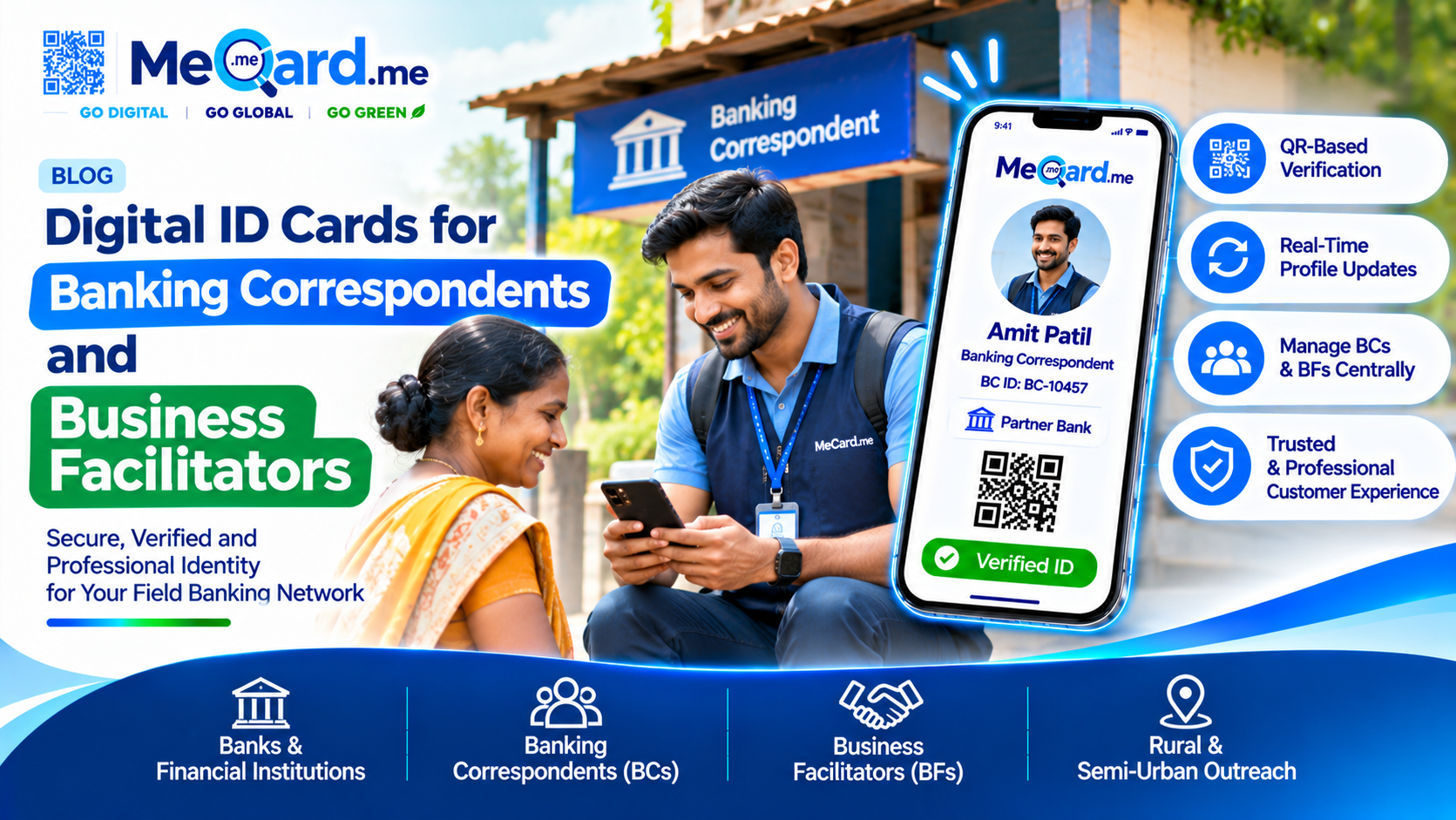
Banking services are increasingly reaching customers beyond traditional bank branches. Banking Correspondents (BCs) and Business Facilitators (BFs) play an important role in extending financial services to rural communities, semi-urban areas, underserved populations, and customers who may have limited access to conventional banking infrastructure.
From assisting customers with account-related services and financial transactions to supporting awareness programmes and facilitating access to banking services, these field representatives act as an important connection between financial institutions and their customers.
However, managing a distributed network of Banking Correspondents and Business Facilitators comes with operational challenges. Banks, NBFCs, microfinance institutions, and financial service providers need to ensure that field representatives can be appropriately identified, their organizational association is clear, and their identity information remains accurate throughout their engagement.
Traditional physical identity cards may become outdated when representatives change assignments, move between service locations, or discontinue their association with an institution. Managing employee and agent identification across large geographical networks can also create administrative difficulties.
This is where Digital ID Cards for Banking Correspondents and Business Facilitators can make a difference.
Digital ID cards provide a convenient way to create, issue, update, and access professional identity profiles through digital devices. With QR-based identity access, centralized administration, and real-time profile updates, financial institutions can establish a more organized approach to identifying their field representatives.
Platforms such as MeCard.me offer digital identity management capabilities that can help financial institutions modernize field workforce identification and improve the way customers connect with authorized representatives.
Banking Correspondents and Business Facilitators often operate outside traditional bank branches. They may visit villages, local markets, customer residences, small businesses, and community centres to support banking-related activities.
Unlike branch-based employees, field representatives frequently interact with customers in different locations and environments.
For customers, identifying whether an individual genuinely represents a particular bank or financial institution is important. For financial institutions, maintaining accurate records of their field representatives is equally essential.
Traditional physical ID cards provide basic identification, but they may not always offer the flexibility required to manage large and distributed field networks.
Digital ID cards can provide a more adaptable approach by connecting employee identity information with accessible digital profiles.
Digital identity should complement existing banking authorization, agent verification, transaction authentication, and customer protection procedures rather than replace them.
Financial institutions may work with hundreds or thousands of Banking Correspondents and Business Facilitators across different districts, towns, and villages.
These representatives may operate through banking outlets, customer service points, microfinance locations, and field-based service networks.
Managing their identity information through disconnected spreadsheets and physical records can become difficult.
A centralized digital identity management system can help institutions maintain standardized profiles and improve administrative coordination.
Customers may interact with Banking Correspondents and Business Facilitators outside traditional banking branches.
They may meet representatives during village visits, doorstep service interactions, financial awareness programmes, or at local business establishments.
In these situations, customers need a convenient way to view relevant representative information and understand which institution the individual claims to represent.
A QR-enabled digital identity profile can provide access to relevant information, helping customers and authorized personnel perform an additional identity check.
However, viewing a digital profile or scanning a QR code alone does not conclusively prove that the person presenting it is the legitimate representative. Institutions should provide appropriate verification mechanisms and official channels for confirming authorization.
Field representatives may change their contact details, service locations, designations, or institutional associations.
When this information is printed on physical ID cards, updates may require replacement cards and distribution.
If outdated cards continue circulating, customers may receive incorrect information.
Digital ID profiles can be updated when authorized information changes, helping institutions maintain more current representative details.
Banks and financial institutions regularly onboard new Banking Correspondents, Business Facilitators, and contractual field personnel.
Traditional identity issuance may involve collecting information, verifying documents, preparing card designs, coordinating printing, and distributing physical IDs.
These steps can become time-consuming when representatives are spread across different locations.
Digital ID issuance can simplify the process for suitable identification use cases by allowing authorized administrators to create and distribute digital profiles after the required verification and approval procedures.
A Banking Correspondent may be assigned to a different service area, or a Business Facilitator may receive new responsibilities.
When identity information does not reflect these changes, customers and internal teams may find it difficult to identify the representative's current organizational association.
Digital profiles can be updated to reflect approved changes in designation, location, and contact details.
Field networks may experience frequent changes because of resignations, contract completion, termination, or changes in service provider arrangements.
When a representative leaves an institution, their identity records should be updated promptly.
If old physical cards remain in circulation, customers may encounter individuals presenting outdated identification.
Digital identity management can support profile deactivation through authorized administrative controls, helping institutions manage representative identity records throughout their lifecycle.
Large banks and financial institutions may manage field representatives through different regional offices, partner organizations, and service providers.
Different locations may follow different identity card formats.
This can affect consistency in institutional branding and make it harder for customers to recognize official representative identification.
Standardized digital ID templates can help maintain a consistent identity format across different locations and representative categories.
Digital ID cards are electronic identity profiles that allow organizations to create and present employee or representative identification through supported digital devices.
For Banking Correspondents and Business Facilitators, a digital ID can display relevant professional and organizational information.
A digital identity profile may include:
For example, a Banking Correspondent's digital ID may display their name, photograph, agent identification number, associated bank, and designated service location.
A Business Facilitator's profile may display their professional designation, institutional association, and approved contact information.
The information displayed should follow the financial institution's identity policies, privacy requirements, and authorization procedures.
A digital ID is an identity presentation tool. It does not independently authorize banking transactions, permit access to banking systems, or establish the authority to collect money or perform regulated activities.
QR codes provide a convenient way to access digital identity profiles.
A Banking Correspondent can present a digital ID containing a QR code. Customers or authorized personnel can scan it using a compatible smartphone to view the linked profile.
Depending on the platform configuration, the profile can display relevant information such as the representative's name, photograph, designation, and institutional association.
This can support additional identity checks during customer interactions.
Financial institutions should ensure that QR codes lead to genuine, controlled profiles and provide customers with official channels to confirm a representative's authorization.
Financial institutions need a consistent way to manage identity information across geographically distributed field networks.
A centralized digital ID platform can help authorized administrators create, update, and manage representative profiles through a common environment.
This can improve coordination between:
Role-based administration, where available, can help restrict identity management activities to authorized personnel.
Financial institutions may onboard representatives across multiple locations.
Digital ID issuance can reduce dependence on physical printing and distribution for suitable identification use cases.
After the required employee verification and institutional approval, administrators can create digital profiles and distribute access through supported methods.
This can make identity issuance more convenient for newly appointed Banking Correspondents and Business Facilitators.
Field representatives may change their contact details, designation, or assigned service area.
Digital ID profiles can be updated when authorized information changes.
This reduces dependence on repeated physical card printing and helps maintain more current representative information.
Financial institutions may engage Banking Correspondents and Business Facilitators through partner organizations and service providers.
Digital profiles can help display the representative's association with the relevant institution and partner organization.
This can improve clarity during customer interactions, provided that the displayed information accurately reflects the representative's actual authorization.
When a Banking Correspondent or Business Facilitator stops working with an institution, their identity profile should be updated or deactivated according to the organization's policies.
Digital identity management can support profile deactivation through authorized controls.
This can help reduce the risk of outdated digital profiles continuing to be presented after the representative's engagement ends.
Customer trust is influenced by the professionalism and consistency of field interactions.
Standardized digital ID templates can help banks maintain consistent logos, colours, identity fields, and professional presentation across their field networks.
This can create a more recognizable identification experience for customers interacting with different representatives.
Financial institutions managing large field networks may regularly issue replacement cards due to employee transfers, changes in information, or card damage.
Digital IDs can reduce repeated printing requirements where digital identification is suitable.
Physical identity cards may still be necessary for certain operational, regulatory, or institutional requirements. A hybrid approach may therefore be appropriate.
Digital ID cards can support different representative categories across the financial services ecosystem.
Banking Correspondents operate as authorized representatives under applicable banking arrangements and help extend banking services to customers beyond conventional branches.
Digital identity profiles can help display their professional information and institutional association during field interactions.
Business Facilitators support banks in activities such as customer acquisition, awareness, and facilitating access to banking services, within their approved responsibilities.
Digital IDs can help provide a standardized professional identity for these representatives.
Microfinance field officers regularly interact with customers in communities, assist with financial service processes, and support field operations.
Digital identity profiles can help customers access relevant representative information during field visits.
Customer Service Point operators may support customers through designated banking service locations.
Digital IDs can provide a convenient way to display professional identity information and institutional association.
Representatives involved in financial inclusion initiatives may interact with customers in rural and underserved communities.
Digital identity profiles can support consistent identification across these distributed activities.
Financial institutions may deploy authorized loan and collection representatives to interact with customers.
Digital IDs can help display their relevant organizational association and professional information.
However, identity presentation should not be confused with authorization to collect payments. Customers should continue using official payment channels and institutional verification procedures.
Regional managers and Business Correspondent network managers coordinate multiple representatives across locations.
Digital business cards can help these professionals share their official contact information during institutional meetings, partner discussions, and field coordination activities.
Traditional physical ID cards remain widely used by banks and financial institutions. However, managing them across large field networks can create administrative challenges.
| Feature | Traditional Physical ID Cards | Digital ID Cards |
|---|---|---|
| Identity issuance | Requires printing and distribution | Can be issued digitally |
| Information updates | May require reprinting | Digital profiles can be updated |
| QR-based profile access | Requires separate implementation | Can support QR-based access |
| Field representative management | Often involves manual coordination | Can support centralized management |
| Partner identification | Depends on card format | Can display approved institutional association |
| Representative exit | Physical card recovery may be required | Profiles can be deactivated through supported controls |
| Branding consistency | Depends on printing processes | Can support standardized templates |
| Mobile accessibility | Requires carrying a physical card | Accessible through supported devices |
| Printing dependency | Higher | Can be reduced |
Digital ID cards do not necessarily eliminate physical identity cards. Financial institutions should determine which format is suitable for each representative category and operational requirement.
Implementing digital ID cards requires a structured approach that connects identity issuance with existing employee verification and authorization processes.
Begin by identifying the field workforce categories that require digital identity profiles.
These may include Banking Correspondents, Business Facilitators, Customer Service Point operators, microfinance field officers, and authorized third-party representatives.
Define the identity information required for each category.
Establish common information fields for representative profiles.
These may include:
Collect only the information necessary for legitimate identification purposes.
Before issuing digital IDs, institutions should verify the representative's identity and authorization.
This may involve document checks, partner confirmation, internal approvals, and other established onboarding procedures.
A digital ID platform should support these processes rather than replace them.
Prepare approved templates for different representative categories.
For example, Banking Correspondents, Business Facilitators, and microfinance field officers may require different designations and identity fields.
Maintain consistent institutional branding across all templates.
Define who can create, approve, update, and deactivate digital ID profiles.
Large institutions may require different permissions for head office, regional offices, branches, and authorized partner administrators.
Once the required verification and approvals are completed, administrators can create digital identity profiles and distribute access through the supported process.
Representatives should receive instructions on how to access and present their digital IDs.
Define how identity profiles should be updated when representatives change service locations, partner organizations, or responsibilities.
Establish a clear procedure for deactivating profiles when their authorization ends.
Financial institutions should explain how customers can identify authorized representatives and confirm their association with the institution.
Customers should be encouraged to use official bank channels for verification and to avoid sharing PINs, OTPs, passwords, or other confidential banking credentials.
Conduct periodic checks to identify:
Regular reviews help maintain accurate identity records across the field network.
Financial institutions handle sensitive customer and employee information. Digital identity implementation should therefore follow appropriate security and privacy practices.
Only authorized administrators should be able to create, update, or deactivate representative profiles.
Administrative permissions should reflect the responsibilities of head office, regional offices, branches, and partner organizations.
Digital ID profiles should contain information required for identification and legitimate operational purposes.
Sensitive personal information should not be exposed through publicly accessible profiles.
QR codes should direct customers to the intended digital identity profile.
Institutions should evaluate profile authenticity, inactive identity handling, and the possibility of unauthorized QR code duplication.
A QR scan alone should not be treated as conclusive proof of identity or authorization.
Profiles should clearly identify the bank, financial institution, or authorized partner organization associated with the representative.
The information must be accurate and regularly reviewed.
When a representative's authorization ends, the identity profile should be updated or deactivated promptly.
Institutions should coordinate with partner organizations to maintain accurate records.
Digital employee IDs should not expose customer account details, transaction records, PINs, OTPs, or other confidential banking information.
Representative identification and customer financial data should remain separate.
Organizations should establish how employee identity information and administrative records are stored, accessed, and retained.
These practices should follow applicable legal requirements, institutional policies, and data protection obligations.
Selecting a digital identity platform requires evaluating both field representative identification and centralized administration requirements.
| Capability | Why It Matters |
|---|---|
| Digital ID card creation | Simplifies representative identity issuance |
| Customizable templates | Maintains institutional branding |
| QR code profile access | Provides convenient identity access |
| Centralized dashboard | Helps manage distributed field networks |
| Bulk ID creation | Supports large-scale onboarding |
| Real-time profile updates | Maintains current representative information |
| Profile deactivation | Helps manage representative exits |
| Temporary ID management | Supports time-bound engagements |
| Role-based administration | Controls identity management permissions |
| Mobile accessibility | Makes digital profiles easier to access |
| Analytics | Helps review available profile activity |
| Integration capabilities | May connect with existing HR or administrative systems |
Banks and financial institutions should also evaluate platform security, data privacy, scalability, support services, integration requirements, and the features available in the selected plan.
Banks and financial institutions need a practical way to create, manage, update, and maintain identities across geographically distributed field networks.
MeCard.me provides digital identity card capabilities that can help organizations move beyond traditional physical employee and representative ID management.
Through digital ID creation, QR-based profile access, centralized administration, and real-time profile updates, MeCard.me can support a more organized approach to field representative identification.
Here is how MeCard.me can help financial institutions.
MeCard.me supports digital ID card use cases for employees and other organizational identity requirements.
Banks and financial institutions can explore creating structured digital profiles for Banking Correspondents, Business Facilitators, and other authorized field representatives.
These profiles can contain relevant identity information, designation, institutional association, and other approved fields.
MeCard.me supports QR-based digital identity access.
Customers and authorized personnel can scan a QR code using compatible smartphones to access the linked digital profile.
This can provide a convenient way to view relevant representative information during field interactions, subject to the institution's verification procedures and platform configuration.
MeCard.me provides centralized digital card management capabilities.
Financial institutions can explore these capabilities to manage representative profiles through a common administrative environment.
This can support more consistent identity administration across branches, regions, service points, and field networks.
Representative contact details, designations, and service locations may change during their engagement.
MeCard.me digital profiles can be updated without requiring repeated physical card printing.
This helps organizations maintain more current representative information.
MeCard.me supports digital identity use cases for employees, contractors, vendors, visitors, and other categories, depending on the selected implementation.
Financial institutions can explore how these capabilities align with their Banking Correspondent networks, Business Facilitator programmes, and third-party field operations.
Financial institutions regularly manage representative onboarding, transfers, and exits.
MeCard.me's digital ID capabilities include profile revocation and temporary ID use cases, depending on configuration.
These capabilities can support identity lifecycle administration when a representative joins, changes assignments, or leaves an organization.
MeCard.me supports customizable digital card templates.
Financial institutions can explore standardized identity designs that display approved institutional branding and relevant representative information.
This can help maintain a consistent identification experience across distributed field teams.
MeCard.me offers enterprise-oriented digital card management capabilities that can support organizations with larger teams and multiple operational requirements.
Banks and financial institutions can explore centralized administration, employee access, customized templates, and other available management features to determine how the platform fits their field identity management processes.
To explore the platform, visit the MeCard.me Digital ID Cards page.
Financial institutions looking for broader team-level digital card management can also explore the MeCard.me Enterprise Business Card solution.
Banking Correspondents and Business Facilitators play an important role in extending financial services to customers across geographically distributed communities.
Their work depends on trust, accurate identification, and reliable communication between customers and financial institutions.
Traditional physical ID cards and disconnected identity records can create administrative challenges, particularly when institutions manage large field networks involving multiple branches, service providers, and contractual representatives.
Digital ID cards offer a more flexible way to manage representative identities through standardized profiles, QR-based access, centralized administration, and easier information updates.
However, digital identification must remain part of a broader verification and governance framework. Financial institutions should continue following applicable banking regulations, representative authorization procedures, customer protection policies, and information security requirements.
MeCard.me provides a practical digital identity solution for banks and financial institutions looking to modernize the identification of Banking Correspondents and Business Facilitators.
With digital ID card creation, QR-based profile access, centralized management, real-time information updates, and support for different identity use cases, MeCard.me can help financial institutions build a more organized and scalable field representative identity management process.
Whether your institution manages Banking Correspondents, Business Facilitators, microfinance field officers, Customer Service Point operators, or third-party representatives, MeCard.me can support a more consistent approach to digital workforce identification.
Explore MeCard.me Digital ID Cards and simplify how your organization creates, manages, and updates representative identities across its banking network.
Explore digital ID cards, QR-based identity access, and centralized representative management for Banking Correspondents and Business Facilitators.
Explore Digital ID Cards Explore Enterprise SolutionsDigital ID cards for Banking Correspondents are electronic identity profiles that display relevant representative information, such as name, photograph, agent identification number, designation, and institutional association. They can be accessed through supported digital devices.
Digital identity cards provide Business Facilitators with a standardized way to present their professional identity and institutional association during customer interactions and field activities.
QR codes can provide access to linked digital identity profiles containing relevant representative information. Customers can scan the code using compatible smartphones. However, scanning a QR code alone does not establish the representative's authorization. Customers should use official institutional channels for confirmation.
Yes. Enterprise digital identity platforms can support centralized management of representative profiles, standardized templates, and administrative controls across multiple locations, depending on platform capabilities.
Digital identity profiles can be updated when authorized information, such as designation, contact details, or assigned location, changes. This can reduce dependence on repeated physical card printing.
Digital identity platforms can support different workforce identity use cases, including contractors and third-party personnel. Financial institutions should clearly display the representative's actual employer or partner organization and follow appropriate verification procedures.
No. A digital ID card is an identity presentation tool. It does not independently authorize financial transactions or replace the institution's transaction authentication, agent authorization, or operational control procedures.
MeCard.me provides digital ID creation, QR-based profile access, centralized management, real-time profile updates, and digital identity use cases for employees and other organizational categories, depending on the selected implementation.
Looking to modernize the identification of Banking Correspondents and Business Facilitators? Connect with the MeCard.me team to explore digital identity solutions for your financial institution.
Phone: +91 77770 01366 / +91 77770 01369
Email: contact@mecard.me
Website: www.mecard.me