
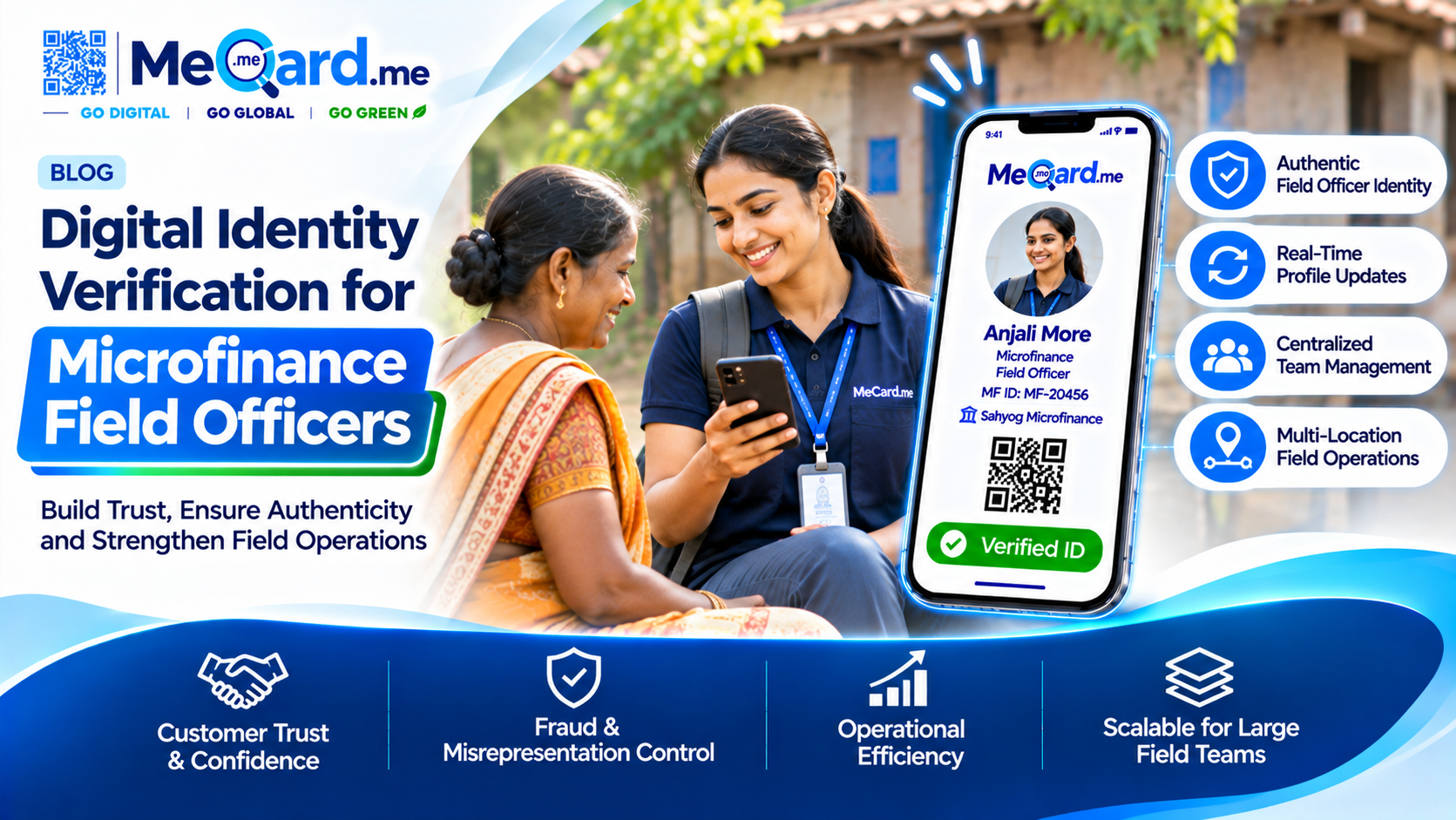
Microfinance institutions play an important role in expanding financial inclusion by providing financial services to individuals, small businesses, and communities that may have limited access to traditional banking facilities.
A significant part of this work happens outside conventional office environments. Microfinance field officers regularly visit customers, conduct group meetings, support loan applications, coordinate repayment activities, collect information, and maintain relationships with borrowers across geographically distributed locations.
During these interactions, field officers represent the microfinance institution directly. Customers need to know who they are dealing with, while the organization must maintain accurate records of its field workforce and ensure that only authorized representatives act on its behalf.
However, verifying field officers across multiple branches, villages, and customer locations can become challenging.
Traditional physical identity cards may contain outdated information, become damaged, or remain in circulation after an employee leaves the organization. Manual verification processes can also make it difficult for customers and internal teams to access relevant representative information quickly.
This is where Digital Identity Verification for Microfinance Field Officers becomes important.
Digital identity solutions enable microfinance institutions to create, manage, update, and access employee identity profiles through digital platforms. With QR-based profile access, centralized administration, and real-time information updates, institutions can establish a more organized approach to field workforce identification.
Platforms such as MeCard.me provide digital identity card capabilities that can help microfinance institutions modernize field officer identification and improve the way representatives present their professional identities during customer interactions.
Microfinance operations depend heavily on field-level interactions. Unlike conventional banking environments, where customers usually visit a branch, microfinance field officers often travel directly to customer locations.
They may interact with borrowers at their homes, workplaces, community centres, village meetings, and group lending locations.
During these interactions, customers may need to confirm:
For microfinance institutions, maintaining accurate field officer identities is equally important.
An outdated employee profile, an unverified representative, or an inactive identity card can create confusion and weaken customer confidence.
Digital identity verification can help institutions make relevant representative information easier to access while supporting a more standardized identity management process.
Digital identity should complement the institution's existing employee verification, customer protection, loan authorization, and financial transaction procedures.
Microfinance field officers frequently interact with customers outside branch premises.
A customer may meet an officer during a loan enquiry, document collection visit, group meeting, repayment discussion, or follow-up interaction.
In these situations, customers need a convenient way to understand who the representative is and which institution they claim to represent.
Traditional physical ID cards provide basic information, but they may not always offer convenient access to updated employee details.
QR-enabled digital identity profiles can provide an additional way to access relevant representative information using a smartphone.
This can support customer verification when combined with official institutional confirmation procedures.
Microfinance institutions may operate across several districts, towns, villages, and rural service areas.
Their workforce can include:
Maintaining consistent identity records across these locations can become difficult when different branches follow separate administrative processes.
A centralized digital identity management approach can help institutions maintain standardized profiles across their field workforce.
Field officers may receive new designations, move to different branches, or change their contact details.
When this information is printed on physical ID cards, organizations may need to issue replacement cards.
If outdated cards continue to circulate, customers may receive incorrect information about the representative.
Digital identity profiles can be updated when authorized information changes, helping institutions maintain more current employee details.
Microfinance institutions regularly recruit new field officers to expand operations and support additional customer locations.
Traditional ID issuance may involve collecting employee information, verifying documents, preparing card designs, coordinating with printing vendors, and distributing physical cards.
These processes can delay employee identification during onboarding.
Digital ID issuance can provide an alternative by allowing authorized administrators to create and distribute digital profiles after completing the required verification and approval procedures.
Field officers may move between branches, districts, or operational territories depending on business requirements.
A representative who previously worked in one location may be assigned to another.
When identity information is not updated, customers and internal teams may find it difficult to understand the officer's current organizational association.
Digital profiles can be updated to reflect approved changes in designation, contact details, and assigned locations.
Microfinance institutions may experience employee movement because of resignations, contract completion, or changes in workforce requirements.
When a field officer leaves, their identity profile should be updated or deactivated according to institutional policy.
If outdated physical or digital identity records remain active, individuals may continue presenting old identification.
A structured digital identity management process can help administrators manage profile deactivation and maintain more accurate workforce records.
Some microfinance institutions work with external agencies, service providers, and contractual field personnel.
These representatives may perform activities on behalf of the institution under specific arrangements.
Customers should be able to understand the representative's actual organizational association.
Digital identity profiles can help display relevant employer or partner information, provided that the details are accurate and approved by the institution.
Digital identity verification for microfinance field officers involves using digital identity profiles and supporting verification procedures to establish and present a representative's professional identity.
A digital employee ID can be accessed through a smartphone or another supported digital device.
A typical field officer identity profile may include:
For example, a field officer's digital ID may display their photograph, employee code, designation, branch name, and institutional association.
A customer or authorized representative can scan the QR code to access the linked profile.
The profile provides an additional identity reference, but a QR scan alone does not conclusively establish that the person presenting the ID is the legitimate employee or is currently authorized to perform a particular financial activity.
Microfinance institutions should combine digital identity access with appropriate employee verification, official confirmation channels, and internal authorization controls.
QR codes provide a convenient way to access digital employee identity profiles.
A field officer can present a QR-enabled digital ID during a customer visit. The customer can scan the code using a compatible smartphone to view the linked profile.
Depending on the platform configuration, the profile may display the officer's name, photograph, designation, and organizational association.
This can make relevant representative information easier to access during field interactions.
Institutions should also provide official channels through which customers can confirm an officer's identity and authorization.
Field officers interact with customers in different environments, often without the immediate presence of branch personnel.
A standardized digital identity profile can provide a consistent way to present professional information during these interactions.
Customers can view relevant details rather than relying entirely on verbal identification.
This can support transparency and improve the professional presentation of field representatives.
Microfinance institutions managing distributed field teams need a consistent approach to employee identity administration.
A centralized digital identity platform can help authorized administrators create, update, and manage employee profiles through a common environment.
This can improve coordination between:
Role-based administration, where available, can help ensure that identity management activities are performed by authorized personnel.
Microfinance institutions frequently recruit field officers to expand their service coverage.
Digital ID issuance can reduce dependence on physical printing and distribution for suitable identification use cases.
After employee information has been verified and approved, authorized administrators can create digital profiles and distribute access through the supported process.
This can make identity issuance more convenient during workforce expansion.
Field officers may change branches, receive promotions, or move into different responsibilities.
Digital profiles can be updated when approved information changes, without requiring repeated physical card printing.
This helps institutions maintain more current employee identity information across their field networks.
When a field officer moves to another branch or leaves the institution, their identity information should reflect the change.
Digital identity management can support profile updates and deactivation through available administrative controls.
This helps reduce dependence on physical card recovery as the only method of managing outdated identity information.
Field officers represent the institution during customer interactions.
A consistent identity format can help maintain a professional appearance across branches and service locations.
Standardized digital ID templates can display approved logos, colours, employee photographs, designations, and institutional information.
This creates a more consistent identification experience across the field workforce.
Microfinance institutions with large field teams may regularly issue replacement cards because of new recruitment, employee transfers, or changes in information.
Digital ID cards can reduce repeated printing requirements where digital identification is suitable.
Physical ID cards may still be required by institutional policy or specific operational environments. A hybrid approach can be appropriate when both formats are needed.
Digital identity solutions can support different employee categories and field activities across the microfinance ecosystem.
Field officers regularly visit customers, support loan-related processes, conduct group meetings, and coordinate field operations.
Digital IDs can provide a standardized way to present their professional identity and institutional association.
Loan officers interact with prospective borrowers, explain loan products, collect relevant information, and support loan application processes.
Digital identity profiles can help customers access relevant representative information during these interactions.
Collection executives visit customers to discuss repayment schedules and support collection-related activities.
Digital identity profiles can help customers identify the representative and understand their organizational association.
However, identity presentation does not independently authorize an individual to collect payments. Customers should use official payment channels and institutional verification procedures.
Group lending coordinators work with borrower groups and community-level customers.
Digital employee IDs can provide a consistent identification format during group meetings and field visits.
Branch managers supervise field operations, coordinate employee activities, and maintain relationships with customers and local communities.
Digital identity profiles can provide standardized professional identification and approved contact information.
Area managers and regional supervisors coordinate multiple branches and field teams.
Digital business cards can help these professionals share their official contact information during internal meetings, partner discussions, and business interactions.
Some institutions engage external service providers and contractual personnel.
Digital identity profiles can help display the representative's actual employer or partner association and relevant approved information.
Traditional physical ID cards remain widely used in microfinance operations. However, managing them across geographically distributed field teams can create administrative challenges.
| Feature | Traditional Physical ID Cards | Digital ID Cards |
|---|---|---|
| ID issuance | Requires printing and distribution | Can be issued digitally |
| Information updates | May require reprinting | Digital profiles can be updated |
| QR-based profile access | Requires separate implementation | Can support QR-based access |
| Distributed workforce management | Often involves manual coordination | Can support centralized management |
| Employee transfers | May require replacement cards | Profiles can be updated |
| Employee exits | Physical card recovery may be required | Profiles can be deactivated through supported controls |
| Branding consistency | Depends on printing processes | Can support standardized templates |
| Mobile accessibility | Requires carrying the physical card | Accessible through supported devices |
| Printing dependency | Higher | Can be reduced |
Digital ID cards do not necessarily eliminate physical identity cards. Institutions should determine which format is suitable for each employee category and operational requirement.
Successful digital identity implementation requires a structured approach that connects employee identity creation with existing verification and authorization procedures.
Begin by identifying all workforce categories that require digital identity profiles.
These may include field officers, loan officers, collection executives, group lending coordinators, branch managers, and third-party representatives.
Define the identification requirements for each category.
Establish a common employee information structure.
Typical fields may include:
Collect only the information necessary for legitimate identification and workforce administration.
Before creating digital IDs, determine how employee information will be verified.
This may involve HR checks, document verification, photograph validation, and internal approval procedures.
A digital ID platform should support these processes rather than replace the underlying employee verification.
Prepare approved templates for different field workforce categories.
For example, field officers, collection executives, and branch managers may require different designations and profile information.
Maintain consistent institutional branding across all templates.
Define who can create, approve, update, and deactivate digital identity profiles.
Large microfinance institutions may require separate permissions for head office, regional offices, branch administrators, and authorized partner organizations.
Once employee information has been verified and approved, create digital identity profiles and distribute access through the supported process.
Employees should receive instructions on how to access and present their digital IDs during customer interactions.
Define how identity profiles should be updated when field officers move between branches, receive new designations, or leave the organization.
Ensure that inactive profiles are handled according to institutional policy.
Customer awareness is an important part of digital identity implementation.
Microfinance institutions should explain how customers can access representative information and confirm an officer's identity through official channels.
Customers should also be reminded never to share PINs, OTPs, passwords, or other confidential financial credentials with field representatives.
Conduct periodic checks to identify:
Regular reviews help maintain accurate identity information across the field network.
Microfinance institutions manage employee information and interact with customers who may be unfamiliar with digital verification processes.
Digital identity implementation should therefore include appropriate security and privacy practices.
Only authorized personnel should be able to create, update, or deactivate employee profiles.
Administrative permissions should reflect the responsibilities of HR, branch management, and field operations teams.
Digital employee profiles should contain information required for identification and legitimate operational purposes.
Sensitive personal information should not be exposed through publicly accessible profiles.
QR codes should direct users to the intended digital identity profile.
Institutions should evaluate profile authenticity, inactive identity handling, and the possibility of unauthorized code duplication.
A QR scan alone should not be treated as conclusive proof of identity or authorization.
Employee profiles should be updated whenever approved changes occur.
Incorrect designations, contact details, or branch information can create confusion during customer interactions.
Employee exits should trigger appropriate identity updates.
Institutions should ensure that former employees cannot continue presenting active digital profiles after their authorization has ended.
Digital employee ID profiles should not expose customer account information, transaction records, PINs, OTPs, or other confidential financial data.
Employee identification and customer financial information should remain separate.
Organizations should establish how employee identity information is stored, accessed, and retained.
These practices should follow applicable legal requirements, institutional policies, and data protection obligations.
Selecting a digital identity platform requires evaluating both field employee identification and centralized administration requirements.
| Capability | Why It Matters |
|---|---|
| Digital employee ID creation | Simplifies field officer identity issuance |
| Customizable templates | Maintains institutional branding |
| QR code profile access | Provides convenient identity access |
| Centralized dashboard | Helps manage distributed field teams |
| Bulk ID creation | Supports large-scale onboarding |
| Real-time profile updates | Maintains current employee information |
| Profile deactivation | Helps manage employee exits |
| Temporary ID management | Supports time-bound workforce engagements |
| Role-based administration | Controls identity management permissions |
| Mobile accessibility | Makes digital profiles easier to access |
| Analytics | Helps review available profile activity |
| Integration capabilities | May connect with existing HR systems |
Institutions should also assess platform security, data privacy, scalability, support services, integration requirements, and the features available in the selected plan.
Microfinance institutions need a practical way to create, manage, update, and maintain identities across geographically distributed field teams.
MeCard.me provides digital identity card capabilities that can help organizations move beyond traditional physical employee ID management.
Through digital ID creation, QR-based profile access, centralized administration, and real-time profile updates, MeCard.me can support a more organized approach to field officer identification.
MeCard.me supports digital ID card use cases for employees and other organizational identity requirements.
Microfinance institutions can explore creating structured digital profiles for field officers, loan officers, collection executives, and other authorized representatives.
These profiles can contain relevant employee information, designation, institutional association, and other approved fields.
MeCard.me supports QR-based digital identity access.
Customers and authorized personnel can scan a QR code using compatible smartphones to access the linked digital profile.
This provides a convenient way to view relevant field officer information during customer interactions, subject to institutional verification procedures and platform configuration.
MeCard.me provides centralized digital card management capabilities.
Microfinance institutions can explore these capabilities to manage employee profiles through a common administrative environment.
This can support more consistent identity administration across branches, regions, service locations, and field teams.
Field officer designations, contact details, and branch assignments may change during employment.
MeCard.me digital profiles can be updated without requiring repeated physical card printing.
This helps institutions maintain more current employee identity information.
MeCard.me supports digital identity use cases for employees, contractors, vendors, visitors, and other categories, depending on the selected implementation.
Microfinance institutions can explore how these capabilities align with their permanent workforce, contractual field personnel, and third-party service provider requirements.
Microfinance institutions regularly manage employee onboarding, transfers, and exits.
MeCard.me's digital ID capabilities include profile revocation and temporary ID use cases, depending on configuration.
These capabilities can support identity lifecycle administration when a field officer joins, changes assignments, or leaves the organization.
MeCard.me supports customizable digital card templates.
Microfinance institutions can explore standardized identity designs that display approved institutional branding and relevant field officer information.
This can help maintain a consistent identification experience across distributed field teams.
MeCard.me offers enterprise-oriented digital card management capabilities that can support organizations with larger teams and multiple operational requirements.
Microfinance institutions can explore centralized administration, customized templates, and available management features to determine how the platform fits their workforce identity management processes.
To explore the platform, visit the MeCard.me Digital ID Cards page.
Financial institutions looking for broader team-level digital card management can also explore the MeCard.me Banking & Finance solution.
Microfinance field officers play an important role in connecting financial institutions with customers across rural, semi-urban, and underserved communities.
Their work depends on professional conduct, accurate identification, and customer confidence during field interactions.
Traditional physical ID cards and disconnected employee records can create administrative challenges, particularly when institutions manage large field teams across multiple locations.
Digital identity solutions offer a more flexible way to manage field officer profiles through QR-based access, centralized administration, standardized templates, and easier information updates.
However, digital identification should remain part of a broader employee verification and customer protection framework. Institutions must continue following their applicable financial regulations, internal authorization procedures, data protection policies, and customer verification requirements.
MeCard.me provides a practical digital identity solution for microfinance institutions looking to modernize field officer identification and workforce identity management.
With digital employee ID cards, QR-based profile access, centralized management, real-time profile updates, and support for different identity use cases, MeCard.me can help microfinance institutions build a more organized and scalable field workforce identification process.
Whether your institution manages field officers, loan executives, collection representatives, group lending coordinators, or third-party personnel, MeCard.me can support a more consistent approach to digital workforce identity management.
Explore MeCard.me Digital ID Cards and simplify how your organization creates, manages, and updates field officer identities across its microfinance network.
Create and manage digital employee identities, provide QR-based profile access, and support a more consistent workforce identification process across your microfinance operations.
Explore Digital ID CardsDigital identity verification involves using digital employee identity profiles and supporting verification procedures to present and check the professional identity of microfinance field officers. Profiles may include the employee's name, photograph, designation, employee code, and institutional association.
Digital ID cards provide a convenient way for field officers to present their professional identity during customer visits, group meetings, and other field activities. They can also help institutions standardize employee identification across multiple locations.
A QR code links to a digital identity profile that can be accessed using a compatible smartphone. Customers can view relevant representative information, while institutions should provide additional official verification channels to confirm authorization.
Yes. Digital identity platforms can support centralized employee profile management, standardized templates, and administrative controls across branches and field locations, depending on platform capabilities.
Digital profiles can be updated when approved employee details, designations, or branch assignments change. This can reduce dependence on repeated physical card printing.
Yes. Digital identity platforms can support different employee categories, including loan officers and collection executives. Institutions should define the relevant identity fields and authorization procedures for each role.
No. A digital ID card presents an individual's professional identity. It does not independently authorize financial transactions or payment collection. Customers should follow the institution's official payment procedures and verification channels.
MeCard.me provides digital ID creation, QR-based profile access, centralized management, real-time profile updates, and digital identity use cases for employees and other organizational categories, depending on the selected implementation.
Looking to modernize employee identification and digital identity management across your organization? Connect with the MeCard.me team to explore a suitable solution for your requirements.
Phone: +91 77770 01366 / +91 77770 01369
Email: contact@mecard.me
Website: www.mecard.me