
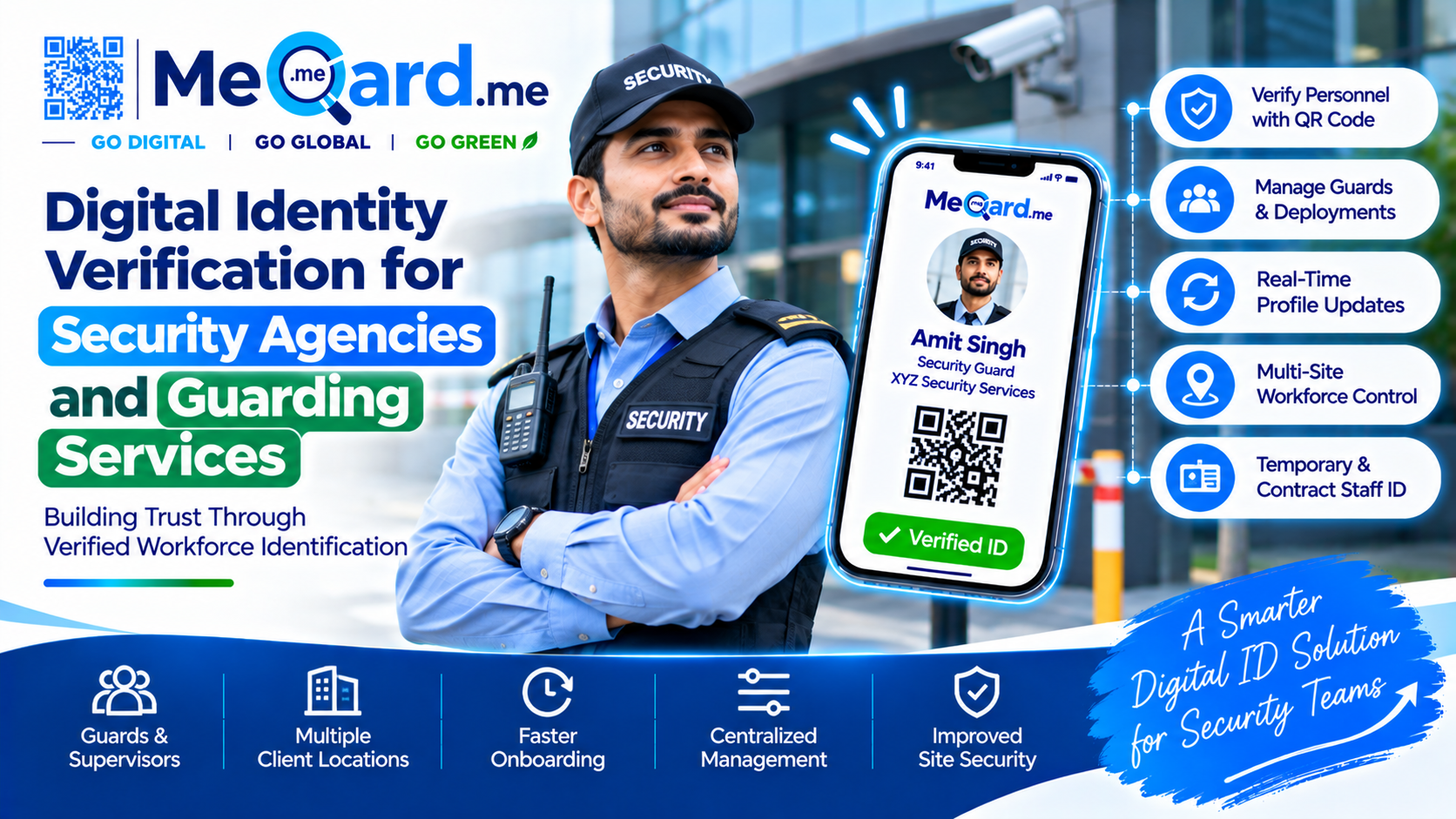
Security agencies and guarding service providers play a critical role in protecting businesses, residential communities, industrial facilities, commercial buildings, hospitals, banks, educational institutions, and infrastructure projects.
Their responsibilities extend beyond deploying security personnel. They must ensure that the right individuals are assigned to the right locations, that workforce identity information remains accurate, and that clients can confidently identify the security personnel responsible for protecting their premises.
However, managing workforce identities across multiple clients, locations, shifts, and contractual assignments can be challenging.
Security agencies often employ hundreds or thousands of guards, supervisors, security officers, and field personnel. They may also manage temporary deployments, replacement staff, subcontracted personnel, and employees moving between client locations.
When identity verification relies entirely on physical ID cards, paper records, spreadsheets, and manual communication, maintaining accurate workforce information becomes difficult.
Outdated identification details, misplaced cards, unauthorized personnel representation, delayed onboarding, and incomplete deployment records can create operational and reputational risks.
This is where Digital Identity Verification for Security Agencies becomes important.
Digital identity solutions provide a more organized way to create, manage, update, and verify workforce identity profiles. Through digital employee IDs, QR-based verification, centralized administration, and controlled profile updates, security agencies can improve how they manage personnel identification across different locations.
Platforms such as MeCard.me offer digital ID card capabilities that can help security agencies modernize workforce identification and create a more consistent identity management process.
Security personnel are often the first representatives a visitor, employee, resident, or customer encounters when entering a facility.
Their identity and organizational association directly influence the confidence clients place in the security agency.
Consider a security company managing 500 guards deployed across 40 client locations. Each location may have different supervisors, shift schedules, deployment requirements, and client coordination procedures.
The agency must ensure that:
Traditional identification methods may not provide the flexibility required to manage these responsibilities efficiently.
Digital identity verification can help security agencies establish a more structured process for workforce identification while supporting their existing operational and site security procedures.
Security agencies frequently operate with large workforces distributed across multiple locations.
A single agency may provide guarding services to corporate offices, residential societies, hospitals, factories, warehouses, and financial institutions.
Managing employee information across these deployments requires continuous coordination between HR, operations, supervisors, and client representatives.
When records are maintained through disconnected spreadsheets and physical documents, updating information consistently becomes difficult.
A centralized digital identity system can help agencies manage employee profiles through a common administrative environment.
Clients need to identify the security personnel assigned to their premises.
For example, a facility manager may want to confirm whether a guard presenting an agency ID is associated with the contracted security provider.
Traditional physical cards generally display printed information, but they may not provide an easy way to access an updated digital profile.
QR-based digital identity verification can provide an additional method of accessing relevant personnel information.
An authorized person can scan the QR code using a compatible smartphone and view the linked digital profile, subject to the platform's configuration and verification controls.
However, a QR scan alone does not establish that the person presenting the ID is its legitimate holder. Agencies should combine digital verification with appropriate identity checks and deployment authorization procedures.
Security agencies regularly transfer personnel based on client requirements, shift schedules, operational changes, and staffing availability.
A guard assigned to one facility may later be deployed at another location.
If identity information is not updated promptly, the employee's digital or physical identification may show an outdated assignment.
Digital employee ID management can help agencies maintain current profile information when authorized changes are made.
Absenteeism, leave, emergencies, and changing deployment requirements may require security agencies to arrange replacement personnel.
Temporary deployment creates additional identification and administrative responsibilities.
The agency needs to maintain accurate records of who is assigned to each location and for what period.
Digital identity systems can support temporary employee profiles and controlled deactivation workflows, depending on the platform and configuration.
When a security guard leaves an agency, their previously issued physical ID card may remain in circulation if it is not collected or invalidated.
This creates the possibility of outdated identification being presented after the employment relationship has ended.
Digital profile management can help agencies deactivate or update employee identities through available administrative controls.
However, organizations should also maintain appropriate physical card recovery and client notification procedures wherever required.
Security agencies may deploy personnel at several customer locations, each with different operational expectations.
Without standardized identification formats, employees may present different card designs or inconsistent information.
A standardized digital identity format can help agencies maintain a recognizable professional identity across client deployments while allowing relevant employee and assignment details to vary.
Maintaining employee records manually can become time-consuming when an agency manages multiple branches and deployment locations.
HR and operations teams may need to coordinate employee information, photographs, designations, deployment records, and status changes.
Digital identity management can help reduce fragmented administration by providing a more structured way to manage employee profiles.
Digital identity verification is the process of using digital identity information and supporting verification procedures to identify individuals and confirm relevant details about their organizational association.
For security agencies, a digital employee ID card can provide a structured profile containing relevant workforce information.
A digital ID profile for a security guard may include:
The exact information displayed should depend on the agency's requirements, client agreements, and applicable privacy policies.
For example, a security guard deployed at a commercial building may need a profile displaying their name, photograph, employee code, agency name, and relevant deployment information.
A supervisor may require a different profile format containing their designation and operational contact details.
The purpose is to make personnel identification more accessible and manageable without unnecessarily exposing sensitive employee information.
Security agencies frequently recruit and deploy new personnel to fulfil client requirements.
Traditional ID issuance may involve collecting information, preparing card designs, printing physical cards, and distributing them to employees.
This process can create delays, especially when recruitment and deployment happen across multiple locations.
Digital employee ID issuance can provide an alternative by allowing authorized administrators to create and distribute digital profiles through a supported process.
This can reduce dependence on repeated physical card production for suitable use cases.
QR codes offer a convenient way to access digital employee identity information.
A guard can present a QR-enabled digital ID, and an authorized person can scan the code using a compatible smartphone.
The linked profile can display relevant information about the employee and their associated security agency.
This can help client representatives and supervisors access identity information more conveniently.
For stronger verification, agencies should ensure that QR codes link to trusted profiles and that the verification process includes appropriate checks against impersonation, copied codes, and outdated information.
A security agency operating across multiple cities needs a consistent way to manage employee identity information.
Centralized digital identity management can help administrators create, update, and manage employee profiles through a common platform.
This can improve coordination between:
Access should be controlled through appropriate administrative permissions so that employee information is modified only by authorized personnel.
Security supervisors and field officers coordinate guards across several client locations.
They frequently interact with facility managers, client representatives, and agency management.
Digital identity profiles can help these professionals present standardized identification and relevant contact details.
This can make it easier for clients to identify the appropriate agency representative when coordination is required.
Employee identity management should cover the entire employment lifecycle rather than stopping at ID card issuance.
Security agencies need to manage:
A digital identity platform can help administrators manage these stages through available controls and workflows.
This is especially valuable for agencies with frequent workforce changes.
Large security agencies may provide guarding services to several clients across different geographical areas.
A centralized digital identity platform can help maintain consistent employee profiles across these deployments.
Relevant assignment information can be updated according to approved operational procedures.
This helps reduce the administrative difficulty of maintaining separate identity formats for every client location.
Security agencies may issue new ID cards when employees join, transfer locations, receive new designations, or lose existing cards.
Digital identity profiles can reduce the need for repeated physical printing when information changes.
Physical ID cards may still be necessary for certain client sites, access control systems, or contractual requirements. Digital identification should complement these arrangements where appropriate.
Security personnel represent both the agency and the service relationship with the client.
Standardized digital identity profiles can help agencies maintain consistent branding and employee information across locations.
This supports a more professional and recognizable identification experience.
Different roles within a security agency have different identification requirements.
A digital identity system should accommodate these differences while maintaining a consistent organizational structure.
Security guards are deployed at offices, residential communities, factories, hospitals, warehouses, and commercial premises.
Their digital IDs can include their photograph, name, employee code, agency name, designation, and relevant deployment information.
Supervisors coordinate teams, monitor deployment requirements, and communicate with client representatives.
Their digital profiles can include their professional designation, contact details, and agency information.
Field officers visit multiple locations to coordinate workforce deployment, conduct operational checks, and communicate with clients.
Digital cards can make their professional identity and contact details easier to share.
Site in-charge personnel coordinate security operations at individual facilities.
Their digital IDs can provide standardized identification and relevant professional contact information.
Temporary personnel may be assigned to a location for a limited period.
Digital identity workflows can support their registration and profile management, provided the agency establishes appropriate validity and deactivation procedures.
Some agencies work with subcontractors or third-party service providers.
A standardized digital identity approach can help distinguish these personnel from direct employees while maintaining relevant identification records.
Physical ID cards remain common in the security industry. However, they have limitations when agencies need to manage changing employee information across multiple client locations.
| Feature | Traditional Physical ID Cards | Digital Employee ID Cards |
|---|---|---|
| ID issuance | Requires printing and distribution | Can be issued digitally |
| Employee information updates | May require reprinting | Digital profile can be updated |
| QR-based access | Requires separate implementation | Can support QR-based profile access |
| Centralized administration | Often involves manual coordination | Can support centralized management |
| Multi-location workforce | Requires location-wise record coordination | Can support common identity management |
| Temporary personnel | Requires physical card administration | Can support temporary digital profiles, depending on setup |
| Employee exit | Physical card recovery may be required | Digital profile can be deactivated through supported controls |
| Contact information | Limited by printed format | Can include relevant digital links |
| Printing dependency | Higher | Can be reduced |
| Engagement insights | Limited by default | Analytics may be available |
The choice between physical and digital identification should depend on client requirements, site conditions, operational policies, and the security agency's technology environment.
A hybrid approach may be the most practical option for many organizations.
Introducing digital identity verification requires a structured implementation process.
Simply issuing QR codes without establishing identity verification and employee lifecycle procedures will not solve the underlying management challenges.
Begin by identifying all workforce categories that require digital identification.
These may include:
Define the information required for each category.
Establish a consistent employee data structure.
Common fields may include name, photograph, employee ID, designation, branch, agency details, and relevant deployment information.
Avoid displaying sensitive personal details that are not necessary for identification.
Before creating a digital ID, determine how employee identity information will be verified.
This may involve authorized HR processes, document checks, photograph validation, and other approved procedures.
A digital card platform should support these processes rather than be treated as a replacement for the underlying verification.
Prepare digital ID templates that reflect the agency's brand identity.
Different templates may be required for guards, supervisors, field officers, and administrative personnel.
The format should remain consistent while displaying relevant role-specific information.
Determine who can create, approve, update, and deactivate employee profiles.
Large agencies may require different permissions for head office, regional offices, and site-level administrators.
This helps maintain control over identity information.
Once employee information is verified and approved, create the digital profiles.
Distribute access through the supported process and explain how employees should present their digital IDs.
Define how employee identity information will be updated when personnel move between client locations.
The digital profile should reflect approved changes rather than relying on employees to update important organizational details independently.
When a security guard leaves the agency or a contract ends, the relevant identity profile should be updated or deactivated according to organizational policy.
Where necessary, the agency should also notify the affected client and recover physical identification.
Train supervisors, operations managers, HR teams, and relevant client representatives on the digital ID verification process.
Employees should understand how to access and present their profiles.
Conduct regular checks to identify:
Periodic reviews help maintain the accuracy of workforce identity information.
Security agencies manage employee information and operate in environments where identity accuracy is important.
Digital identity implementation should therefore include appropriate security and privacy controls.
Only authorized personnel should be allowed to create, update, or deactivate employee profiles.
Role-based permissions can help separate responsibilities across HR, operations, and regional administration teams.
Display only information necessary for identification and legitimate operational purposes.
Avoid exposing sensitive personal information through publicly accessible digital profiles.
A QR code should direct users to the intended digital identity profile.
Agencies should evaluate the security of the verification process, including profile authenticity, unauthorized duplication, and the handling of inactive identities.
A scanned QR code alone should not be treated as conclusive proof of identity.
Digital identity information should be updated whenever approved changes occur.
Incorrect employee information can undermine the reliability of the entire identification process.
Employee exits, contract completion, and deployment changes should trigger appropriate identity updates.
This helps reduce the risk of outdated profiles continuing to be used.
Agencies should establish how employee identity records, changes, and administrative actions are retained and reviewed.
Data retention and access should follow applicable legal requirements and organizational policies.
A digital employee ID confirms access to an identity profile. It does not automatically prove that an individual is authorized to enter a specific client location, carry out a particular security duty, or perform a regulated activity.
Client-specific deployment approval, site access control, background verification, training, and licensing requirements must continue to be managed through appropriate processes.
Before selecting a digital employee ID solution, security agencies should evaluate whether the platform can support their workforce size, administrative structure, and operational requirements.
| Capability | Why It Matters |
|---|---|
| Digital employee ID creation | Simplifies identity issuance |
| Customizable templates | Supports different employee categories |
| QR code verification | Provides convenient digital profile access |
| Centralized dashboard | Supports workforce identity administration |
| Bulk ID creation | Helps manage large employee populations |
| Real-time updates | Maintains current employee information |
| Profile deactivation | Supports employee exit workflows |
| Temporary ID management | Helps manage short-term engagements |
| Role-based administration | Controls who can manage identity records |
| Mobile accessibility | Makes digital profiles easier to present |
| Analytics | Helps review available profile activity |
| Integration capabilities | May connect with existing HR systems |
Security agencies should also assess platform security, data privacy, scalability, administrative permissions, support services, and the capabilities included in the selected plan.
Security agencies need a practical solution for managing employee identities across different branches, client locations, and workforce categories.
MeCard.me provides digital identity card capabilities that can help organizations move beyond traditional physical employee ID management.
Through digital ID creation, QR-based identity access, centralized administration, and real-time profile updates, MeCard.me can support a more structured approach to workforce identification.
Here is how MeCard.me can help security agencies.
MeCard.me supports digital ID card use cases for employees and other organizational identity requirements.
Security agencies can use structured digital profiles to display relevant personnel information, including employee details, designation, agency information, and other approved fields.
MeCard.me supports QR-based digital identity access.
An authorized person can scan the QR code using a compatible smartphone to access the linked digital profile.
This can provide a convenient way to view relevant security personnel information during client interactions and identity checks, subject to the agency's verification procedures and platform configuration.
MeCard.me offers centralized digital card management capabilities.
This can help security agencies manage employee profiles across branches, operational teams, and client locations.
A common management environment can support more consistent identity administration as the organization expands.
Employee details and deployment information may change frequently in the security industry.
MeCard.me digital profiles can be updated without repeatedly printing new physical cards.
This can help agencies maintain more current identification information.
MeCard.me supports digital identity use cases for employees, contractors, vendors, visitors, and other categories, depending on the selected implementation.
Security agencies can explore how these capabilities align with their workforce and client identification requirements.
Security agencies frequently manage temporary deployments and changing employment relationships.
MeCard.me's digital ID capabilities include temporary ID and profile revocation use cases, depending on configuration.
These capabilities can support identity lifecycle administration when employees join, transfer, or leave the organization.
Digital identity profiles can reduce the need for repeated physical card printing when employees join or relevant information changes.
This can be useful for agencies managing large and frequently changing workforces.
For security agencies managing multiple teams and locations, MeCard.me offers enterprise-oriented digital card management capabilities.
Organizations can explore centralized administration, standardized profiles, and other available features to determine how the platform fits their workforce identity processes.
To explore the solution, visit the MeCard.me Digital ID Cards page.
Explore digital employee ID cards, QR-based identity access, and centralized digital identity management for security agencies and guarding service providers.
Explore Digital ID Cards Explore Enterprise SolutionsLooking to modernize workforce identification and digital identity management across your security agency? Connect with the MeCard.me team to explore the available solutions.
Phone: +91 77770 01366 / +91 77770 01369
Email: contact@mecard.me
Website: www.mecard.me