
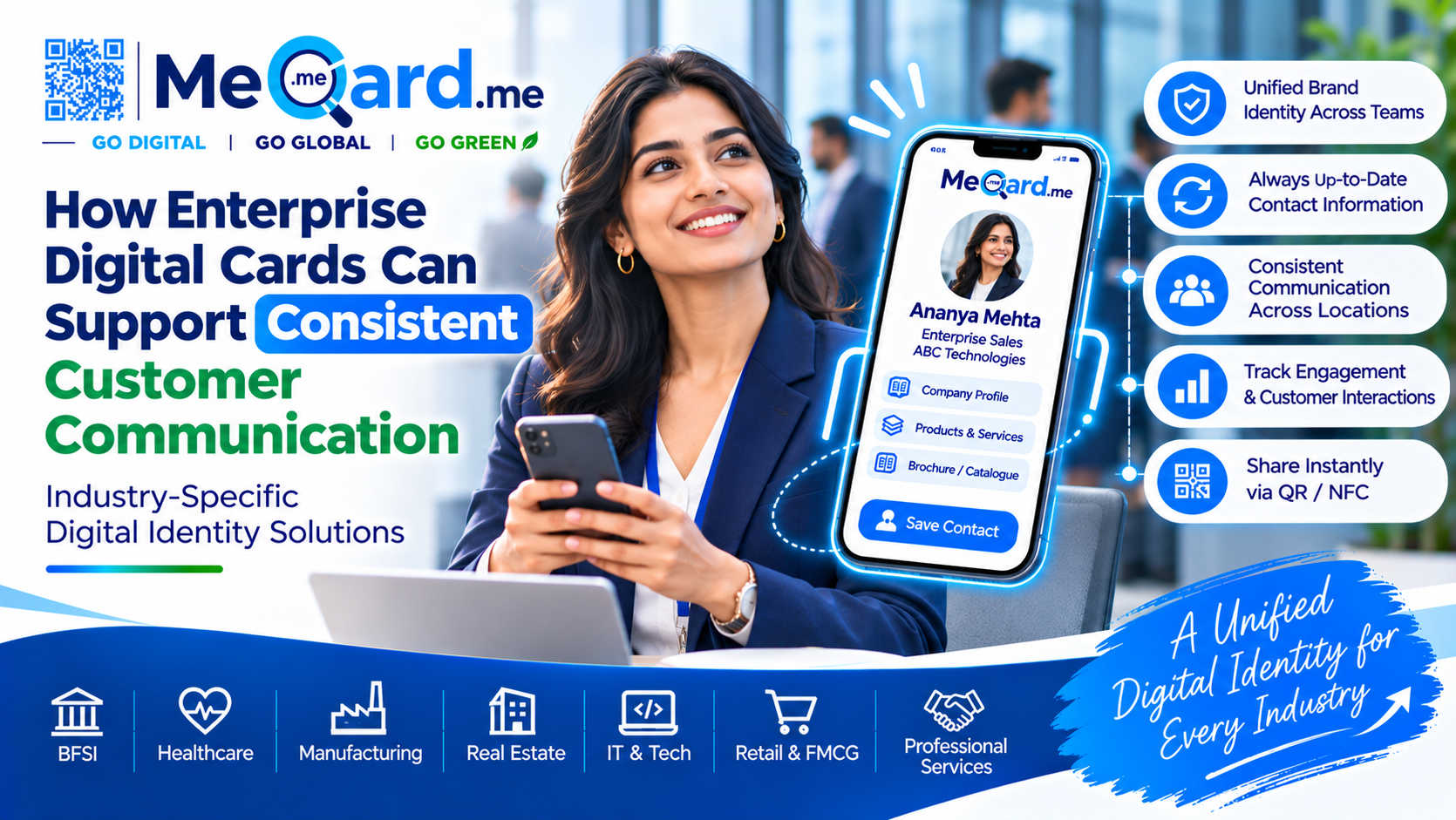
In today's competitive business environment, customer communication plays a critical role in building trust, maintaining relationships, and creating a consistent brand experience. Whether a customer interacts with a sales representative, business development executive, distributor, consultant, or customer relationship manager, every interaction contributes to how they perceive an organization.
However, maintaining consistent communication across a large enterprise is not always easy.
Organizations often operate through multiple departments, branches, regional offices, sales teams, and external business partners. Each team may communicate with customers through different channels, share different contact details, or use outdated company information. This can create inconsistencies in how the business presents itself.
A customer might receive one company representative's visiting card at an exhibition, another employee's contact details through email, and a different version of the company's service information through WhatsApp.
These disconnected interactions can affect the customer experience and make it difficult for organizations to maintain a unified professional identity.
This is where enterprise digital business cards can make a difference.
By providing standardized digital profiles, centralized administration, QR and NFC-based sharing, and real-time information updates, enterprise digital cards help organizations create a more consistent approach to professional communication.
Platforms such as MeCard.me support businesses in managing digital identities and sharing professional information through a connected digital platform.
Customer communication is not limited to responding to enquiries or sharing product information. It includes every interaction through which customers learn about an organization, its people, products, services, and professional capabilities.
For enterprises, consistency is especially important because customers may interact with several representatives across different departments and locations.
Consider a company operating across 20 cities with hundreds of sales representatives and business associates. If every representative uses a different visiting card format, outdated contact information, or inconsistent company details, maintaining a unified brand experience becomes difficult.
Consistent communication helps organizations:
The objective is not to make every conversation identical. It is to ensure that the information customers receive remains accurate, recognizable, and aligned with the organization's communication standards.
In large organizations, employees from different departments may use different visiting card formats, email signatures, profile descriptions, and contact-sharing methods.
While these differences may appear minor, they can affect how customers perceive the organization.
For example, a customer meeting a sales executive at an exhibition may receive a visiting card with an outdated company logo, while another representative shares a different design.
Standardized enterprise digital cards can help organizations maintain a consistent professional identity across employees and customer-facing teams.
Employee contact information changes frequently.
Employees may receive new designations, move between departments, change office locations, or take on different responsibilities.
Traditional printed visiting cards cannot easily accommodate these changes. Organizations may need to print and distribute new cards, while previously distributed versions continue circulating.
This can create confusion when customers try to contact employees using outdated information.
Digital business cards allow relevant profile information to be updated without repeatedly printing physical cards.
Enterprises communicate with customers through multiple channels, including:
When these channels are not connected through a consistent professional identity, customers may struggle to find the correct information.
An enterprise digital business card can act as a central access point connecting professional contact details with relevant company websites, service pages, social profiles, and business resources.
Organizations with multiple branches and regional offices often face challenges in maintaining consistent branding.
Different teams may create their own visiting cards or use locally modified designs.
This can result in inconsistent logos, colours, contact formats, and business descriptions.
Centralized digital card management can help organizations introduce approved templates and maintain consistent branding across their teams.
Employees and business representatives frequently share company websites, product brochures, presentations, and service information.
However, the information being shared may not always be current.
An outdated product brochure or incorrect service link can create unnecessary confusion for customers.
Digital business cards can connect employees with online resources that organizations can maintain and update independently of printed visiting cards.
When an employee changes roles or leaves an organization, previously shared contact details may continue circulating.
Customers may unknowingly contact someone who is no longer responsible for their account or business relationship.
Enterprises need a process for updating or deactivating professional digital profiles when employee responsibilities change.
A centralized digital identity management approach can help organizations maintain more accurate professional information throughout the employee lifecycle.
Enterprise digital cards are centrally managed digital business card profiles designed for employees and customer-facing representatives within an organization.
Unlike individual digital visiting cards, enterprise digital card platforms provide organizational capabilities that help businesses maintain consistent branding and manage profiles across multiple employees.
An enterprise digital card may include:
The objective is to create a consistent digital identity that customers can access through a convenient sharing method.
With centralized administration, organizations can also establish processes for creating, updating, and managing employee profiles.
One of the most important advantages of enterprise digital cards is the ability to establish a common professional identity across teams.
Organizations can use standardized templates containing approved logos, colours, typography, and business information.
This helps ensure that employees across different departments and locations represent the company consistently.
For example, a customer interacting with a sales executive in Mumbai and a business development manager in Bengaluru can access digital profiles that follow the same organizational branding.
The employee details may differ, but the overall professional presentation remains consistent.
Customers should be able to access the correct contact information whenever they need to reconnect with a company representative.
Digital business cards make it easier to update relevant profile details when employee information changes.
Instead of requiring employees to distribute newly printed visiting cards, organizations can update the digital profiles through the available administrative controls.
This reduces dependence on outdated printed contact information and supports more consistent customer communication.
A professional digital card can serve as a gateway to the organization's wider digital presence.
Instead of sharing only a phone number and email address, employees can connect customers with:
This makes it easier for customers to explore relevant information after meeting an employee.
It also reduces the need to share multiple documents and links separately.
Sales and business development teams frequently interact with potential customers, existing clients, distributors, and strategic partners.
These professionals represent the organization during meetings, conferences, exhibitions, and business discussions.
Enterprise digital cards provide a standardized way for these employees to share their professional information and relevant business resources.
Customers can access the same organizational identity format regardless of which representative they meet.
QR codes make professional information easier to share during face-to-face interactions.
An employee can display a QR code on a smartphone, presentation, brochure, or visiting card.
Customers can scan the code using a compatible smartphone to access the linked digital profile.
This is particularly useful during:
QR-based sharing reduces the effort involved in manually entering contact details and provides customers with a convenient way to access professional information.
NFC-enabled digital business cards provide another way to exchange professional information.
With compatible devices and supported configurations, employees can share their digital profiles through a simple tap.
For enterprises with frequent customer-facing interactions, QR and NFC sharing offer flexible alternatives to traditional contact exchange.
Both methods can help organizations introduce a consistent digital sharing experience across their teams.
Enterprise employees may share different types of business information depending on their responsibilities.
A sales executive may need to share product catalogues, while a consultant may need to provide service information or case studies.
Digital business cards can connect these professionals with relevant business resources through one profile.
Organizations can maintain approved links and information so customers are directed towards the appropriate company resources.
This is particularly valuable for businesses with multiple products, services, departments, and customer segments.
Employees may change roles, move between departments, or leave the organization.
A digital identity management process can help organizations update or deactivate their digital profiles according to approved administrative workflows.
This reduces the possibility of customers repeatedly accessing outdated professional information.
For enterprises, managing these changes centrally can support better communication continuity and professional identity governance.
Enterprise digital cards can support customer communication throughout the business relationship, not just during the first introduction.
During a customer meeting, an employee can share a digital card containing their contact information, company website, and relevant business links.
Customers can save the professional details and access the information again when required.
At exhibitions, organizations interact with large numbers of potential customers and business partners.
Digital cards make it easier for employees to share contact information and connect visitors with product catalogues, brochures, and service pages.
During corporate presentations, sales representatives can share QR codes that direct prospects to their digital profiles.
This gives potential customers an easy way to access the representative's contact information after the presentation.
Customer-facing teams can share professional contact information and relevant support resources through digital profiles.
However, digital business cards should complement official customer support channels rather than replace formal service and grievance processes.
Enterprises often work with distributors, dealers, resellers, and business associates.
Standardized digital profiles can help maintain consistent brand representation across these external business networks, subject to the organization's partner management policies.
HR professionals and corporate representatives can share their digital identities during recruitment events, conferences, and professional networking activities.
This creates a consistent way for individuals to connect with the organization.
The need for consistent customer communication exists across industries, but the information shared may vary depending on the business model.
Banks and financial institutions interact with customers through relationship managers, branch employees, financial advisors, and business development teams.
Enterprise digital cards can help standardize professional contact information and connect customers with official banking websites and relevant service information.
For organizations managing field representatives, digital identity and QR verification workflows may also support broader identity management processes.
However, a digital business card alone does not establish authorization to perform regulated financial activities or replace formal customer verification procedures.
Insurance companies often operate through large networks of agents, advisors, brokers, and relationship managers.
Enterprise digital cards can help standardize professional profiles and connect customers with relevant insurance service information and official company resources.
This makes it easier for customers to identify and contact the appropriate representative.
Manufacturing organizations frequently communicate with distributors, dealers, sales representatives, and service teams.
Digital cards can connect customers with product catalogues, technical brochures, company websites, and service information.
This helps maintain consistent communication across different sales regions.
Healthcare organizations and pharmaceutical businesses interact with medical representatives, institutional sales teams, healthcare professionals, and distributors.
Digital cards can provide access to professional details and approved business resources.
Organizations should ensure that shared healthcare and promotional information follows applicable internal and industry requirements.
IT companies may offer multiple services, including software development, cybersecurity, cloud infrastructure, and enterprise technology solutions.
Digital cards can connect employees with company service pages, case studies, product demonstrations, and business contact details.
This helps maintain consistent communication across sales and consulting teams.
Real estate developers, construction companies, and property consultants regularly interact with customers through multiple sales representatives and channel partners.
Digital cards can connect customers with project information, brochures, company websites, and enquiry options.
This provides a more organized way to share business information across property sales teams.
Retail organizations and consumer brands often work through regional sales teams, distributors, dealers, and franchise networks.
Enterprise digital cards can help standardize contact information and connect customers and business partners with official product and service resources.
Traditional visiting cards remain useful for physical networking, but they offer limited flexibility when organizations need to maintain consistent communication across large teams.
| Feature | Traditional visiting cards | Enterprise digital cards |
|---|---|---|
| Brand consistency | Depends on individual printing and design control | Standardized templates can be centrally managed |
| Contact updates | Requires reprinting | Digital profiles can be updated |
| QR code sharing | Requires separate QR implementation | Can support built-in QR sharing |
| NFC sharing | Requires separate NFC cards | Available through supported NFC-enabled setups |
| Company website | Printed URL | Clickable website link |
| Product information | Limited physical space | Can connect to digital resources |
| Team management | Manual administration | Centralized management capabilities |
| Employee transitions | Previously distributed cards remain in circulation | Profiles can be updated or deactivated through available controls |
| Engagement insights | Limited by default | Analytics may be available |
| Scalability | Requires repeated printing and distribution | Supports digital profile management across teams |
The objective is not necessarily to eliminate every printed card. Instead, enterprises can introduce digital cards as a more flexible and manageable approach to professional communication.
Introducing digital cards across an enterprise requires a structured process to ensure consistent adoption and effective management.
Begin by identifying the employees and representatives who regularly communicate with customers and business partners.
These may include sales executives, business development teams, consultants, relationship managers, customer success professionals, branch employees, and authorized external representatives.
Create approved digital card templates that reflect the organization's brand identity.
Define the information that should appear on each profile, including employee name, designation, department, company details, contact information, and relevant business links.
Different departments may require customized layouts while maintaining a common organizational identity.
Determine who can create, approve, update, and deactivate digital profiles.
For larger organizations, central administrators and authorized regional teams may need different responsibilities.
Clear permissions help maintain consistency and reduce unauthorized changes.
Create profiles for the identified employees and distribute their digital card links and QR codes.
Provide basic instructions on how to share profiles through smartphones, email signatures, presentations, and customer interactions.
Add relevant company websites, product pages, service information, brochures, and other approved resources.
Review the links periodically to ensure customers are directed towards current information.
Define what happens when an employee joins, changes roles, transfers departments, or leaves the organization.
Digital profiles should be updated or deactivated according to approved HR and administrative processes.
Review available profile analytics, QR interactions, and other engagement indicators.
Collect feedback from employees and customers to understand whether the digital cards are making professional communication more convenient.
Periodically review templates, information accuracy, permissions, and profile usage.
As the organization grows, its digital identity requirements may change. Regular reviews help maintain consistency and relevance.
Not every digital business card solution is designed to support enterprise-wide communication.
Organizations should evaluate platforms based on their administrative, branding, and operational requirements.
| Capability | Why it matters |
|---|---|
| Customizable templates | Maintains consistent brand presentation |
| Centralized dashboard | Supports organization-wide profile administration |
| Bulk card creation | Simplifies employee onboarding |
| QR code sharing | Makes contact information accessible |
| NFC support | Enables convenient sharing through compatible devices |
| Real-time updates | Helps maintain current information |
| Role-based administration | Supports controlled profile management |
| Website and social links | Connects customers with official resources |
| Analytics | Helps understand available engagement |
| Employee profile management | Supports identity lifecycle workflows |
| Integration capabilities | Helps connect with existing business systems |
| Scalability | Supports growing teams and locations |
Enterprises should also evaluate data privacy, security controls, hosting arrangements, integration requirements, administrative permissions, and support services before selecting a platform.
Maintaining consistent customer communication requires a professional digital identity that can be managed across employees, departments, and business locations.
MeCard.me provides digital business card capabilities designed to help individuals and organizations move beyond traditional printed visiting cards.
With customizable digital profiles, QR and NFC sharing, centralized management, real-time updates, and available engagement features, MeCard.me can support a more consistent approach to enterprise communication.
Here is how MeCard.me can help organizations.
MeCard.me enables organizations to create digital business card profiles for employees and customer-facing professionals.
These profiles can contain professional details, contact information, company branding, websites, and relevant business links.
Standardized templates can help maintain a consistent professional identity across teams.
MeCard.me offers centralized management capabilities that can help organizations create, manage, update, and administer digital card profiles.
This is particularly useful for businesses with multiple departments, branches, sales teams, and regional representatives.
MeCard.me supports QR-based digital business card sharing.
Employees can share their profiles through QR codes during customer meetings, exhibitions, conferences, and networking activities.
Customers can scan the code using compatible smartphones to access the linked professional profile.
MeCard.me supports NFC-enabled digital card use cases, offering another convenient way to exchange professional information through compatible devices.
Organizations can use QR and NFC sharing to simplify digital contact exchange across different customer interactions.
When an employee's designation, contact details, or other relevant profile information changes, the digital card can be updated without repeatedly printing new visiting cards.
This helps organizations reduce the circulation of outdated contact information.
MeCard.me digital business cards can connect professional profiles with company websites, social media pages, product information, and other relevant business resources.
This allows employees to provide customers with a more complete digital introduction.
MeCard.me offers analytics and business engagement capabilities, depending on the selected offering and configuration.
These may support organizations in reviewing available digital profile engagement and providing additional ways for customers to connect through enquiry and appointment-related features.
As organizations expand into new locations and add more customer-facing employees, digital card management can support a consistent approach to professional identity sharing.
Businesses can use a centralized digital platform to maintain standardized profiles and simplify ongoing administration.
Enterprises can explore these capabilities through the MeCard.me Digital Business Card platform.
For organizations looking for team-level administration and corporate digital card capabilities, the MeCard.me Enterprise Business Card solution provides further information.
Customer communication is one of the most visible parts of an organization's professional identity.
When employees across different departments and locations share inconsistent contact details, outdated company information, or unapproved business resources, it can affect the overall customer experience.
Enterprise digital cards offer a practical way to address these challenges by bringing professional identity, contact information, company resources, and digital sharing into one connected format.
With standardized templates, centralized administration, QR and NFC sharing, and real-time profile updates, organizations can make customer-facing communication more consistent and manageable.
MeCard.me helps enterprises take this step by providing a digital business card platform that supports standardized professional profiles, centralized management, and convenient digital communication.
Instead of relying entirely on printed visiting cards and disconnected contact-sharing methods, organizations can use MeCard.me to create a more consistent digital identity experience across their teams.
Whether your organization operates through multiple branches, large sales teams, consultants, relationship managers, or channel partners, MeCard.me can support a more connected way to communicate with customers.
Explore MeCard.me Digital Business Cards and build a more consistent digital communication experience across your enterprise.
Standardize professional digital identities across your teams, simplify contact sharing, and connect customers with official business information through a centralized digital card platform.
Explore Enterprise SolutionsEnterprise digital cards are centrally managed digital business card profiles created for employees and customer-facing representatives. They provide professional information, contact details, company branding, and relevant business links in a shareable digital format.
They help standardize employee profiles, maintain updated contact information, connect customers with official business resources, and simplify contact sharing through QR codes, NFC, and digital links.
Yes. Enterprise digital card platforms can provide centralized administration and standardized templates to support employee profiles across departments and locations. The available capabilities depend on the platform and selected plan.
Yes. Digital profiles can be updated when relevant information changes, reducing the need to print and distribute new physical cards.
Yes. Digital profiles can connect customers with company websites, product catalogues, service pages, brochures, presentations, and other relevant business resources.
QR codes allow employees to share their digital business card profiles through compatible smartphones. Customers can scan the code to access professional contact information and relevant business links.
MeCard.me offers customizable digital profiles and centralized management capabilities that can help organizations maintain consistent professional identity sharing across teams.
They can reduce dependence on traditional printed cards by providing digital sharing and easier profile updates. However, physical cards may still be useful in certain situations, so enterprises can use both approaches based on their requirements.
Looking to standardize customer communication and manage digital business cards across your organization? Connect with our team to explore enterprise digital card solutions.
Phone: +91 77770 01366 / +91 77770 01369
Email: contact@mecard.me
Website: www.mecard.me