
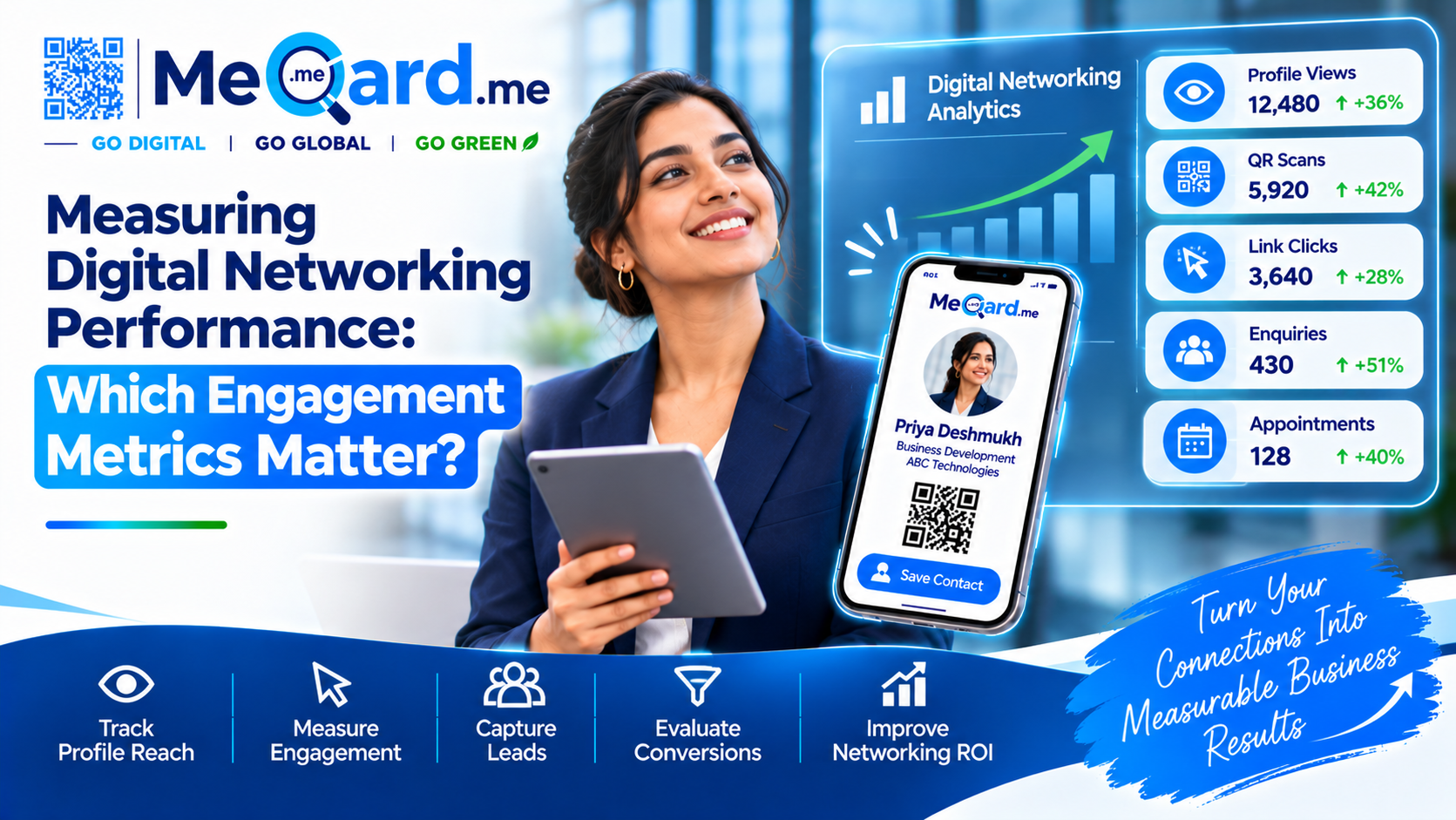
Digital networking has become an important part of modern business development. Professionals no longer rely exclusively on traditional visiting cards, face-to-face introductions, and manual contact exchanges to build business relationships. Today, digital business cards, QR codes, NFC-enabled sharing, professional profiles, and online communication channels make it easier to connect with potential customers, partners, and industry professionals.
However, simply sharing a digital business card or collecting online connections does not necessarily mean that networking activities are delivering business value.
Businesses need to understand what happens after a digital interaction. Are people viewing professional profiles? Are they saving contact information? Are they exploring company websites? Are they clicking on service links or submitting enquiries? Most importantly, are these interactions contributing to meaningful business relationships?
This is where measuring digital networking performance becomes important.
By tracking relevant engagement metrics, organizations can understand how people interact with their digital identities, evaluate networking effectiveness, and identify opportunities to improve customer engagement.
Platforms such as MeCard.me support digital business card sharing through QR codes, NFC-enabled connectivity, digital profiles, and available engagement analytics. These capabilities can help businesses move towards a more measurable approach to professional networking.
Digital networking performance refers to how effectively professionals and organizations use digital channels to create, maintain, and develop business connections.
It involves measuring the interactions that take place when someone shares a digital business card, visits a professional profile, explores business information, or initiates contact through available digital channels.
Unlike traditional networking, where organizations may primarily count the number of visiting cards exchanged or meetings attended, digital networking can provide additional engagement indicators.
For example, a business development executive attending an industry conference may share their digital business card with 100 people.
However, the number of cards shared alone does not explain whether those interactions were valuable.
A more meaningful analysis would examine:
These indicators provide a more useful understanding of digital networking activity.
Organizations invest time and resources in networking events, conferences, exhibitions, business meetings, and digital relationship-building activities.
Without measurement, it becomes difficult to understand which activities are generating meaningful engagement.
Tracking digital networking performance can help businesses in several ways.
A digital business card represents a professional's online identity. But creating a profile does not guarantee that people will view or interact with it.
Profile engagement metrics can help businesses understand whether their digital cards are reaching the intended audience.
If a sales executive shares their profile frequently but receives limited engagement, the organization may need to review the profile's presentation, relevance, or sharing approach.
Digital business cards can be shared through QR codes, NFC-enabled devices, email, messaging applications, and direct links.
Businesses may want to understand which sharing methods generate the most engagement.
For example, a company participating in multiple exhibitions may compare the engagement generated through QR codes displayed at its booth with profiles shared through follow-up emails.
Where the platform provides channel-specific tracking, these insights can help businesses improve their networking strategy.
A digital business card can contain more than basic contact information.
It may connect visitors with company websites, service pages, product catalogues, brochures, social media profiles, and enquiry options.
Understanding which resources attract attention can help organizations improve the information they present to customers.
For example, if visitors frequently access a particular service page, the business may consider making that information more prominent.
Business development teams need to understand whether networking activities are contributing to commercial opportunities.
Engagement metrics can provide an early indication of interest, helping teams decide which contacts or interactions require additional attention.
However, profile engagement should not be confused with qualified leads or confirmed sales opportunities. It should be considered alongside conversations, customer requirements, CRM records, and actual business outcomes.
Organizations may spend money on exhibition booths, event participation, promotional materials, employee travel, and networking activities.
Measuring digital engagement can help businesses evaluate whether these activities are generating attention and follow-up opportunities.
When digital engagement data is combined with CRM and sales information, organizations can develop a better understanding of networking performance.
Not every metric provides the same business value. Organizations should focus on indicators that help explain how people discover, access, and interact with their digital profiles.
What it measures: The number of times a digital business card or professional profile is viewed, according to the platform's measurement method.
Profile views are one of the basic indicators of digital networking activity.
For example, if a business development executive shares a digital profile during an exhibition and receives 250 profile views, the metric provides an indication of the profile's reach.
However, organizations should understand how the platform counts views. Repeat visits, automated activity, and different devices may affect the total.
Why it matters: Profile views help businesses evaluate whether their digital identities are attracting attention.
How to improve it: Use clear profile information, professional photographs, relevant descriptions, and convenient QR or NFC sharing methods.
What it measures: The number of recorded interactions generated through QR code scanning, where supported by the platform.
QR codes are commonly used to share digital business cards during face-to-face networking.
They can appear on smartphones, presentations, visiting cards, brochures, exhibition displays, and promotional materials.
Tracking QR interactions can help organizations understand how frequently people use this sharing method.
Why it matters: QR engagement can indicate how effectively businesses are using offline interactions to direct people towards their digital profiles.
How to improve it: Make QR codes clearly visible, use an appropriate size, provide a simple instruction such as "Scan to Connect", and ensure the linked profile works properly on mobile devices.
What it measures: NFC-related sharing interactions, where the platform and associated tracking setup support this measurement.
NFC-enabled digital business cards provide a convenient way to share professional information through compatible devices.
Organizations that use NFC cards may want to understand how frequently this sharing method is being used.
Why it matters: It helps businesses evaluate the adoption of NFC-based networking alongside other sharing methods.
How to improve it: Train employees to use NFC cards correctly and explain the sharing process to customers and networking contacts.
What it measures: The number of times users save or access contact information through available profile features, where measurable.
A digital business card is intended to make professional information easier to access and retain.
Contact-saving activity can therefore provide a useful indication of whether visitors are taking an additional step beyond simply viewing the profile.
However, profile views and actual contact saves are different actions. Organizations should not assume that every visitor saves the contact details.
Why it matters: Contact-related interactions can help indicate whether people find the profile useful enough to retain the professional's information.
How to improve it: Keep essential contact details visible and provide a clear contact-saving option.
What it measures: Clicks on the website links included in a digital business card, where link tracking is available.
Many digital business cards connect professional identity with the organization's website.
For example, a potential customer may view a sales representative's profile and click through to the company website to explore its products or services.
Why it matters: Website clicks help businesses understand whether digital networking is directing visitors towards additional company information.
How to improve it: Use relevant website links, clear descriptions, and landing pages that match the visitor's likely interests.
What it measures: Interactions with product pages, service links, brochures, catalogues, and other resources included in the profile, where supported.
This is particularly useful for organizations that use digital business cards as product and service showcases.
For example, a manufacturing company's sales representative may include links to product catalogues, technical brochures, and demonstration videos.
Tracking engagement with these resources can help the business understand which information attracts attention.
Why it matters: It provides insight into the type of business information visitors explore after viewing a digital profile.
How to improve it: Organize links into clear categories and prioritize the resources most relevant to the target audience.
What it measures: Interactions with linked social media profiles, where tracking is available.
Digital business cards can connect professionals with LinkedIn, Instagram, YouTube, and other relevant social platforms.
For B2B professionals, LinkedIn engagement may be particularly relevant because it provides an additional channel for professional communication.
Why it matters: Social profile interactions can indicate interest in learning more about a professional or organization.
How to improve it: Include only relevant social profiles and maintain updated, professional accounts.
What it measures: The number of enquiries or lead submissions generated through supported digital profile features or linked forms.
This is one of the more commercially meaningful engagement indicators.
A visitor who submits an enquiry has taken a more direct action than someone who simply views a profile.
For example, a potential customer may submit a request for a product demonstration, consultation, quotation, or business discussion.
Why it matters: Enquiry activity provides a stronger indication of potential business interest.
How to improve it: Use clear calls to action, short enquiry forms, relevant service descriptions, and an easy-to-use contact process.
What it measures: The number of appointment or meeting requests made through available booking options.
For consultants, insurance advisors, sales professionals, and business development teams, scheduling a meeting is an important step in developing a professional relationship.
Why it matters: Appointment activity can help organizations understand whether digital networking is encouraging visitors to take a meaningful next step.
How to improve it: Provide clear booking options and communicate the purpose of the meeting.
What it measures: The percentage of relevant networking contacts who progress to a defined follow-up action.
This metric generally requires information from a CRM or another contact management system. It should not be assumed to be automatically available through a digital business card platform.
For example, a business development team may collect 100 relevant contacts at an event and successfully arrange follow-up conversations with 25 of them.
The follow-up conversion rate would be:
Follow-up Conversion Rate
(Contacts Reached Successfully / Relevant Contacts Collected) × 100
In this example:
25 / 100 × 100 = 25%
Why it matters: It helps organizations evaluate whether networking interactions are progressing into actual business conversations.
How to improve it: Assign contact ownership, record conversation context, schedule follow-ups, and personalize communication.
What it measures: The percentage of collected contacts that meet the organization's defined lead qualification criteria.
Not every person who scans a QR code is a potential customer.
A qualified lead may need to meet criteria such as business relevance, requirement, decision-making authority, budget, or purchase timeline.
The formula is:
Qualified Lead Rate
(Qualified Leads / Total Contacts Collected) × 100
This metric is best measured using CRM or sales records.
Why it matters: It shifts the focus from collecting a large number of contacts to identifying commercially relevant opportunities.
What it measures: The percentage of networking contacts that eventually become recorded business opportunities.
This is a more advanced performance indicator because it connects networking activity with the sales pipeline.
Opportunity Conversion Rate
(Opportunities Created / Relevant Networking Contacts) × 100
For example, if a team collects 200 relevant contacts and 12 become recorded sales opportunities, the opportunity conversion rate is 6%.
This metric requires reliable CRM tracking and a clear definition of what qualifies as an opportunity.
Why it matters: It helps management understand whether networking activities are contributing to business development.
Not all metrics measure the same stage of engagement. The following table helps organizations distinguish between basic digital interactions and business outcomes.
| Metric | What it indicates | Measurement level |
|---|---|---|
| Profile views | Interest in the digital profile | Awareness |
| QR scans | QR-based profile access | Discovery |
| NFC interactions | NFC-based sharing activity | Discovery |
| Contact saves | Retention of contact details | Engagement |
| Website clicks | Interest in company information | Engagement |
| Product/service clicks | Interest in specific offerings | Consideration |
| Social profile clicks | Interest in professional presence | Engagement |
| Enquiry submissions | Direct customer interest | Intent |
| Appointment requests | Willingness to continue discussion | Intent |
| Follow-up conversion | Progression into conversations | Business development |
| Qualified lead rate | Commercial relevance of contacts | Lead quality |
| Opportunity conversion | Progression into the sales pipeline | Business outcome |
The most useful approach is to measure a combination of metrics rather than relying on one number.
Businesses can use simple calculations to understand the effectiveness of their networking activities.
Consider a business development team that participates in an industry exhibition.
The team records the following illustrative results:
Example figures for demonstration only, not MeCard.me performance data.
| Activity | Result |
|---|---|
| Relevant contacts collected | 200 |
| Digital profile views | 500 |
| QR interactions recorded | 180 |
| Website clicks | 90 |
| Product catalogue clicks | 70 |
| Enquiries received | 20 |
| Qualified leads | 12 |
| Sales opportunities created | 5 |
These figures can be used to calculate several performance indicators.
For a consistent measurement, businesses can define the engagement rate as the percentage of profile visitors who take at least one meaningful action, such as clicking a business link or submitting an enquiry.
Profile Engagement Rate
(Unique Engaged Visitors / Unique Profile Visitors) × 100
Use unique visitors and unique actions where available. If the platform does not provide these distinctions, avoid presenting an approximate ratio as an exact engagement rate.
If 20 enquiries are received from 200 relevant contacts:
Enquiry Rate
20 / 200 × 100 = 10%
This indicates that 10% of the collected relevant contacts submitted an enquiry, based on the example's defined measurement period.
If 12 of the 200 contacts are qualified:
Qualified Lead Rate
12 / 200 × 100 = 6%
If five contacts progress into recorded sales opportunities:
Opportunity Conversion Rate
5 / 200 × 100 = 2.5%
These calculations help businesses understand the progression from networking activity to commercial outcomes.
The denominators should always be defined consistently. For example, organizations should distinguish between all event attendees, relevant contacts, unique profile visitors, and qualified leads.
A centralized dashboard can make it easier for organizations to review networking activity across individuals, teams, departments, and events.
Instead of relying on scattered spreadsheets, businesses can create a reporting framework that brings important engagement and business development indicators together.
A useful dashboard may include the following sections.
Track available indicators such as:
Review interactions with:
Track:
Connect digital engagement with CRM information to review:
Where appropriate, compare performance across:
Ensure comparisons use consistent definitions and account for differences in audience size, role, event type, and opportunity quality.
Tracking metrics is useful only when organizations act on the insights.
The following practices can help improve the effectiveness of digital networking activities.
A digital business card should clearly communicate who the professional is and what the organization offers.
Include an appropriate photograph, designation, contact details, company information, and relevant business links.
Avoid unnecessary information that makes the profile difficult to navigate.
Every digital profile should guide visitors towards a relevant next step.
Examples include:
The call to action should match the audience and the purpose of the interaction.
QR codes should be clearly displayed and easy to scan.
Test them across different smartphone devices before using them at exhibitions, conferences, or customer meetings.
A QR code that is difficult to scan can create unnecessary friction.
Place the most important resources where visitors can find them easily.
For example, a manufacturing company may prioritize product catalogues and technical brochures, while a consulting firm may highlight services and case studies.
Digital engagement should be connected with a clear follow-up process.
When a visitor submits an enquiry or requests a meeting, the responsible team member should receive and handle the request according to the organization's workflow.
Use CRM systems to track conversations and maintain appropriate records.
Do not evaluate networking performance only after a major event.
Review available metrics periodically to identify changes in profile engagement, customer enquiries, and follow-up activity.
This can help businesses improve their digital profiles and networking processes over time.
Organizations should collect and use contact information responsibly.
Make sure that tracking practices, enquiry forms, and follow-up communications comply with applicable privacy requirements and organizational policies.
Avoid treating every profile visitor as someone who has agreed to receive marketing communications.
Even when organizations track engagement, incorrect interpretation can lead to poor decisions.
A high number of profile views does not necessarily indicate strong business performance.
Organizations should also examine meaningful interactions, enquiries, and follow-up outcomes.
A QR scan indicates an interaction with a QR code. It does not automatically establish that the person is interested in purchasing a product or service.
Lead qualification requires additional information.
Collecting 500 unrelated contacts may be less valuable than building 50 relevant relationships.
Businesses should evaluate networking quality alongside volume.
Metrics become difficult to compare when reporting periods are inconsistent.
Organizations should define whether they are measuring daily, weekly, monthly, campaign-based, or event-based performance.
Digital networking does not end when someone views a profile.
If interested contacts are not followed up appropriately, potential opportunities may be lost.
One team may count every profile view, while another may count only unique visitors. This makes comparisons unreliable.
Establish clear metric definitions before building performance reports.
Measuring digital networking performance requires a convenient way to share professional information and understand how people interact with digital profiles.
MeCard.me provides digital business card capabilities that help professionals and organizations create a more connected approach to business networking.
With digital profiles, QR and NFC-based sharing, centralized management, and available engagement analytics, MeCard.me can support organizations looking to make their networking activities more measurable.
Here is how MeCard.me can contribute to this process.
MeCard.me allows professionals to create digital business card profiles containing contact information, professional details, company information, and relevant business links.
These profiles provide a convenient digital identity that can be shared during meetings, exhibitions, conferences, and customer interactions.
MeCard.me supports QR-based digital card sharing.
This helps professionals direct customers and networking contacts to their digital profiles through compatible smartphones.
QR-based sharing also creates a digital touchpoint between offline networking interactions and online business information.
MeCard.me supports NFC-enabled digital card use cases, providing another way to share professional profiles through compatible devices.
Organizations can use QR and NFC sharing to provide convenient contact exchange options across different networking situations.
MeCard.me offers analytics capabilities for digital business card engagement.
Depending on the available plan and configuration, these insights can help businesses review available profile activity and understand how their digital identities are being used.
Organizations should confirm the exact metrics available in their selected offering before designing performance reports around them.
MeCard.me provides centralized digital card management capabilities that can help organizations manage professional profiles across their teams.
This is useful for companies with multiple sales representatives, business development executives, consultants, and channel partners.
Standardized profiles can make it easier to maintain consistent branding and professional information across the organization.
When a professional's contact details, designation, or other relevant information changes, digital profiles can be updated without repeatedly printing physical visiting cards.
This helps businesses maintain current professional information across their networking activities.
MeCard.me offers business engagement capabilities such as enquiry options, prospect and client capture, appointment booking, notifications, and analytics, depending on the selected offering and configuration.
These features can support the transition from profile engagement to direct customer interaction.
For a complete picture of business outcomes, organizations can connect relevant enquiry and lead records with their CRM or sales reporting processes.
MeCard.me digital business cards can connect professional profiles with company websites, social media pages, and other business resources.
This allows visitors to move beyond basic contact information and explore the organization's offerings.
To explore these capabilities, visit the MeCard.me Digital Business Card platform.
Organizations looking for team-level administration and digital card management can also explore the MeCard.me Enterprise Business Card solution.
Digital networking has made professional connections easier to create and maintain. But for businesses, the real value lies in understanding what happens after a connection is made.
Tracking profile views, QR interactions, website clicks, product engagement, enquiries, and follow-up outcomes can help organizations understand how effectively their digital networking activities are performing.
The most important approach is to move beyond vanity metrics and focus on meaningful engagement and measurable business outcomes.
A profile view may indicate awareness. A product link click may indicate interest. An enquiry may indicate intent. A qualified opportunity provides a stronger connection to business performance.
When these stages are measured consistently, organizations can improve their networking strategies and make more informed decisions.
MeCard.me helps businesses take this step by providing digital business cards, QR and NFC sharing, centralized profile management, and available engagement analytics.
Instead of treating digital business cards as simple contact-sharing tools, organizations can use MeCard.me as part of a more structured and measurable digital networking strategy.
Whether you are a business development professional, sales manager, consultant, or enterprise managing a large team, MeCard.me can help make professional connections easier to share, manage, and evaluate.
Explore MeCard.me Digital Business Cards and start building a more measurable approach to digital networking.
Create professional digital business cards, share them through QR and NFC, and explore available engagement analytics to improve your business networking strategy.
Explore MeCard.meDigital networking performance measures how effectively professionals and organizations use digital profiles, QR codes, NFC sharing, and online communication channels to create and develop business connections.
Important metrics include profile views, QR interactions, NFC sharing activity, contact saves, website clicks, product link engagement, enquiries, appointment requests, qualified lead rate, and opportunity conversion.
The most relevant metrics depend on the organization's networking objectives and the tracking capabilities available.
No. Profile views indicate that a digital profile has attracted attention, but they do not necessarily indicate meaningful engagement or business interest. Businesses should also evaluate link clicks, enquiries, follow-ups, and qualified opportunities.
Businesses can track recorded QR interactions through platforms or analytics tools that support QR tracking. They should distinguish between scans, unique visitors, profile views, and subsequent actions.
Digital business cards can connect visitors with company websites, product information, enquiry forms, appointment options, and contact details. These features can make it easier for interested visitors to initiate a conversation.
MeCard.me offers analytics capabilities for digital business card engagement. The exact metrics and reporting features available depend on the selected offering and configuration.
Engagement metrics measure interactions such as profile views, QR scans, and link clicks. Business outcome metrics measure results such as qualified leads, meetings, sales opportunities, and revenue.
Both are useful, but they measure different stages of the networking journey.
Businesses can review basic engagement metrics weekly or monthly and conduct deeper evaluations after major networking events or campaigns. The reporting frequency should match the organization's business objectives and activity levels.
Looking to make your business networking more measurable? Connect with our team to explore digital business card solutions for your organization.
Phone: +91 77770 01366 / +91 77770 01369
Email: contact@mecard.me
Website: www.mecard.me