
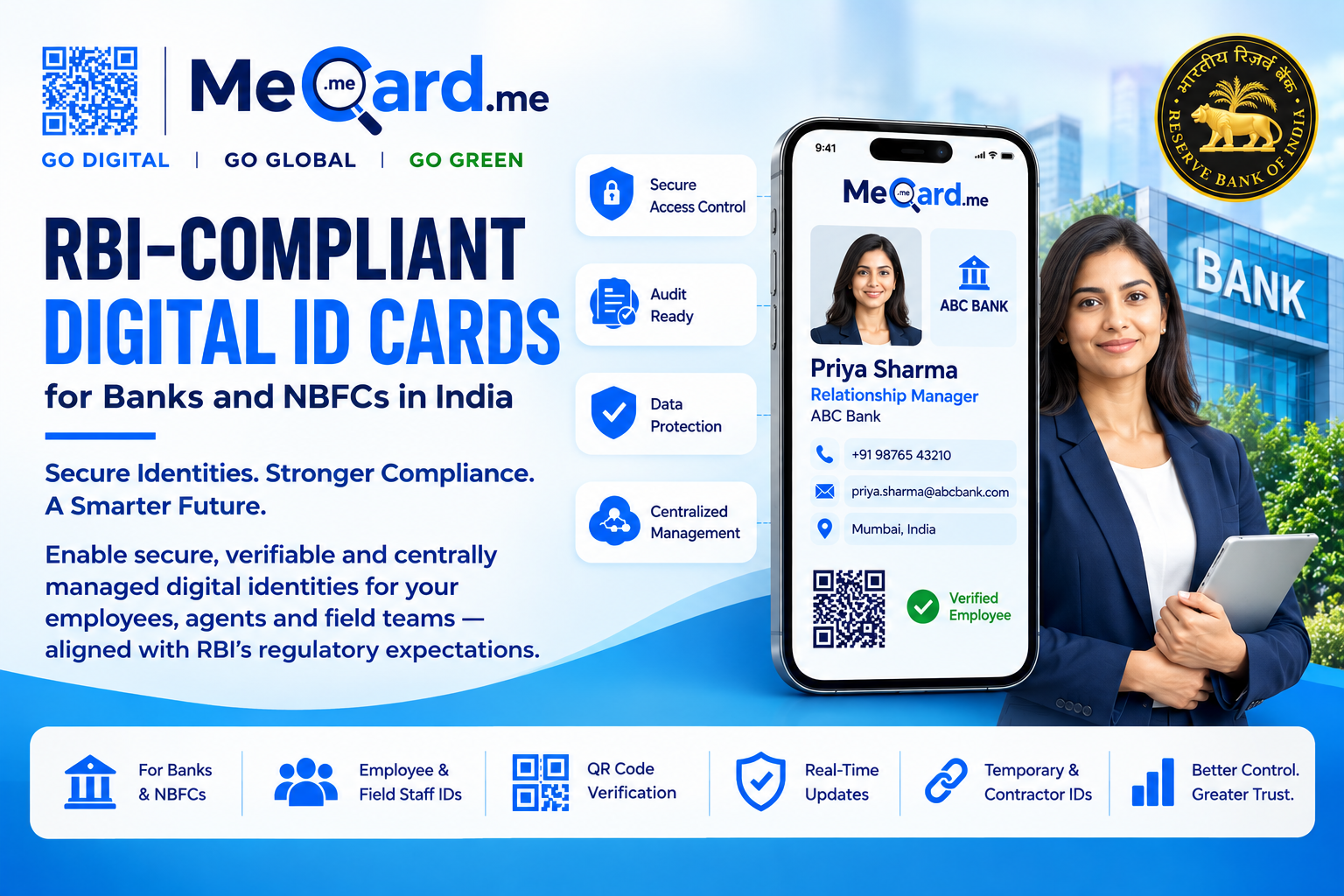
India’s banking and financial services sector is rapidly moving toward digital-first operations. From digital onboarding and paperless KYC processes to cloud-based banking infrastructure, technology is transforming how financial institutions manage customers, employees, branches, and field operations.
Yet one area often remains surprisingly traditional: employee and field-agent identity management.
Banks and NBFCs continue to depend on physical ID cards for employees, collection agents, relationship managers, sales representatives, contractors, and other third-party personnel. These cards can be lost, duplicated, misused, become outdated after role changes, or remain active even after an employee or agent leaves the organization.
A modern Digital ID Card solution can address many of these operational challenges by providing centrally managed identities, QR-based verification, controlled issuance, instant updates, and remote deactivation.
However, there is an important distinction to understand: RBI does not prescribe a specific “RBI-certified digital employee ID card” format. Instead, banks and applicable NBFCs must comply with the broader regulatory expectations around information security, access controls, auditability, data protection, identity verification, and technology governance. RBI's 2023 IT Governance, Risk, Controls and Assurance Directions specifically include areas such as access controls, audit trails, cryptographic controls, information security risk management, cyber incident response, and third-party arrangements.
This makes secure Digital ID infrastructure an important part of a financial institution's broader governance framework.
A physical employee ID card may appear simple, but managing thousands of identities across branches and field operations can become complicated.
Consider an NBFC with hundreds or thousands of collection agents working across multiple cities. An agent may leave the organization, change agencies, change territories, or change responsibilities. If the physical ID card is not collected or deactivated immediately, the former agent may still possess a card that appears legitimate.
The same challenge exists when an employee changes designation, branch, department, or contact information.
Physical cards also require printing, distribution, replacement, courier logistics, manual verification, and periodic updating.
For organizations operating across India, these challenges become even more significant because identity management must work across geographically distributed teams.
A Digital ID Card changes the model from “issue a card and hope it remains accurate” to “centrally manage an identity throughout its lifecycle.”
The phrase “RBI-compliant Digital ID Card” should be used carefully.
A Digital ID Card itself does not automatically become compliant simply because it contains a QR code or is stored on a smartphone. Compliance depends on how the organization designs, implements, governs, secures, and monitors the underlying identity system.
RBI's regulatory framework places significant emphasis on information security, confidentiality, integrity, availability, authenticity, access control, and protection of sensitive information.
Earlier RBI guidance for NBFCs explicitly described information security in terms of ensuring that sensitive information is accessible only to legitimate users and that information remains accurate, reliable, available, and authentic.
The RBI's 2023 IT governance directions applicable to banks and specified financial entities further establish requirements around IT governance, access controls, audit trails, cryptographic controls, risk assessment, information security, vulnerability management, incident response, and business continuity.
Therefore, a Digital ID platform for a bank or NBFC should be designed to support these broader control objectives rather than simply digitizing a physical card.
Another important distinction is between employee identity management and customer KYC.
RBI's KYC framework governs how regulated entities identify and conduct due diligence on customers. The current KYC Direction includes requirements relating to customer identification, officially valid documents, equivalent e-documents, digital KYC, and Central KYC Records Registry processes.
An employee Digital ID Card serves a different purpose.
It establishes and communicates an individual's organizational identity and affiliation. For example, it can show that a person is an authorized employee, collection agent, relationship manager, contractor, or representative of a particular institution.
The Digital ID should therefore complement the organization's internal HR, agency management, verification, access-control, and compliance processes rather than being presented as a replacement for customer KYC.
A financial institution should look beyond simply putting an employee's photograph and name into a mobile application.
A robust Digital ID ecosystem should provide a controlled identity lifecycle.
Each employee or authorized representative should receive a unique digital identity that can be associated with their organizational record.
A unique QR code can provide an additional mechanism for identity verification. MeCard's Digital ID solution, for example, supports unique QR-based verification and centralized management of employee, contractor, temporary-worker, and visitor identities.
QR verification can make field-level identity checking faster.
A customer, security officer, branch employee, or authorized verifier can scan the QR code associated with the Digital ID and validate the identity through the organization's configured verification mechanism.
For banks and NBFCs, this can be particularly useful for field employees such as collection agents, sales representatives, recovery teams, relationship managers, and other customer-facing personnel.
Identity management becomes significantly more effective when HR, IT, administration, or authorized business teams can manage cards from a centralized dashboard.
Administrators should be able to create, issue, update, suspend, and revoke identities without relying on manual card replacement.
MeCard's enterprise platform provides centralized management, employee access controls, QR identity creation, card blocking, real-time updates, and analytics.
One of the most important controls is the ability to deactivate an identity quickly.
When an employee or agent leaves the organization, their Digital ID should no longer represent an active organizational identity.
MeCard's Digital ID platform supports remote management and revocation of issued IDs, including the ability to block an employee's card after separation.
This can be particularly valuable for NBFCs that rely heavily on distributed collection networks and third-party agencies.
Not every employee needs access to the same information.
A relationship manager, branch employee, collection agent, senior executive, and contractor may require different identity attributes and permissions.
Role-based identity management allows organizations to control what information is displayed and who can manage particular identities.
This approach also aligns with the broader principle of access control emphasized in RBI's IT governance framework.
Employee details change frequently.
Designation changes. Branches change. Mobile numbers change. Departments change.
With physical cards, every change potentially creates another printing and distribution cycle.
A digital identity can be updated centrally, allowing the latest approved information to be displayed without issuing a completely new physical card.
MeCard's enterprise platform specifically supports real-time updates to employee roles and contact information.
The use case becomes particularly important for NBFCs with large field teams.
Collection agents may interact directly with borrowers at their homes or workplaces. The borrower needs confidence that the individual claiming to represent the financial institution is actually authorized.
A Digital ID can provide a recognizable organizational profile containing the person's name, photograph, designation, organization details, and verification mechanism.
MeCard's Digital ID platform has been used for financial-services identity workflows, including a Tata Capital deployment involving collection agents. The stated workflow included ID creation requests, verification, approval, integration with an existing application, instant Digital ID creation, and card blocking.
This illustrates how Digital ID technology can become more than a replacement for a plastic card—it can become part of an organization's identity lifecycle.
The real value of Digital ID emerges when it connects with existing organizational systems.
Instead of manually entering employee information into a Digital ID platform, banks and NBFCs can connect identity management with HRMS or directory systems where appropriate.
A typical lifecycle can look like this:
Employee joins → HR record is created → Digital ID is issued → Employee becomes active → Role or branch changes → Digital identity is updated → Employee exits → Digital ID is revoked.
This creates a much stronger relationship between employee lifecycle management and professional identity.
MeCard's enterprise offering supports integrations including Active Directory and HRMS, along with centralized card management and enterprise-level administration.
For financial institutions, convenience cannot come at the expense of security.
The Digital ID platform should therefore be evaluated based on how it protects identity information, controls administrative access, manages credentials, supports secure verification, and handles identity lifecycle events.
RBI's 2023 IT governance directions specifically identify access controls and audit trails among the areas regulated entities need to address.
For this reason, banks and NBFCs should assess Digital ID vendors not merely on visual design or QR functionality, but on their overall security architecture, administrative controls, data handling, integration capabilities, and governance processes.
Financial-sector employees do not always work in environments with reliable connectivity.
Collection agents, sales representatives, branch employees, and field executives may need to display their identity even when network connectivity is unavailable.
MeCard's Digital ID solution supports offline display of mobile IDs, while QR-based verification can be used as part of the identity-verification workflow.
This can make Digital IDs more practical for geographically distributed financial-services operations.
Banks and NBFCs frequently deal with contractors, vendors, temporary workers, visitors, and third-party personnel.
Creating permanent physical IDs for every temporary user is inefficient.
A Digital ID platform can instead support temporary identities with defined validity periods.
MeCard supports temporary Digital IDs and visitor passes with automatic expiration, allowing organizations to control the lifespan of temporary identities.
This is especially useful for branches, corporate offices, events, audits, contractors, and third-party service providers.
The strongest reason to adopt Digital ID Cards is not simply regulatory alignment.
It is operational control.
A well-designed Digital ID platform can help organizations reduce dependence on physical cards, simplify employee onboarding, improve identity verification, strengthen brand consistency, and provide administrators with greater control over active identities.
It can also create a more professional customer experience.
Instead of asking a customer to trust a physical card that may be difficult to verify, an employee can present a digital identity with an organization-controlled verification mechanism.
For banking and financial institutions, that additional layer of transparency can contribute to customer confidence.
MeCard positions its Digital ID and Digital Business Card platform specifically for organizations that need centralized digital identity management.
Its Digital ID solution supports employee, contractor, temporary-worker, and visitor identities, QR verification, remote issuance, card blocking, temporary cards, internal-system integration, and enterprise-level security and privacy practices.
For banking and financial-services organizations, MeCard also provides Digital Business Card and Employee ID solutions designed around centralized employee profiles, QR verification, role-based access, secure cloud storage, and enterprise management.
The enterprise platform adds centralized administration, real-time updates, employee access permissions, QR identity creation, and analytics.
This makes MeCard particularly relevant for banks and NBFCs looking to move from fragmented physical identity processes toward a centralized digital identity ecosystem.
Banks and NBFCs should not approach Digital ID implementation as simply a card-digitization project.
The better approach is to treat it as an enterprise identity governance initiative.
The implementation should begin by identifying every employee and third-party identity that requires verification.
The organization can then define approval workflows, identity attributes, role-based permissions, verification mechanisms, integration requirements, deactivation procedures, data-retention policies, and security controls.
The Digital ID system should subsequently be evaluated against the institution's internal information-security framework and applicable RBI requirements.
This is important because regulatory compliance is ultimately the responsibility of the regulated entity.
A technology vendor can provide capabilities that support compliance, but the deployment, configuration, governance, policies, and controls must be appropriate for the institution's specific regulatory obligations.
The financial sector is becoming increasingly digital, but digital transformation should not stop at customer-facing applications.
The people representing financial institutions also need secure digital identities.
Employees, relationship managers, collection agents, contractors, sales teams, and branch personnel interact directly with customers every day.
Their identity is therefore part of the institution's security and customer-trust ecosystem.
Digital ID Cards provide a way to connect identity, verification, access control, employee lifecycle management, and operational efficiency through one digital framework.
For banks and NBFCs in India, the objective should not simply be to replace a plastic card with a digital one.
The objective should be to build a secure, centrally governed, verifiable, and lifecycle-managed digital identity system aligned with the organization's information-security and regulatory requirements.
RBI's regulatory framework does not establish a universal “RBI-certified Digital ID Card” format for bank or NBFC employees.
Instead, regulated entities operate within broader requirements around information security, access control, auditability, technology governance, and identity-related processes.
For organizations looking to modernize employee and field-agent identity management, MeCard offers a practical Digital ID and Digital Business Card platform that combines QR-based verification, centralized administration, remote identity management, temporary IDs, real-time updates, and enterprise integrations.
For banks and NBFCs, this means moving beyond traditional plastic ID cards toward a more intelligent identity infrastructure—one designed to support security, verification, operational control, scalability, and a stronger digital customer experience.
MeCard can serve as a strong digital identity solution for banks and NBFCs seeking to modernize employee, contractor, and field-agent identification while building their Digital ID processes around enterprise security and regulatory governance.
Phone: +91 77770 01366 / +91 77770 01369
Email: contact@mecard.me
Website: www.mecard.me