
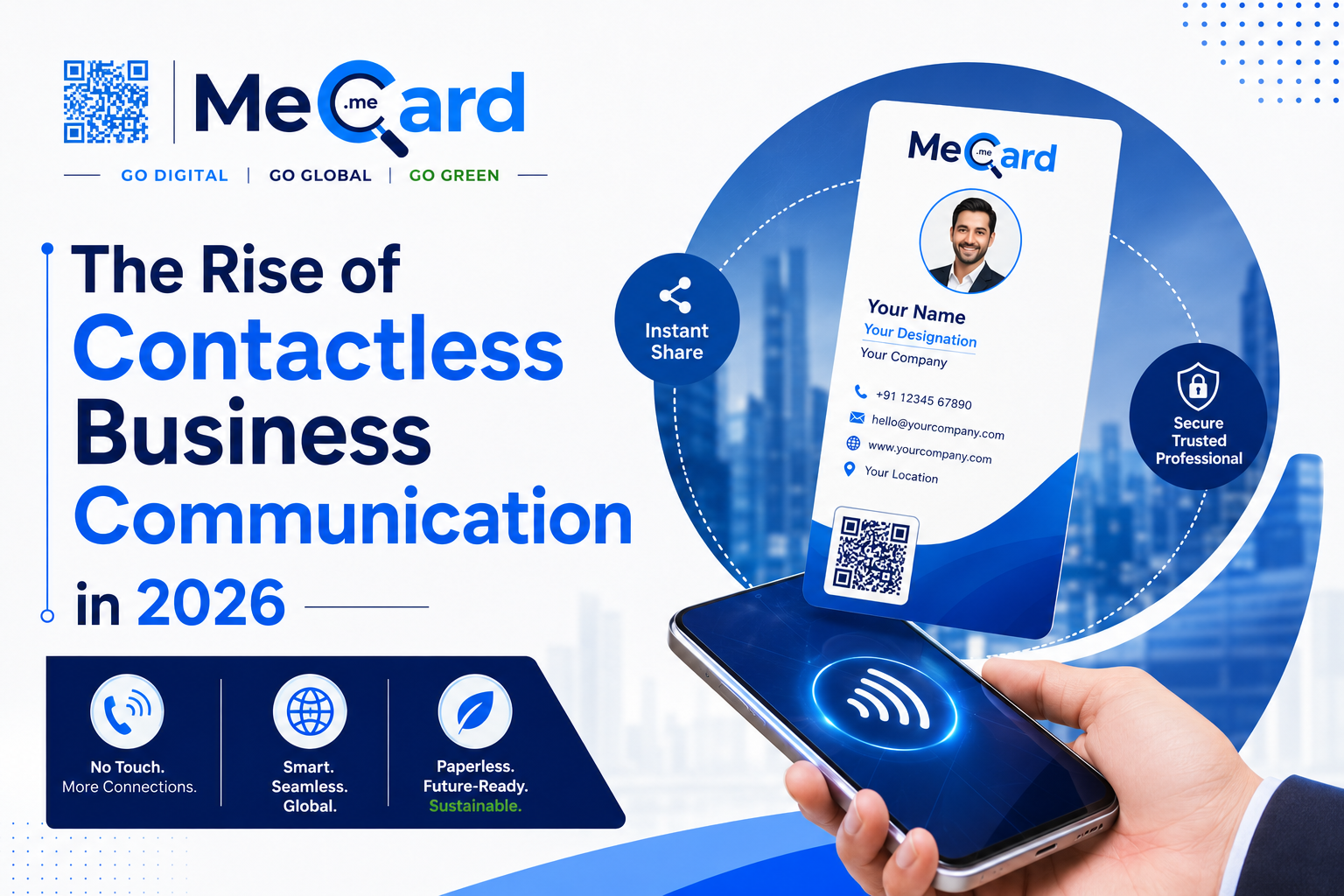
Business Communication Has Entered a New Era
A few years ago, exchanging paper business cards, scheduling in-person meetings, and manually sharing contact details were considered standard business practices. Fast forward to 2026, and the workplace looks dramatically different.
Today, professionals connect through QR codes, digital business cards, NFC technology, virtual meetings, AI-powered collaboration platforms, and mobile first communication tools. A single scan or tap can instantly exchange complete professional profiles, schedule meetings, share company information, and build meaningful business relationships.
This shift isn't simply about convenience it represents a fundamental transformation in how businesses communicate, collaborate, and build trust.
As organizations accelerate digital transformation, contactless business communication has become a competitive necessity rather than an optional innovation. Businesses that embrace these technologies are improving customer experiences, increasing operational efficiency, and creating stronger professional connections in an increasingly digital world.
The workplace has undergone remarkable changes over the past few years. Hybrid work models, remote teams, international collaborations, and digital customer interactions have redefined how professionals communicate.
Business relationships are no longer limited by physical locations or office meetings. Clients expect instant responses, employees collaborate across time zones, and networking often begins before two people meet face to face.
These changing expectations have fueled the rapid adoption of contactless communication technologies that eliminate unnecessary friction while improving speed and accessibility.
Professionals now prefer communication methods that are instant, secure, and accessible from anywhere.
Contactless business communication refers to the use of digital technologies that allow professionals to exchange information, collaborate, and interact without relying on physical documents or face to face exchanges.
Instead of printing business cards or exchanging paperwork, organizations now communicate through digital tools that enable seamless interactions.
These technologies include QR codes, digital business cards, NFC enabled devices, cloud collaboration platforms, electronic signatures, video conferencing, digital payment systems, AI-powered chat assistants, and mobile communication applications.
Together, they create a connected ecosystem where information flows instantly between employees, customers, partners, and stakeholders.
Several technologies are reshaping professional communication in 2026.
QR codes have become one of the most widely adopted business tools. Professionals use them to instantly share contact details, portfolios, company information, websites, product brochures, and appointment booking links. Instead of typing information manually, recipients simply scan a code and access everything they need.
Digital business cards have replaced traditional paper cards in many industries. Unlike printed cards, digital profiles remain updated in real time and allow professionals to share far more than just a phone number and email address. They can include social media profiles, company websites, videos, presentations, and service portfolios.
Near Field Communication (NFC) technology is also transforming networking. A simple tap between an NFC-enabled card and a smartphone can instantly exchange professional information without requiring any application downloads.
Cloud collaboration platforms continue to connect distributed teams by enabling secure document sharing, project management, and real-time communication regardless of location.
Artificial Intelligence is further enhancing communication by automating routine interactions, scheduling meetings, generating responses, and improving customer support.
Together, these innovations are creating a workplace where communication is faster, smarter, and more connected than ever before.
Traditional business communication methods often introduce unnecessary delays and inefficiencies.
Paper business cards become outdated whenever contact information changes. Printed brochures require expensive reprints. Manual data entry increases the risk of errors. Physical documents slow collaboration and make remote work more difficult.
In contrast, contactless communication removes these limitations by providing instant access to accurate and up-to-date information.
Organizations adopting digital communication tools benefit from faster workflows, reduced operational costs, improved customer experiences, and greater flexibility.
The ability to communicate instantly has become a significant competitive advantage in today's business environment.
The rise of contactless communication is delivering measurable benefits across industries.
Professionals can now connect with prospects in seconds instead of minutes. Digital profiles eliminate repetitive data entry while ensuring contact information is always current.
Businesses are also improving customer experiences by reducing waiting times and simplifying interactions. Whether scanning a QR code at an exhibition booth or receiving a digital business card after a meeting, customers appreciate quick and effortless access to information.
Operational efficiency has improved significantly as digital communication reduces paperwork, minimizes administrative tasks, and streamlines collaboration.
Security is another major advantage. Digital communication platforms often include encryption, authentication, and permission-based access controls that help protect sensitive business information.
Finally, organizations are making meaningful progress toward sustainability goals by reducing paper consumption and minimizing printing waste.
Networking has always been essential for business growth.
However, the methods professionals use to build relationships have changed dramatically.
Business conferences, exhibitions, seminars, and corporate events increasingly encourage attendees to exchange information digitally rather than distributing stacks of paper business cards.
A QR code displayed on a smartphone, presentation, or event badge can instantly provide access to a complete professional profile.
This creates a more engaging networking experience while ensuring that valuable connections are not lost after the event.
Professionals also benefit from stronger personal branding because digital profiles provide richer information than traditional business cards ever could.
As businesses embrace contactless communication, platforms like Mecard.me are helping professionals modernize how they introduce themselves and build relationships.
Mecard.me enables users to create dynamic digital business cards that can be shared instantly using QR codes, NFC technology, or secure links.
Instead of carrying multiple printed business cards, professionals can maintain a single digital identity containing their contact information, company details, social media profiles, website, portfolio, and other professional resources.
Whenever information changes, updates are reflected instantly without requiring new cards to be printed.
Whether attending networking events, meeting prospective clients, participating in webinars, or connecting through hybrid workplaces,Mecard.me provides a simple and professional way to communicate in today's digital first environment.
The transition toward contactless communication is visible across nearly every sector.
Sales professionals use digital business cards to accelerate lead generation and follow up. Consultants share service portfolios and appointment links instantly. HR teams streamline recruitment through digital profiles and QR enabled candidate information. Healthcare providers simplify patient communication using contactless information sharing. Financial institutions strengthen trust by providing verified digital identities, while real estate professionals enhance property marketing through QR-powered listings.
Regardless of industry, organizations are discovering that contactless communication improves both operational efficiency and customer satisfaction.
Several trends suggest that contactless communication will continue evolving rapidly.
Artificial Intelligence will create increasingly personalized communication experiences by analyzing customer preferences and automating interactions.
Digital identity verification will become more sophisticated, helping organizations reduce fraud while strengthening trust in online interactions.
Augmented Reality and Virtual Reality may transform networking by enabling immersive business meetings and virtual exhibitions.
Wearable devices and smart technologies are expected to make exchanging professional information even more seamless.
Sustainability initiatives will continue encouraging organizations to replace paper based communication with digital alternatives.
Businesses that adopt these innovations early will be better positioned to compete in an increasingly connected economy.
Transitioning to contactless communication does not require a complete organizational overhaul. Instead, businesses should begin by evaluating how information is currently shared with customers, partners, and employees.
Replacing paper business cards with digital alternatives, implementing QR codes across marketing materials, maintaining consistent digital identities, and adopting secure cloud collaboration tools are practical first steps.
Investing in employee training and ensuring communication platforms remain user friendly will further improve adoption and long term success.
Organizations that prioritize simplicity, accessibility, and customer convenience will gain a significant advantage in the years ahead.
Business communication has evolved far beyond printed business cards, paper brochures, and face to face meetings. In 2026, professionals expect faster, smarter, and more connected ways to exchange information.
Contactless communication is no longer just a technological trend it has become a core business strategy that improves efficiency, enhances customer experiences, strengthens professional relationships, and supports sustainable business practices.
Solutions like Mecard.me demonstrate how digital business cards and QR powered networking are helping professionals adapt to this new reality by making every interaction faster, more meaningful, and easier to manage.
As digital transformation continues to reshape the workplace, businesses that embrace contactless communication today will be better prepared to build stronger relationships, create lasting impressions, and thrive in the connected economy of tomorrow.
Phone: +91 77770 01366 / +91 77770 01369
Email: contact@mecard.me
Website: www.mecard.me