In the Digital Economy, Trust Is Built Before the First Conversation
Imagine your sales executive reaches out to a prospective client after weeks of nurturing the opportunity. The email is professionally written, the proposal is compelling, and the timing is perfect. Yet the prospect hesitates,not because of the solution, but because they cannot confidently verify who is contacting them.
The same challenge plays out across recruitment, partnerships, procurement, consulting, financial services, and enterprise sales. Before responding, people verify LinkedIn profiles, search company websites, cross-check email domains, and look for authentic digital footprints.
In 2026, business relationships begin long before the first meeting. They begin with verification.
Every interaction,whether it's a sales call, recruitment interview, vendor discussion, or executive introduction,is evaluated through the lens of digital trust. Organizations that fail to establish a verified digital identity risk delayed decisions, lower engagement, missed opportunities, and reputational damage.
Digital transformation has fundamentally changed customer expectations. Today, people don't simply ask, "What does your company do?" They ask, "Can I trust the person representing your organization?"
That question has become one of the most important competitive differentiators in modern business.
Hybrid workforces, virtual meetings, AI-generated content, phishing attacks, business email compromise (BEC), executive impersonation, and fraudulent websites have made professionals significantly more cautious when engaging with unknown contacts.
Customers, partners, investors, and candidates now validate every interaction before responding.
Enterprise decision-makers understand that trust is no longer created solely through brand recognition. It is built through transparency, consistency, authenticity, and verifiable professional identity.
Organizations that overlook this shift often encounter slower sales cycles, reduced response rates, and lower customer confidence.
Trust is no longer assumed,it must be demonstrated.
A verified digital identity is a professional, authenticated, and consistently managed representation of an individual or organization across digital channels.
It extends beyond a LinkedIn profile or company website.
A complete digital identity includes verified contact information, organizational affiliation, professional credentials, company branding, social profiles, websites, portfolios, and other trusted business information presented through a unified digital presence.
Rather than forcing customers to search across multiple platforms to validate someone's identity, a verified digital identity consolidates everything into one secure and easily accessible profile.
This simplifies verification while creating confidence from the very first interaction.
Business communication is becoming increasingly decentralized.
Employees work remotely.
Customers engage through digital channels.
Recruitment happens virtually.
Sales presentations take place over video conferencing.Business networking has become mobile-first.
As physical interactions decline, digital identity becomes the primary mechanism through which trust is established.
A verified identity provides immediate reassurance that the individual represents a legitimate organization and that the information being shared is accurate, current, and authentic.
This significantly reduces uncertainty during the earliest stages of every business relationship.
When trust is missing, organizations experience consequences that extend far beyond communication.
Sales teams spend more time validating credibility before meaningful conversations begin. Recruitment teams struggle to attract candidates who question unsolicited outreach. Procurement processes slow as vendors undergo additional verification. Customers hesitate before sharing sensitive information or scheduling meetings.
These seemingly small delays accumulate into measurable business costs.
Longer sales cycles.
Reduced conversion rates.
Lower customer engagement.
Missed partnership opportunities.
Increased operational friction.
Organizations that prioritize verified digital identities remove these barriers and enable faster, more confident business interactions.
Every employee represents the organization's brand.
Whether communicating with customers, suppliers, regulators, candidates, or partners, employees become ambassadors of corporate credibility.
Customers immediately recognize legitimate representatives.
Partners engage with greater certainty.
Candidates experience a more professional recruitment process.
Enterprise reputation becomes stronger because trust is consistently reinforced at every interaction.
Many organizations invest heavily in customer experience after the relationship begins.
However, customer experience actually starts much earlier.
It begins when a prospect receives an email.
When a recruiter reaches out to a candidate.
When an executive sends a meeting invitation.
When a consultant shares a proposal.
When a business development manager exchanges contact information.
Each of these touchpoints contributes to the customer's perception of the organization.
Verified digital identities eliminate unnecessary uncertainty by providing immediate access to accurate contact information, professional credentials, company details, and digital channels.
The result is a smoother, more trustworthy customer journey from the very first interaction.
Traditional paper business cards were designed for an era when most networking occurred face-to-face.
Today's enterprise environment is fundamentally different.
Hybrid work, virtual meetings, international collaboration, and mobile-first communication require a more dynamic solution.
Digital business cards have evolved beyond simple contact-sharing tools.
They now function as verified professional identities that strengthen customer confidence while simplifying communication.
A modern digital business card enables professionals to instantly share verified contact information, organizational branding, social profiles, websites, portfolios, meeting links, and other relevant business resources.
Unlike printed cards, digital profiles remain continuously updated.
This ensures every interaction reflects the latest information while eliminating inconsistencies across communication channels.
Organizations seeking to strengthen trust at every customer touchpoint require more than digital contact sharing,they require a centralized and professional identity platform.
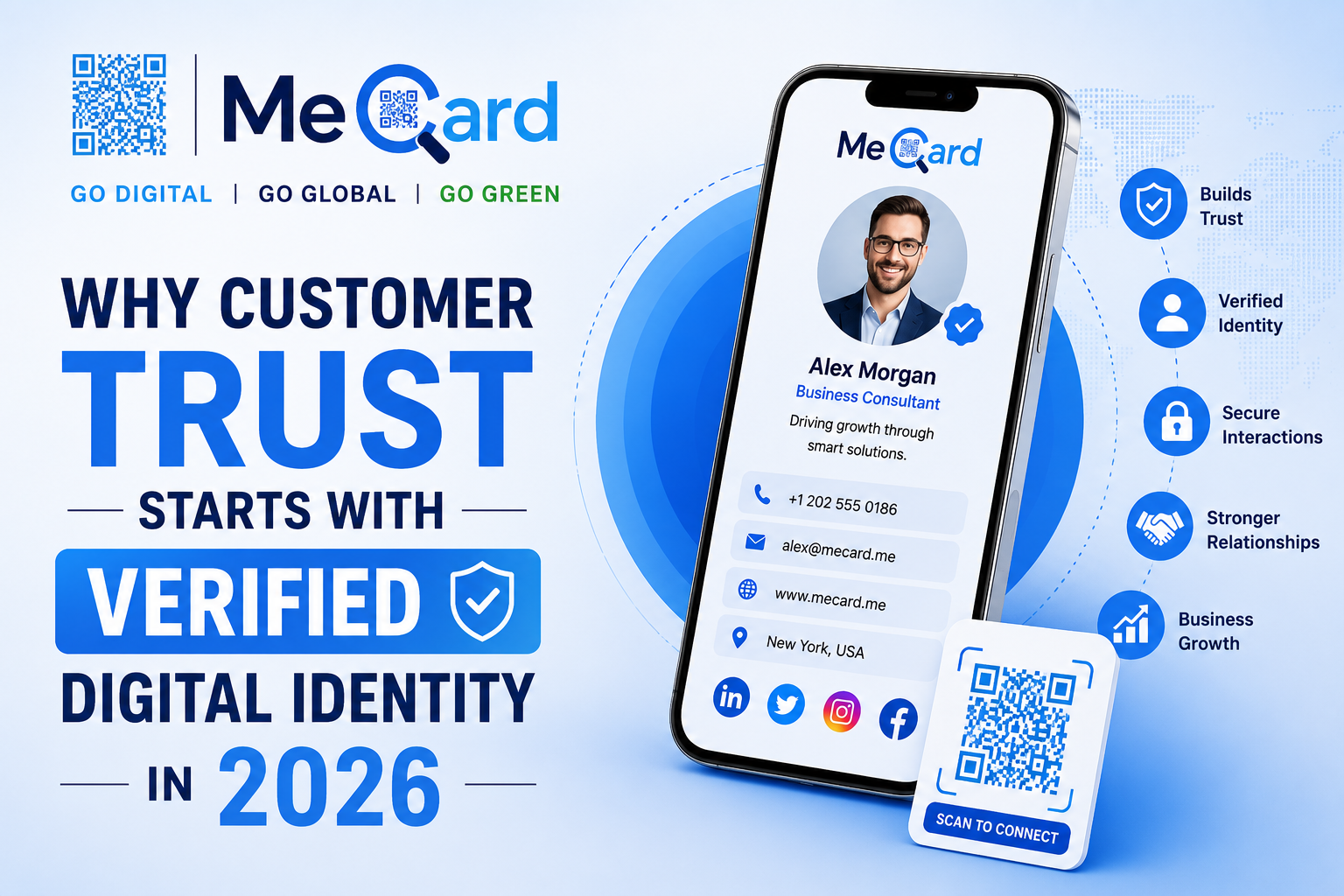
Mecard.me addresses this challenge by enabling professionals to create verified digital business cards that consolidate their complete professional identity into a secure, easily shareable profile.
Through QR codes, NFC technology, and secure digital links, employees can instantly share authenticated contact information, company branding, websites, LinkedIn profiles, social media accounts, portfolios, calendars, and additional business resources.
Because profiles remain dynamic, organizations can ensure that every employee always shares the most current information without the need for reprinting business cards or manually updating contact details.
For enterprises managing distributed workforces, multiple office locations, or customer-facing team Mecard.me helps standardize professional identity while strengthening organizational credibility.
For CXOs and business leaders, verified digital identity is more than a technology initiative,it is a strategic investment.
Sales leaders benefit from faster trust-building and improved conversion rates.
HR leaders strengthen employer branding and candidate engagement.
Marketing teams create consistent brand experiences across every employee interaction.
IT and security teams reduce the risks associated with impersonation and outdated contact information.
Customer success teams simplify communication while improving accessibility.
Executive leadership enhances corporate reputation through a unified digital identity strategy.
When every employee represents the organization consistently, the business becomes easier to trust.
As artificial intelligence, digital identity technologies, and cybersecurity regulations continue evolving, trust will become one of the most valuable business assets.
Organizations that invest in verified digital identities today will be better positioned to navigate emerging challenges related to fraud prevention, customer engagement, digital governance, and brand reputation.
Verified digital identity is rapidly becoming an essential component of enterprise digital transformation strategies rather than a standalone communication tool.
Forward-looking organizations recognize that trust should not depend on chance.
It should be designed into every interaction.
In 2026, customer trust is earned before conversations begin, before contracts are signed, and before partnerships are formed.
Every digital interaction contributes to an organization's credibility, making verified digital identity a strategic business necessity rather than a technological convenience.
Platforms like Mecard.me help enterprises transform digital identity into a competitive advantage by enabling professionals to share trusted, always-updated digital business cards that reflect the organization's professionalism and commitment to transparency.
As the business world becomes increasingly digital, verified identity will distinguish organizations that merely communicate from those that inspire confidence.
Because in the trust economy of 2026, credibility isn't built after the first meeting,it starts with a verified digital identity.
Phone: +91 77770 01366 / +91 77770 01369
Email: contact@mecard.me
Website: www.mecard.me