The First Impression Has Gone Digital
Picture this: you walk out of a high-stakes client meeting, exchange paper cards with six people, and by Thursday three of those cards are buried under a stack of files, one has an outdated phone number, and one is already in a bin. That ritual the paper business card exchange has defined professional networking for over three centuries. But in a world where your phone unlocks with your face and your boarding pass lives in your pocket,the paper card is quietly becoming a relic.
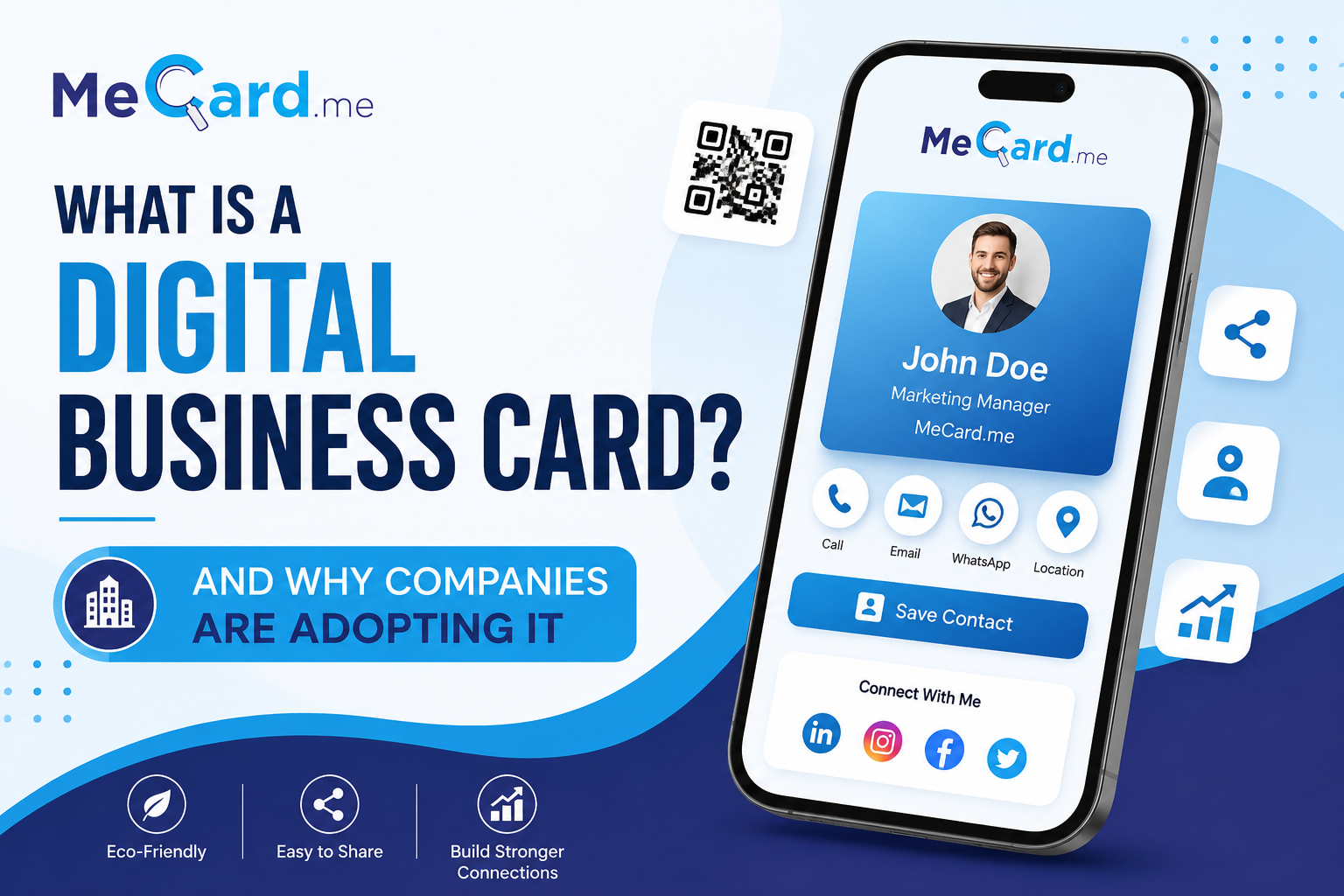
A Digital Business Card is a smart, online professional profile that you share instantly using a QR code, NFC tap, WhatsApp link, SMS, email, or a direct URL,no paper, no printing, no waiting.
Unlike a static PDF or a screenshot of your contact details, a true digital business card is a live, interactive profile. It can carry your phone number, email address, website, office location on Google Maps, social media handles (LinkedIn, Instagram, YouTube, WhatsApp), product catalogues, payment links, portfolio links, and even embedded videos,all accessible the moment someone scans your QR code or taps an NFC-enabled card on their phone.
The issue is bigger than paper waste. The real problem is invisibility.The key distinction from its paper predecessor is dynamism. A paper card is frozen in time the moment it is printed. A digital card is a living document. update your job title, mobile number, or brand logo once, and every person who has ever scanned your card instantly sees the new information,No reprints, No waste.
Platforms like Mecard.me(mecard.me), India's leading digital card platform, have taken this concept further by building an entire ecosystem: digital visiting cards, employee ID cards, visitor passes, membership cards, health and insurance cards, parking QR tags, and digital letterheads,all managed from a single centralised admin dashboard.
A Digital Business Card is a smart, online professional profile that you share instantly using a QR code, NFC tap, WhatsApp link, SMS, email, or a direct URL,no paper, no printing, no waiting.
For years, the pain points of paper business cards were tolerated as an unavoidable cost of doing business. But as organisations scale, those pain points compound into real operational and reputational problems.
The Cost is straightforward but often underestimated. A mid-sized company with 200 sales executives reprinting cards twice a year,factoring in design, printing, delivery, and distribution, spends hundreds of thousands of rupees annually on cards that will mostly end up in drawers or landfills. For enterprises with high employee turnover, like insurance agencies or financial services companies, this cost escalates further.
The accuracy problem is arguably worse. A paper card is outdated the moment an employee changes their designation, mobile number, email domain, or office address. In sales-intensive industries, giving a client a card with a wrong number is not just embarrassing,it breaks the follow-up chain entirely.
The environmental problem has moved from a CSR talking point to a boardroom priority. India prints an estimated 7–10 billion business cards every year globally. The vast majority are discarded within a week. For companies with sustainability targets and ESG commitments, paper cards represent a visible and easily solvable source of paper waste.
The data problem is the newest pain point. Paper cards give you zero insight: you never know who looked at your card, who tried to call, or which networking event generated the most engagement. In a data-driven business environment, this blind spot is untenable.
The solution is not simply to "go digital" in a superficial sense,it is to replace a passive, static artefact with an interactive, real-time, trackable professional identity.
When a professional shares their MeCard digital business card via a QR code at an industry event, the recipient scans it with their smartphone camera, instantly opens a branded profile page, and saves the contact with a single tap. No app download is required on the recipient's side. No information is ever out of date. The entire exchange takes under ten seconds.
The benefits compound at scale. When an organisation deploys digital cards for its entire workforce through a platform like MeCard, the administrator gains a centralised dashboard to create, update, deactivate, and monitor all cards across all employees,instantly. If a sales executive leaves the company, their card can be deactivated in seconds. If the company rebrands, every card across every department reflects the new identity simultaneously.
Real-time analytics close the loop that paper never could. Managers can track QR code scan volumes, profile visit counts, and engagement data,turning every card share into a measurable touchpoint in the sales and networking funnel.
The adoption of digital business cards has moved well beyond early adopters. Today, companies across virtually every sector are standardising on digital cards, and the use cases span every function.
Financial Services and Banking were among the first industries to scale digital cards. Institutions like HDFC Life, Tata Capital, DMI Finance, Unity Small Finance Bank, and Royal Sundaram Insurance have deployed digital cards for their agent networks and frontline teams. In an industry where agent turnover is high and compliance with accurate contact disclosure matters, the ability to instantly update and deactivate cards is mission-critical.
Retail and Consumer Brands use digital cards for store managers, brand ambassadors, and corporate teams. Zepto, Inorbit Mall, and Crompton are among the brands that have integrated digital cards into their customer facing communication.
Hospitality leverages digital cards to project the premium image their guests expect. The Leela Hotels, for instance, uses digital business cards that reflect their brand's elegance while enabling seamless guest follow-up from a single QR scan.
Real Estate and Infrastructure professionals, including teams from K Raheja Corp, rely on digital cards for site visits, broker meetings, and client presentations, environments where leaving an accurate, always-current point of contact is critical.
Healthcare has discovered a specific and powerful use case: patient communication. Gokuldham Medical Centre noted that patients are happy to receive updated facility information directly on their mobile screens, without any cost — a use case that goes far beyond traditional networking.
Manufacturing and Industrial Enterprises like Shriram Pistons and Rings have standardised digital cards for senior executives, with their Chief Digital Officer citing the flexibility, speed, and professional image the platform delivers.
The power of a platform-level digital card solution is that it serves every department differently but from the same system.
Sales Teams are the most obvious beneficiaries. A digital card with integrated WhatsApp, a one-tap call button, a link to a product catalogue, and scan analytics transforms every card exchange into a trackable lead capture event. Sales managers can see which executives are generating the most card engagement and which follow-up actions are being triggered.
HR and People Teams use digital cards as part of employee onboarding. A new joiner receives their branded digital business card on day one, connected to the company's Active Directory or HRMS, ensuring consistency without manual data entry. When employees leave, deactivation is instant.
Marketing Teams benefit from the ability to embed campaign links, video introductions, and promotional QR codes directly into a card. Every card becomes a micro-landing page, and analytics reveal how prospects are engaging.
IT and Admin Teams appreciate centralised control: one dashboard, bulk data upload for large teams, role-based access management, and integration with existing enterprise systems via API.
Customer Support and Account Management teams use cards that include calendar booking links and instant enquiry buttons, so clients can reach the right person in one tap, improving response times and satisfaction.
Not all digital business card tools are equal. For enterprise adoption, the right platform must deliver across several dimensions.
QR Code and NFC Technologyare non-negotiable. The card must be shareable without requiring the recipient to download an app. QR scanning with any smartphone camera, combined with NFC tap capability for compatible devices, ensures universal accessibility.
Real-Time Updates must be instant and automatic. Any change made to a card should propagate across all shared QRs and profiles without requiring redistribution.
Centralised Admin Dashboard is essential for organisations with more than a handful of users. The ability to create cards via bulk data upload, manage access permissions, monitor usage analytics, and deactivate cards remotely transforms a networking tool into an enterprise identity management system.
Customisation and Branding should allow complete white-labelling company logos, brand colours, custom templates, and corporate identity elements applied consistently across the entire team.
CRM Integration via API enables digital cards to feed lead capture data directly into existing sales and customer management workflows, eliminating manual entry.
Analytics and Tracking should provide granular insight: scan counts, profile visits, engagement trends, and real-time notifications when a card is scanned.
Multi-Channel Sharing WhatsApp, email, SMS, LinkedIn, direct link, QR, NFC — ensures the card works in every networking context, from a formal boardroom to a trade exhibition.
AI-Powered Automation as offered by MeCard, can automate lead capture, customer engagement, and follow-up actions, turning passive card shares into active business development workflows.
The comparison between digital and paper business cards is no longer close. Paper cards are static, costly to reprint, environmentally wasteful, untrackable, and prone to loss. They offer no analytics, no update capability, and no integration with any business system.
Digital cards from a platform like MeCard are dynamic, updatable in real time, shareable across every channel, backed by analytics, integrated with CRM and HRMS systems, and managed centrally. They eliminate printing costs, reduce paper waste, and ensure that every professional interaction starts with accurate, complete, and brand-consistent information.
The only scenario where paper still holds an edge is in contexts where the recipient has no smartphone, a scenario that is vanishingly rare in modern professional environments.
The return on investment from a digital business card platform is measurable across multiple lines.
Direct cost savings from eliminating printing, design, and distribution of paper cards are immediate. For a team of 100, the annual saving typically runs into five to six figures in rupees, and scales proportionally.
Lead conversion improvement comes from analytics-driven follow-up. When sales teams know which contacts engaged with their card, opened their catalogue, or clicked their WhatsApp link, they can prioritise outreach with precision.
Brand consistency reduces the cost and frequency of brand corrections. When a rebrand or address change propagates instantly across 500 employee cards, the saving in management time alone is significant.
Compliance and accuracy reduce the risk of miscommunication, missed follow-ups, and reputational damage from outdated contact information costs that are harder to quantify but very real.
At MeCard's pricing starting at as little as ₹8 per user per year at the Business tier — the ROI calculation is almost immediate for any organisation with more than a handful of client facing employees.
For enterprise decision-makers, security and compliance are not afterthoughts,they are preconditions. MeCard holds ISO 9001:2015 certification for quality management and ISO/IEC 27001:2013 certification for information security, the internationally recognised standard for data protection and cybersecurity.
Enterprise clients receive access to SOC 2 reports, Active Directory and HRMS integration, on-premises deployment options for organisations with more than 1,000 users, and dedicated Customer Success Managers. These are not features offered by generic digital card tools, they are the markers of a platform built for serious enterprise deployment.
Data privacy is maintained with cloud-first architecture, ensuring that card data is securely stored, backed up, and accessible from any device, while access permissions are tightly controlled at the admin level.
If your organisation has more than ten client facing employees, still reprints paper cards when details change, has no visibility into networking engagement, or is looking to reduce paper consumption — the answer is yes, and the time is now
The companies that have already moved from HDFC Life to The Leela, from Zepto to Shriram Pistons have not done so because digital cards are a novelty. They have done so because digital cards are demonstrably better: more professional, more functional, more measurable, and more sustainable.
MeCard offers a 30-day free trial for all plans, and enterprise enquiries are handled with custom consultation, template design, and integration support. The onboarding is fast, the platform is intuitive, and the results in cost savings, brand consistency, and lead engagement are visible from the first week.
The paper business card had a three hundred year run. Its digital successor is here, and it is already reshaping how India's most forward-thinking companies connect, communicate, and grow.
Explore MeCard's digital business card solutions at Mecard.me India's trusted digital identity platform with 50,000+ satisfied users.
Phone: +91 77770 01366 / +91 77770 01369
Email: contact@mecard.me
Website: www.mecard.me