In various professional interactions, a fundamental question often arises for customers and stakeholders: “How do I know this person really represents the organization?”
A name badge or printed business card may provide basic information. But information printed on a card does not necessarily provide an easy way to validate whether that identity is current, genuine or authorized.
This is where digital verification can change the interaction. Instead of asking people to simply trust an identity, organizations can provide a digital mechanism through which relevant identity information can be accessed and verified.
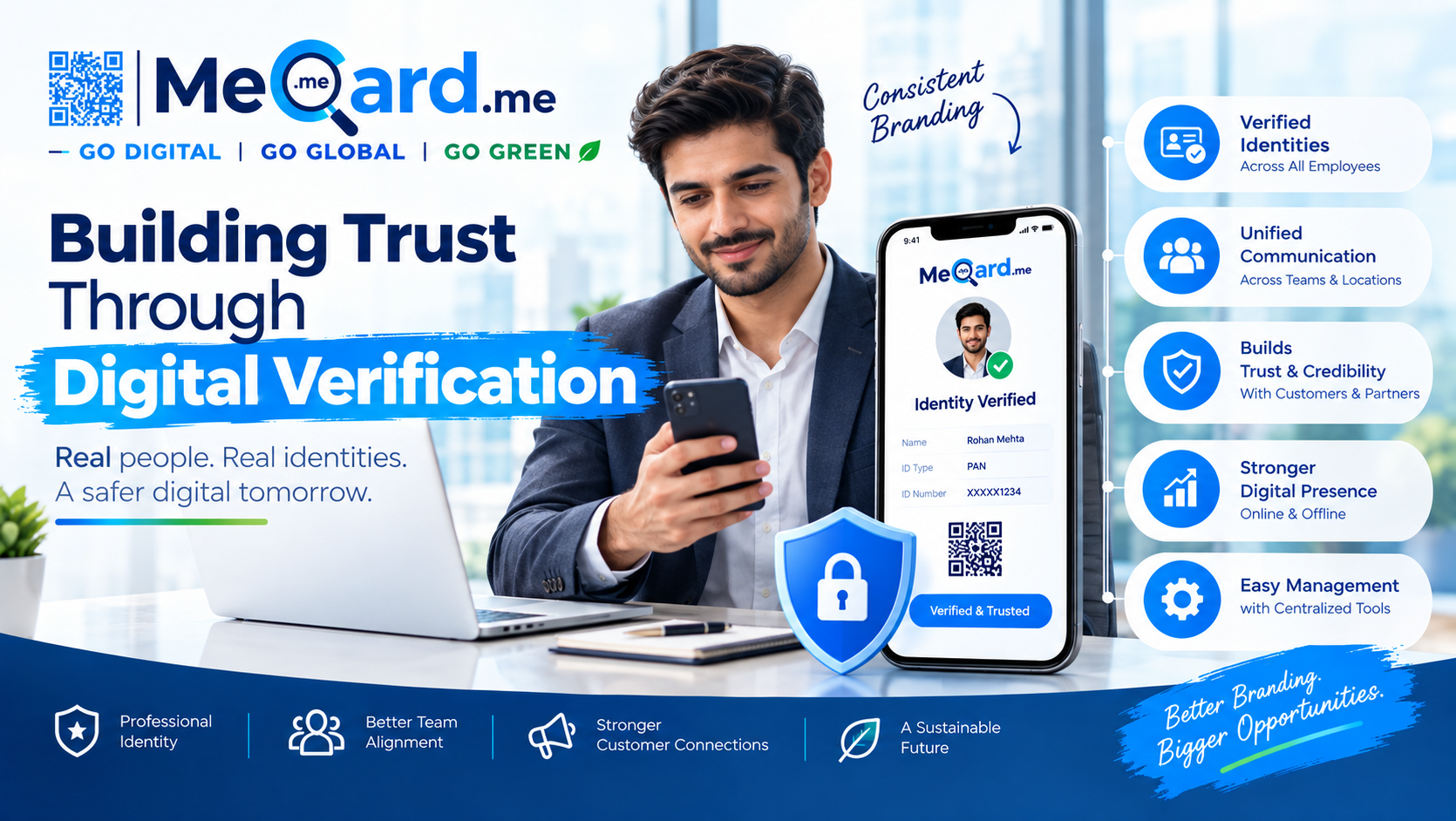
MeCard's digital identity ecosystem uses QR-based verification, centrally managed Digital IDs and Digital Business Cards to help organizations create more transparent and connected identity experiences.
Trust is often built through small signals:
But when someone represents an organization outside its physical premises, these signals can become difficult to validate. Consider a field representative visiting a customer. The representative may show an employee ID card. The customer can see the name, photograph and company logo.
But several questions remain unanswered:
The physical card can show identity information, but it is not inherently a live verification system. Digital verification introduces another layer: the ability to connect an identity with organization-controlled digital information.
Digital verification is the process of using digital technology to validate information about a person, credential, identity or organizational affiliation.
In the context of employee and professional identity, this can mean allowing someone to access a digital profile containing relevant information through a QR code or another secure mechanism.
Present QR Code → Scan → Access Digital Profile → Verify Relevant Information → Continue the Interaction
The technology is straightforward, but the trust impact can be significant. MeCard's QR solution is designed to connect a QR code with digital information such as Digital Business Cards, Employee Identity, company information, and contact details.
Traditional identity says: “Here is my ID.”
Digital verification says: “Here is my identity. You can check the information associated with it.”
That distinction matters. A Digital ID can contain relevant professional information such as an employee's name, employee code, department, reporting manager, office location and validity status.
For customer-facing teams, the objective isn't to expose unnecessary personal information. It is to provide appropriate, organization-controlled information that helps establish authenticity.
One reason QR-based verification is becoming useful for organizations is accessibility. Most customers already have smartphones capable of scanning QR codes. No specialized reader necessarily needs to be issued to every customer.
MeCard's QR-based identity model allows users to scan a Digital ID or Digital Business Card and access the configured digital profile. This creates a practical bridge between physical-world interactions and digital identity.
The need for digital verification becomes particularly visible when employees operate outside the organization's premises. Consider:
A QR-enabled Digital ID provides another route to organizationally controlled information. MeCard specifically positions QR verification for banking and financial services to help customers verify identities and access official contact information.
Trust is also about knowing whether the information is current. A physical card may remain unchanged even if an employee changes departments or leaves the organization.
A centrally managed digital identity can be updated without requiring the same physical replacement cycle. This creates a direct relationship: Current information → Better transparency → Greater confidence in the interaction.
This distinction is especially important for organizations:
MeCard's collection and recovery use case illustrates this by connecting an agent's digital identity with authorization information, allowing administrators to manage active, inactive, and blocked identities centrally.
If an organization has centralized control, the digital identity can be deactivated or revoked immediately as part of the employee lifecycle. MeCard's Digital ID solution supports remote management and revocation of issued identities.
This lifecycle is difficult to achieve with a static printed card alone:
Employee joins → Digital ID issued → Identity remains active → Role changes → Information updated → Employee exits → Identity blocked/revoked
When customers interact with an employee, they are also interacting with the organization's brand. A professional Digital Business Card can provide:
Digital verification is only useful if the underlying information is properly managed. MeCard provides a centralized console for controlling digital profiles and business cards, ensuring consistency in branding and accuracy in designations across the organization.
Organizations can use QR-enabled digital identity experiences across multiple use cases:
MeCard brings digital identity, Digital Business Cards and QR-based verification into one broader ecosystem, allowing organizations to move toward more dynamic digital identities with features like:
It is a technology-enabled process used to validate identity through a digital mechanism, such as QR-based access to an organization-controlled profile.
It gives customers a simple way to access relevant digital identity information instead of relying solely on physical cards or verbal identification.
Yes. MeCard supports remote management and revocation, allowing organizations to deactivate identities instantly.
It is particularly relevant for field teams like relationship managers and collection agents who interact with customers outside office premises.
No. Employee or organizational Digital ID verification is distinct from customer KYC and should be implemented alongside existing security and regulatory requirements.
The future of professional trust is not simply about showing more information. It is about making the right information accessible, current and verifiable. With MeCard, trust doesn't have to begin with a promise—it can begin with proof.
Enable your workforce with secure, verifiable digital identities.
Phone: +91 77770 01366 / +91 77770 01369
Email: contact@mecard.me