How CEOs, CXOs, directors, founders, business heads, consultants, and senior professionals can use Digital Business Cards to build a connected, updatable, and measurable professional identity.
For senior management and executives, every professional interaction can carry significant business value.
A conversation with a prospective client can lead to a new account. A conference introduction can create a strategic partnership. An investor meeting can open a new opportunity. Even a brief interaction at an industry event can become the beginning of a long-term business relationship.
Yet, despite how digitally connected modern businesses have become, executive networking often still ends with a traditional paper business card.
In 2026, that model is changing.
Digital Business Cards are becoming a smarter way for CEOs, CXOs, directors, founders, business heads, consultants, and senior professionals to share and manage their professional identity.
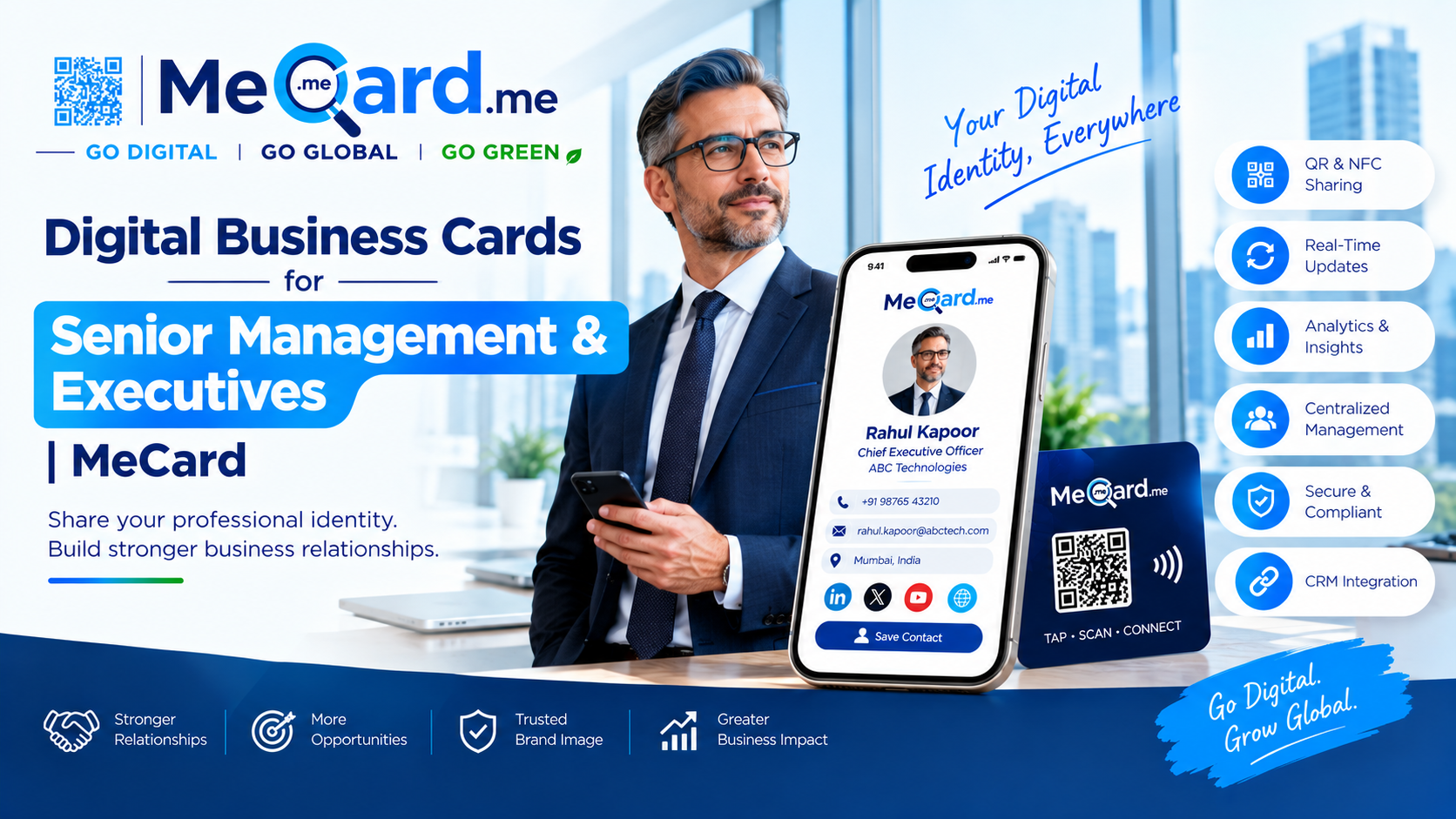
With platforms such as MeCard.me, an executive's business card can go beyond name, designation, phone number, and email to become a connected digital profile with QR/NFC sharing, company information, social profiles, analytics, real-time updates, and enterprise-level management.
A traditional business card does one primary job: it transfers contact information.
That was sufficient when professional networking was predominantly physical.
Today's executives operate across boardrooms, conferences, client meetings, investor discussions, webinars, LinkedIn, WhatsApp, international events, and hybrid meetings.
Their professional identity therefore exists across multiple channels.
A printed card cannot easily keep up with that environment.
An executive may change their designation, phone number, office location, website, or professional profile. A printed card distributed months earlier remains unchanged.
A Digital Business Card works differently because the profile can remain live and can be updated digitally.
For senior leaders, this means the information they share with clients, partners, investors, and other stakeholders can remain current without repeatedly redesigning and printing physical cards. MeCard specifically supports real-time updates to digital card information.
The biggest misconception about Digital Business Cards is that they are simply a digital version of a paper card.
They can be much more comprehensive.
An executive's MeCard profile can bring together professional contact information, company details, websites, social profiles, office location, videos, documents, product information, and calls to action.
Instead of giving someone only a phone number and email address, an executive can provide a complete professional touchpoint.
For example, a CEO could share:
The recipient gets a richer picture of both the executive and the organization.
Executive networking often happens in environments where time is limited.
At a conference, an executive may meet dozens of people in a single day.
At an exhibition, conversations can last only a few minutes.
During a business event, several introductions can happen within an hour.
Manually entering contact information after every interaction creates unnecessary friction.
QR sharing provides a simple alternative.
The executive can display a QR code on a smartphone, presentation, badge, digital screen, or other approved medium. The other person scans the code and accesses the digital profile.
MeCard supports QR-based Digital Business Card sharing, allowing executives to make their professional information accessible through a quick scan.
Meet → Scan → Connect → Continue the conversation
QR codes are not the only option.
NFC can allow compatible smartphones to access a Digital Business Card through a simple tap.
This can be particularly useful for executives attending:
MeCard supports both QR and NFC sharing, giving professionals multiple ways to exchange their digital identity.
This flexibility is important because executive networking does not always happen in the same environment.
A senior executive does not represent only themselves. They represent the organization.
Every interaction can therefore become a brand touchpoint.
Imagine a company with ten senior executives, each using a completely different business card design.
The organization may unintentionally create an inconsistent brand experience.
An enterprise Digital Business Card platform can help solve this through standardized and customized templates.
MeCard's Enterprise offering includes customized card templates and centralized management capabilities, allowing organizations to establish a more consistent digital identity across employees.
For senior management, this means the executive's individual identity can remain professional while still aligning with the organization's corporate identity.
The role of an executive Digital Business Card can extend beyond networking.
Consider a business head meeting a prospective enterprise client.
The digital profile can provide access to:
Instead of treating the business card as the end of the introduction, the organization can use it as the starting point for a digital business relationship.
This is where the concept becomes particularly relevant for enterprises.
Executives frequently experience changes in their professional information.
A director becomes a managing director.
A business head takes responsibility for a new region.
A company changes its corporate office.
A new website is launched.
A new LinkedIn profile becomes relevant.
A traditional card cannot reflect these changes after it has been printed.
A Digital Business Card can.
Authorized information can be updated digitally without requiring the executive to replace every previously distributed card.
MeCard supports real-time updates, allowing information such as contact details, websites, addresses, and social profiles to be maintained digitally.
This is particularly valuable for senior executives because their professional information may be shared across a large network of clients, partners, investors, and stakeholders.
Traditional business cards have a major limitation:
They provide almost no visibility into what happens after the exchange.
An executive can hand someone a card, but the organization may never know whether that person visited the company's website, viewed the executive's profile, or interacted with the shared information.
Digital platforms can provide engagement insights.
MeCard includes analytics capabilities that allow organizations to understand interactions with digital cards and measure engagement.
This creates a shift from:
“How many business cards did our executives distribute?”
to:
“How much engagement did those professional connections generate?”
For organizations focused on measurable networking and business development, that distinction matters.
For CEOs and CXOs, a Digital Business Card can function as a compact executive profile.
The objective should not be to overload the profile with information. It should make relevant information immediately accessible.
A CEO's profile might include:
The recipient should quickly understand three things:
MeCard's Digital Business Card ecosystem supports this broader profile-based approach through QR/NFC sharing and rich digital content.
Directors and business heads often interact with multiple stakeholder groups.
They may work with customers, partners, suppliers, investors, employees, consultants, and industry bodies.
Each interaction can have a different context, but the executive's core professional identity remains the same.
A Digital Business Card provides a single live profile that can be shared across these environments.
Rather than maintaining multiple physical cards for different situations, the executive can use one centrally managed digital identity and update the relevant information when required.
This makes the Digital Business Card a continuously evolving professional asset rather than a static printed document.
Modern leadership is increasingly global.
An executive may meet a customer in Mumbai on Monday, attend a conference in Singapore on Wednesday, and participate in a virtual meeting with a European partner on Friday.
The method of networking changes, but the professional identity remains the same.
A Digital Business Card works across these environments.
It can be shared through:
MeCard supports multiple digital sharing channels, making the executive's professional identity accessible across physical and digital networking environments.
Leadership is no longer restricted to a physical office.
Executives increasingly communicate through virtual meetings, webinars, online events, LinkedIn, email, and messaging platforms.
A physical card is difficult to use in these environments.
A digital profile is not.
An executive can share a Digital Business Card link through an email signature, meeting chat, WhatsApp conversation, LinkedIn interaction, or presentation.
This makes digital identity particularly useful for modern hybrid organizations.
One of the biggest differences between an individual Digital Business Card and an enterprise Digital Business Card platform is management.
An enterprise may have:
The organization cannot rely entirely on every individual to independently create and maintain their professional identity.
A centralized system allows authorized administrators to manage employee cards, maintain approved templates, update information, and manage access.
MeCard provides centralized card management, employee card creation, bulk management, analytics, and enterprise integrations.
This makes the technology relevant not only to executives but also to HR, IT, administration, marketing, and corporate communications teams.
For large organizations, digital identity should not become another isolated database.
Employee information already exists in systems such as HRMS and directory platforms.
MeCard's Enterprise offering supports integrations including Active Directory and HRMS, allowing organizations to connect digital card management with their existing employee information infrastructure.
A possible lifecycle can look like:
Executive joins → Employee identity is created → Digital Business Card is issued → Information is updated as roles change → Identity remains current → Card is deactivated when the employee exits
This creates a more structured approach to professional identity management.
For enterprises, executive identity also involves governance.
Organizations may need to control:
A centralized platform provides greater control than allowing every employee to independently design and maintain their own digital profile.
MeCard's enterprise capabilities are designed around centralized administration, employee management, customized templates, analytics, and integrations.
Executive profiles contain professional and organizational information, so security should be considered when selecting a platform.
Organizations should evaluate areas such as administrative access, data handling, identity lifecycle management, permissions, integrations, and available security documentation.
MeCard's current Enterprise offering includes access to its SOC 2 report, alongside enterprise management and integration capabilities.
Enterprises should still conduct their own security, privacy, legal, and procurement assessment according to their specific requirements.
Senior executives can exchange hundreds of professional contacts over the course of a year.
Traditional networking therefore creates a recurring requirement for printed cards.
Digital Business Cards reduce dependence on these physical materials.
For organizations pursuing paper-reduction and sustainability initiatives, this can complement broader digital-transformation goals.
MeCard's positioning includes “Go Digital | Go Global | Go Green,” connecting digital networking with a paperless professional communication approach.
The sustainability benefit is therefore accompanied by practical advantages such as real-time updates, digital sharing, and centralized management.
A professional-looking design is important, but enterprise buyers should evaluate much more than appearance.
A Digital Business Card platform for senior management should ideally support:
These capabilities are reflected across MeCard's current enterprise Digital Business Card offering.
MeCard.me positions Digital Business Cards as part of a broader digital identity ecosystem rather than simply as online replacements for paper visiting cards.
For senior management and executives, this means a digital profile can combine professional contact information, company branding, QR/NFC sharing, rich content, analytics, and centralized enterprise management.
For the organization, the value extends further.
The same infrastructure can support digital identities across sales teams, HR, management, field teams, and other customer-facing employees.
MeCard's Enterprise capabilities include customized templates, centralized card management, bulk employee card creation, analytics, Active Directory and HRMS integration, and dedicated customer-success support.
This makes the Digital Business Card part of a broader enterprise identity strategy.
The business card is not disappearing simply because paper is being replaced.
Its purpose is evolving.
The traditional business card was primarily a contact-sharing tool.
The modern Digital Business Card can become a professional identity and digital engagement touchpoint.
For executives, it can connect a single introduction to company information, professional profiles, business resources, communication channels, and future interactions.
For enterprises, it can provide a consistent identity framework across leadership and customer-facing teams.
And for organizations using MeCard, the transition can extend beyond individual networking toward centralized digital identity management.
Senior executives operate in environments where every professional interaction can create business value.
Their business card should therefore do more than display a name and phone number.
It should make professional identity easier to share, easier to update, and more connected to the organization the executive represents.
Digital Business Cards for Senior Management and Executives provide that opportunity.
With QR and NFC sharing, real-time updates, rich digital profiles, analytics, centralized management, corporate branding, and enterprise integrations, MeCard.me enables organizations to move executive networking beyond traditional paper cards and toward a more connected digital identity experience.
The question for modern executives is no longer:
“Do I have a business card?”
It is:
“Does my business card represent the way I do business today?”
A Digital Business Card for executives is a digital professional profile that can combine an executive's contact details, designation, company information, social profiles, websites, business resources, and other relevant information.
CEOs and CXOs interact with clients, investors, partners, employees, and industry stakeholders across both physical and digital environments. A Digital Business Card provides a convenient way to share a current professional identity across these interactions.
Yes. Executives can use QR codes to allow contacts to quickly access their digital professional profile using a smartphone.
Yes. NFC can allow compatible smartphones to access a Digital Business Card through a simple tap.
Yes. Digital profiles can be updated when approved information such as designation, phone number, office location, website, or social profiles changes.
Yes. An executive profile can include company information, websites, social channels, products, presentations, videos, appointment links, and other approved business resources.
Yes. Enterprise platforms such as MeCard provide centralized management capabilities that can allow organizations to create, update, manage, and control employee Digital Business Cards.
Yes. Customized templates and centralized administration can help organizations maintain consistent branding across executive and employee Digital Business Cards.
Enterprise Digital Business Card platforms can provide analytics around profile views and engagement, helping organizations understand digital networking activity.
MeCard's Enterprise offering includes HRMS and Active Directory integration capabilities, allowing organizations to connect employee information with digital identity management.
Yes. Digital profiles can be shared through links, email, WhatsApp, meeting chats, social platforms, QR codes, and other digital channels, making them suitable for remote and hybrid leadership environments.
Enterprises should evaluate centralized management, branding, QR/NFC sharing, real-time updates, analytics, employee management, integrations, security controls, permissions, scalability, and governance requirements rather than focusing only on the visual design of the card.
Phone: +91 77770 01366 / +91 77770 01369
Email: contact@mecard.me
Website: www.mecard.me