
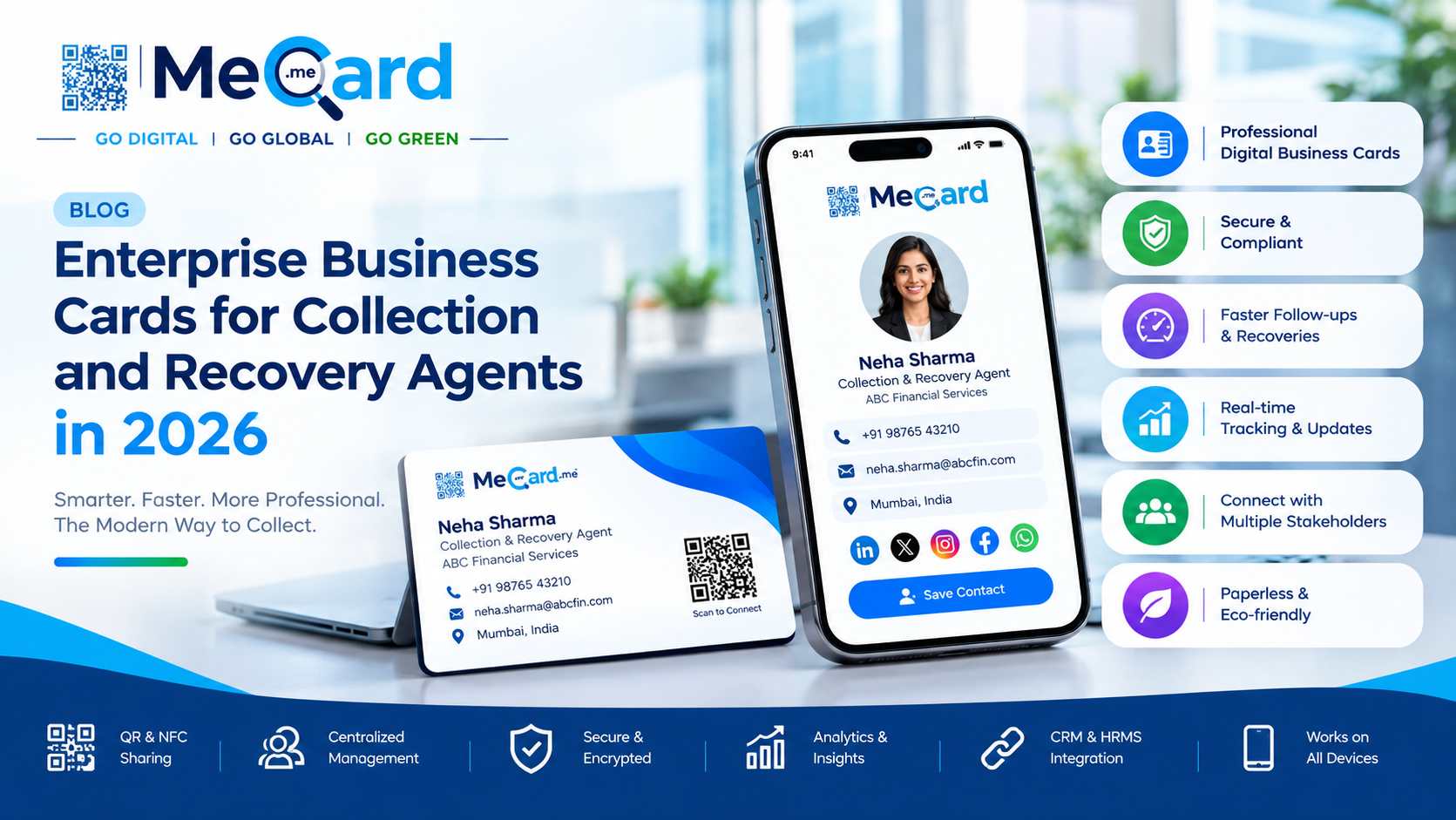
How banks, NBFCs, fintech companies, housing finance companies, microfinance institutions, and collection agencies can use Digital ID Cards, QR verification, centralized management, and digital identity lifecycle controls for field agents.
For banks, NBFCs, fintech companies, housing finance companies, microfinance institutions, and collection agencies, field agents represent the organization at one of the most sensitive points in the customer relationship: loan collection and recovery.
A collection or recovery agent may visit a customer's home, workplace, or business premises. In that moment, the customer needs to know an important thing:
“Who is this person, which organization do they represent, and are they actually authorized to contact me?”
Traditional employee or agent ID cards provide basic identification, but modern collection operations increasingly require something more: verifiable identity, centralized control, real-time status, and an easy way for customers to validate the representative.
This is where Enterprise Digital Business Cards and Digital ID Cards for Collection and Recovery Agents can play an important role in 2026.
Collection operations are often distributed across cities, branches, agencies, and third-party service providers.
An organization may have hundreds or thousands of collection and recovery representatives working in different territories. Some may be direct employees while others may work through outsourced agencies.
This creates an identity-management challenge.
A physical card can show an agent's photograph, name, employee number, and company logo. However, the information printed on the card does not automatically change when the agent's status changes.
An agent could change agencies, territories, roles, or employment status. A physical card may also be lost, damaged, duplicated, or retained after an agent is no longer authorized.
A centrally managed digital identity introduces a different model: the organization controls the identity throughout its lifecycle.
For regulated entities, recovery-agent identification is not simply a branding exercise.
RBI guidance for banks states that borrowers should be informed about the recovery agency, and that recovery agents should carry the notice and authorization letter along with the identity card issued by the bank or recovery agency.
The guidance also addresses verification of agents' antecedents and identification of the agency involved.
RBI has also emphasized that regulated entities remain responsible for the actions of outsourced recovery agents.
Its 2022 directions specifically state that regulated entities and their agents must not engage in intimidation or harassment and must protect customer privacy.
For NBFCs, RBI directions similarly address training, confidentiality, fair practices, and restrictions on harassment in recovery activities.
This makes identity, authorization, privacy, and agent governance important considerations when designing a modern collection operation.
A Digital ID should therefore complement—not replace—the institution's required notices, authorization documents, internal controls, and applicable regulatory processes.
An Enterprise Digital Business Card for a collection or recovery agent is a centrally managed digital professional identity that can be accessed through a smartphone.
Instead of showing only static information printed on a plastic card, the digital profile can present approved organizational information such as:
The exact information displayed should be determined by the financial institution's security, privacy, compliance, and operational requirements.
The objective is straightforward:
Make it easier for customers and authorized personnel to verify who is representing the organization.
A traditional process generally looks like this:
Issue physical ID → Agent carries card → Customer visually checks card → Organization manually manages changes
A digital identity model can look different:
Create identity → Approve authorization → Generate QR identity → Agent presents digital ID → Customer scans → Organization-controlled information is displayed → Identity can be updated or deactivated centrally
This shift is particularly relevant for large collection teams.
MeCard's collection and recovery solution, for example, describes QR-based identity verification, centralized agent management, authorization information, and activity logs as components of its digital ID approach.
QR codes provide a simple bridge between a physical field interaction and a digital verification experience.
An agent can display their QR-enabled Digital ID on a smartphone or approved ID medium.
A customer can scan the QR code using a smartphone camera and access the organization's configured digital profile.
The profile can provide approved information about the representative and the organization.
This can be particularly useful when customers want to verify an agent before sharing information or continuing a conversation.
MeCard's Banking & Finance solution describes encrypted QR verification, secure cloud-based identity management, role-based access controls, centralized administration, and audit logs for financial-sector use cases.
One of the biggest limitations of physical identification is that it is static.
Suppose an agent leaves an agency today.
Their physical ID card may still exist.
If it is not returned or collected, the card could potentially continue to appear legitimate.
A centrally managed digital identity can be handled differently.
When an agent is no longer authorized, the organization can deactivate or block the digital identity according to its internal process.
MeCard's enterprise platform supports creating, issuing, updating, blocking, and retiring digital identities from a centralized dashboard.
For collection organizations managing large field teams, this creates an important operational capability:
Identity status can be managed centrally instead of relying entirely on physical-card recovery.
Many financial institutions work with external collection and recovery agencies.
This creates another layer of complexity.
The institution needs visibility into who is authorized to represent it, while the agency needs to manage its own field workforce.
A centralized digital identity system can provide a common structure for managing these identities.
For example, an organization can establish approved identity templates and required information while allowing authorized administrators to manage agents belonging to different agencies or operational units.
MeCard specifically describes its collection-agent solution as supporting both in-house field employees and third-party collection and recovery agencies through centralized digital identity management.
Imagine an organization managing 5,000 collection agents across multiple states.
Managing their physical IDs can involve:
Digital identity management can consolidate many of these activities into a centralized administrative workflow.
Administrators can maintain active and inactive identities, update information, and control access according to organizational permissions.
MeCard's platform describes centralized control of active, inactive, and blocked agents, along with logging of identity creation, updates, activation, deactivation, and blocking activities.
Large field operations generate recurring physical ID expenses.
There is the cost of PVC or other card production, printing, replacement, courier dispatch, inventory, and reprinting whenever information changes.
Digital identity reduces dependence on these physical processes.
MeCard's collection-agent solution specifically positions digital IDs as a way to reduce dependence on physical card printing, consumables, courier dispatch, and reprints resulting from lost or outdated cards.
For an organization with hundreds or thousands of agents, even small reductions per agent can accumulate over time.
A customer may receive a call or visit from someone claiming to represent a bank, NBFC, fintech company, or recovery agency.
In an environment where impersonation and fraudulent representations are concerns, customers benefit from having access to official organizational information.
A digital profile can display more than the agent's personal phone number.
It can provide the organization's approved identity information and official contact channels.
MeCard's collection-agent solution describes displaying official company contact details alongside the agent's digital identity.
This creates a clearer distinction between:
“This person says they represent the company.”
and:
“This person's identity can be checked against an organization-controlled digital profile.”
Identification and authorization are related but not identical.
Knowing someone's name does not necessarily establish that they are currently authorized to perform a particular activity.
For collection and recovery operations, organizations may therefore want their digital identity workflow to associate approved authorization information with the agent profile.
MeCard describes the ability to associate authorization information with an agent's digital identity so that the customer can see both the identity and the relevant authority under which the representative is visiting.
The exact authorization information and its validity should be governed by the institution's policies and applicable regulations.
Not every person involved in collections needs the same access.
A field collection agent may need a basic customer-facing identity.
A regional manager may need additional administrative capabilities.
A compliance officer may require monitoring access.
An agency administrator may need to manage only their assigned workforce.
Role-based access can help separate these responsibilities.
MeCard's Banking & Finance solution describes role-based access controls for administrators and branch managers as part of its digital identity architecture.
For larger financial institutions, this can help create a more structured identity-management environment.
In a large collection operation, organizations may need to know:
A digital system can maintain records of these administrative events.
MeCard's collection and recovery solution describes logs covering identity creation, updates, activation, deactivation, and blocking.
These records can support internal monitoring, operational reviews, investigations, and audit processes.
They should be considered part of the organization's broader governance framework rather than as a substitute for formal regulatory records.
Collection agents handle sensitive customer interactions.
A Digital ID platform should therefore follow a principle of minimum necessary information.
The customer's personal loan information, financial details, account information, or other sensitive data should not simply be exposed through a public-facing Digital ID.
The agent-facing identity and the customer-facing verification profile should be designed separately from confidential case-management information.
RBI guidance emphasizes customer confidentiality and privacy in recovery activities.
For example, RBI directions for NBFCs explicitly address customer confidentiality and prohibit inappropriate handling of personal information during recovery.
A Digital ID should therefore reveal only information appropriate for identity verification and customer communication.
It is important to understand the role of an Enterprise Digital ID.
It does not replace:
The Digital ID is an identity and verification layer.
Its purpose is to make the representative's identity easier to verify and easier for the organization to manage.
This distinction is particularly important for banks and NBFCs designing digital identity programs.
Although both use similar technologies, their purposes can be different.
| Digital Business Card | Digital ID for Collection Agents |
|---|---|
| Professional networking | Identity verification |
| Contact sharing | Field representative verification |
| Sales and business development | Collection and recovery operations |
| Lead generation | Customer-facing authorization context |
| QR/NFC sharing | QR-based identity verification |
| Business information | Approved identity and organization information |
| Networking analytics | Identity lifecycle and administrative controls |
An enterprise platform can support both use cases while applying different templates, permissions, information fields, and workflows.
MeCard has expanded its digital identity capabilities beyond conventional Digital Business Cards into use cases involving collection and recovery teams.
Its published collection-agent solution includes:
Customers can access an agent's digital profile through a QR-enabled identity.
Relevant authorization information can be presented alongside the agent's identity where appropriate.
Administrators can manage the agent lifecycle through centralized digital identity controls.
Identity-management events such as creation, updates, activation, deactivation, and blocking can be recorded.
Customers can access approved company-level contact information alongside the agent's digital identity.
Its broader Banking & Finance offering also describes encrypted QR verification, role-based access, centralized branch management, audit logs, and secure backups.
For organizations already using Digital Business Cards, this creates an opportunity to extend the same digital identity infrastructure into field operations.
A financial institution can design its collection-agent identity process around a controlled lifecycle.
The resulting model creates a continuous identity lifecycle rather than a one-time physical card issuance.
For collection and recovery organizations, the value of Digital IDs can be considered across several dimensions.
Collection and recovery operations are becoming increasingly digital.
Customer communication is increasingly mobile.
Financial institutions are adopting centralized technology platforms.
Third-party agency networks require stronger operational oversight.
At the same time, customers increasingly expect transparency about who is contacting them.
This creates a natural role for digital identity.
The future collection agent may no longer rely on a laminated card as the primary identity touchpoint.
Digital + Verifiable + Centrally Managed + Updateable + Auditable
That does not eliminate the need for regulatory documentation or institutional controls.
It adds a digital layer that can make those identity processes more accessible and manageable.
For collection and recovery teams, an Enterprise Business Card should not be viewed simply as a more modern version of a visiting card.
The more relevant concept is Enterprise Digital Identity.
A well-designed system can connect an agent's identity with organizational information, QR-based verification, authorization context, lifecycle management, centralized administration, and auditability.
For banks, NBFCs, fintechs, housing finance companies, microfinance institutions, and collection agencies, this can help create a more controlled and transparent field identity process.
MeCard's Digital ID solution for collection and recovery agents is designed around this model, combining QR verification, centralized agent management, authorization information, real-time control, and audit trails.
The key question for collection organizations in 2026 is therefore not simply:
“What should our recovery agents carry?”
It is:
“How can we make every field representative's identity easier to verify, manage, update, and control?”
That is the shift from a physical agent ID card to a digitally managed enterprise identity.
A Digital ID for a collection agent is a centrally managed digital identity that can provide approved information about the agent, organization, role, and verification details through a smartphone-accessible profile.
Digital identity verification can help customers and authorized personnel check the representative's organizational identity and access approved information before continuing an interaction.
Yes. A QR-enabled Digital ID can allow a customer to scan the representative's identity and access the organization's configured verification profile.
Yes. A centrally managed system can allow authorized administrators to block or deactivate a digital identity when an agent is no longer active or authorized, according to the organization's internal processes.
Yes. A centralized digital identity system can support identity management for both in-house field employees and authorized third-party collection and recovery agencies.
Depending on the institution's requirements, it may include the agent's name, photograph, role, organization or agency, identification number, official contact details, branch, authorization information, customer-support contact, and verification details. Sensitive customer or case information should not be exposed unnecessarily.
No. A Digital ID is an identity and verification layer. It should complement required notices, authorization letters, internal processes, grievance mechanisms, and applicable regulatory requirements.
Yes. Centralized digital identity platforms can provide controls for managing active, inactive, and blocked agent identities.
Digital identity systems can record administrative events such as identity creation, updates, activation, deactivation, and blocking to support operational monitoring and review.
Yes. The Digital ID should follow a minimum-necessary-information approach and should not expose sensitive customer loan, financial, account, or case-management information through a public-facing identity profile.
MeCard positions its collection and recovery solution around QR-based identity verification, centralized agent management, authorization information, active/inactive/blocked status, and identity activity logs.
Phone: +91 77770 01366 / +91 77770 01369
Email: contact@mecard.me
Website: www.mecard.me