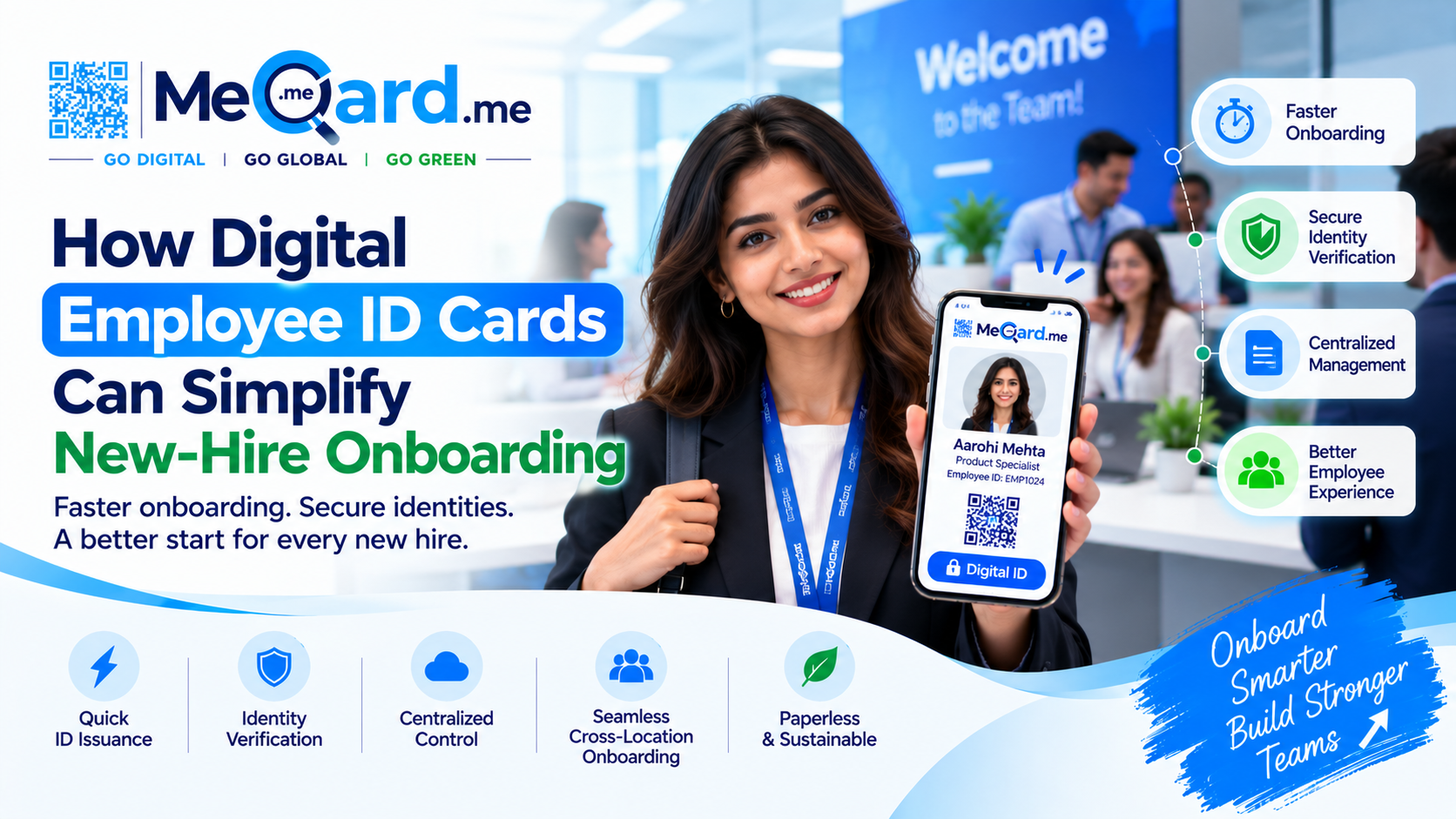
A new employee's first day should be about understanding the organization, meeting the team, and getting ready to contribute. Yet, in many enterprises, onboarding begins with administrative delays.
HR teams collect employee details, coordinate approvals, prepare identity cards, communicate with printing vendors, and distribute credentials. If any information is missing or incorrect, the process may need to start again. For organizations with multiple offices, large hiring volumes, or distributed workforces, these small delays can become a recurring operational challenge.
Traditional employee ID card processes can make onboarding more dependent on physical printing, manual coordination, and repeated data entry than necessary.
Digital employee ID cards offer a more flexible approach, helping HR teams streamline identity-related tasks while providing new hires with a convenient way to access their organizational profiles.
For enterprises looking to modernize employee onboarding, digital identity management can be an important step toward creating a smoother, more consistent first-day experience.
Digital employee ID cards are electronic identity credentials that represent an employee's association with an organization. Depending on the platform and configuration, they can display information such as the employee's name, designation, department, company details, and other approved identification fields.
Employees can access their digital identity through a supported digital profile, mobile device, or QR-enabled solution rather than depending exclusively on a printed card. Unlike a physical card that may require reprinting whenever certain details change, a digital identity profile can be updated centrally, subject to the organization's permissions and approval procedures.
Traditional ID card issuance often involves collecting employee information, designing the card, printing it, and distributing it. When printing is managed centrally, remote employees may wait longer to receive their cards. Digital IDs allow organizations to issue eligible identities instantly.
HR teams often share details across administration, IT, and security. Re-entering information across systems increases effort and error risks. A centralized platform helps standardize profiles and reduce repetitive tasks.
Incorrect names or outdated designations create avoidable rework. Authorized administrators can update digital fields without necessarily issuing a replacement physical card.
Manual processes become harder to manage as hiring scales. Digital issuance and bulk-management capabilities help organizations handle identity creation more consistently.
New hires change teams, get promotions, or leave. A digital process makes it easier to maintain profiles and deactivate IDs when authorization ends, coordinating with HR and IT security procedures.
HR Teams: Simplify onboarding checklists and establish consistent profile creation processes.
IT and Administration: Benefit from centralized records, defined permissions, and automated updates.
Security Teams: Use digital profiles to support identification workflows and maintain better control over active credentials.
New Employees: Enjoy a modern, convenient way to receive their organizational identity immediately.
Digital identity technology works best when supported by clear governance. Consider:
MeCard provides digital identity solutions designed for modern workplaces, supporting QR-enabled profiles and centralized administration to reduce friction during onboarding.
They reduce dependence on physical printing, support standardized issuance, and allow for real-time profile updates, making the identity-related part of onboarding faster and more accurate.
Yes, they can be issued on or even before a first day as long as the employee data is verified and the approval workflow is complete.
Yes. Digital profile fields can be updated centrally by authorized administrators, keeping information current without the cost of physical replacements.
A smooth onboarding experience starts with removing avoidable administrative delays. Digital employee ID cards offer a flexible, modern approach to managing workforce identity across its entire lifecycle.
Secure, Centralized, and Scalable Digital ID Solutions.
Ready to simplify employee identity management and improve the onboarding experience? Explore how MeCard's enterprise-grade solutions can work for your organization.