
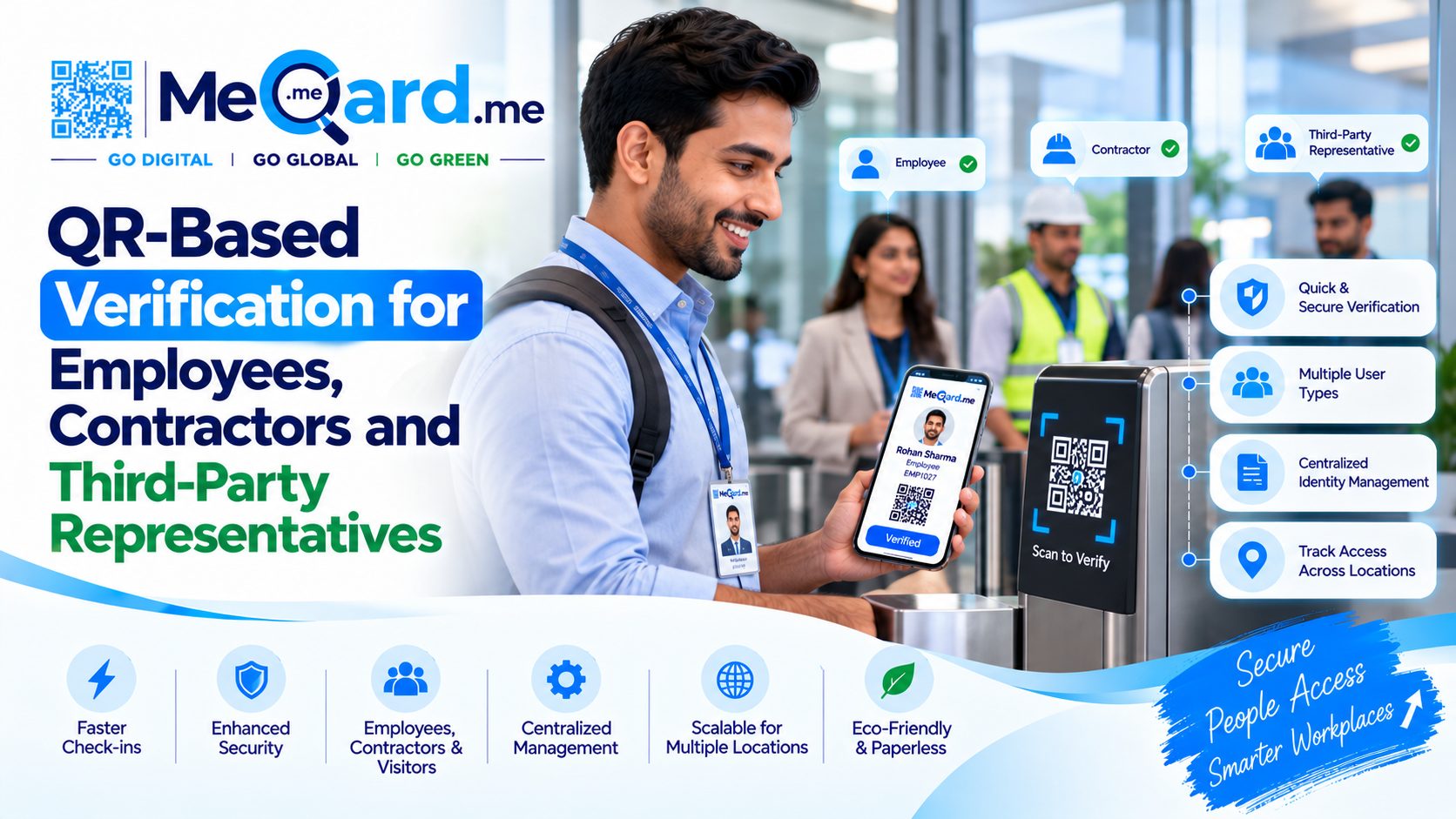
Modern enterprises depend on more than their permanent employees. Contractors, outsourced personnel, consultants, collection agents, delivery representatives, service providers and other third parties often interact with customers, visit business locations, and perform work on behalf of an organization.
Every interaction creates an important question: how can the organization verify that the person presenting themselves as its representative is genuinely authorized to do so?
Traditional employee ID cards can help with visual identification, but they may become outdated when an employee changes roles or leaves the organization. Third-party representatives may have different identification formats, validity periods and approval procedures. In some cases, verification depends on phone calls, email confirmations or manual checks that take time and interrupt daily operations.
QR-based verification offers a more accessible way to connect a person's identity with an approved digital profile.
By scanning a QR code, an authorized user can access relevant identity information through a supported digital verification experience. When combined with centralized identity management, clear authorization rules and timely updates, this approach can help enterprises manage employee and third-party identities more consistently.
Digital identity solutions such as MeCard.me can support this process through QR-enabled digital profiles and centralized digital card management.
QR-based identity verification uses a Quick Response (QR) code to provide access to digital identity information or a verification service. For an enterprise, the QR code may be associated with a digital employee ID card, contractor profile, field-agent identity, or another approved representative profile.
Depending on the platform and configuration, scanning the code can display information such as:
The exact information displayed should depend on the organization's verification requirements and privacy policy. A QR code is a convenient access mechanism, but it is not automatically proof that the person presenting it is genuine or currently authorized. Effective verification also depends on the integrity of the underlying profile, the accuracy of the information, and appropriate controls against misuse.
As organizations expand, managing employee identities becomes more complicated. New branches open, contractors join projects, outsourced teams change, and third-party representatives operate across different locations. Maintaining separate records and identification processes for every group can create inconsistencies.
Employees who interact directly with customers often need to establish their professional identity quickly. Sales representatives, insurance advisors, field officers, and service engineers may visit customers outside the organization's premises. A QR-enabled digital ID can provide a convenient way for customers to confirm relevant organizational details rather than relying entirely on a physical card.
Contractors often work for a specific period or business purpose. Their requirements differ from permanent employees. QR-based digital identity management can support these workflows when the platform allows the organization to maintain appropriate profile and validity information.
In many cases, customers need to understand whether the individual is genuinely associated with the organization they claim to represent. A QR-enabled identity profile can make approved organizational information accessible through a digital channel, identifying the sponsoring organization or the scope of the assignment.
Financial institutions use QR-enabled profiles to support field and collection personnel identification, helping customers access approved organizational details.
Insurance advisors use digital profiles to provide convenient access to business contact information, supporting a consistent verification experience outside the office.
Delivery teams and outsourced logistics providers use QR profiles for identity presentation when visiting customer premises.
Supports identification for contractors and maintenance personnel while maintaining existing facility access-control procedures.
MeCard.me offers digital identity solutions that include digital employee ID cards, QR-enabled profiles, and centralized digital card management to help enterprises organize identity information.
MeCard allows users to access digital profiles through a scan. Organizations can configure these profiles to present approved information in a convenient digital format.
MeCard provides a centralized dashboard for managing digital cards, allowing authorized administrators to organize identities across teams and locations.
Our offering includes bulk card issuance and integrations with HRMS and Active Directory, helping organizations manage digital identities as they grow.
Modernize your identity management with QR-enabled digital profiles.
Rather than relying entirely on physical cards and disconnected manual checks, organizations can build a more consistent digital approach to identity management while retaining the security controls their operations require.
Ready to modernize employee and third-party identity management? Explore MeCard.me Digital ID Solutions and discover how QR-enabled digital identities can support your organization's verification processes.
Phone: +91 77770 01366 / +91 77770 01369
Email: contact@mecard.me