
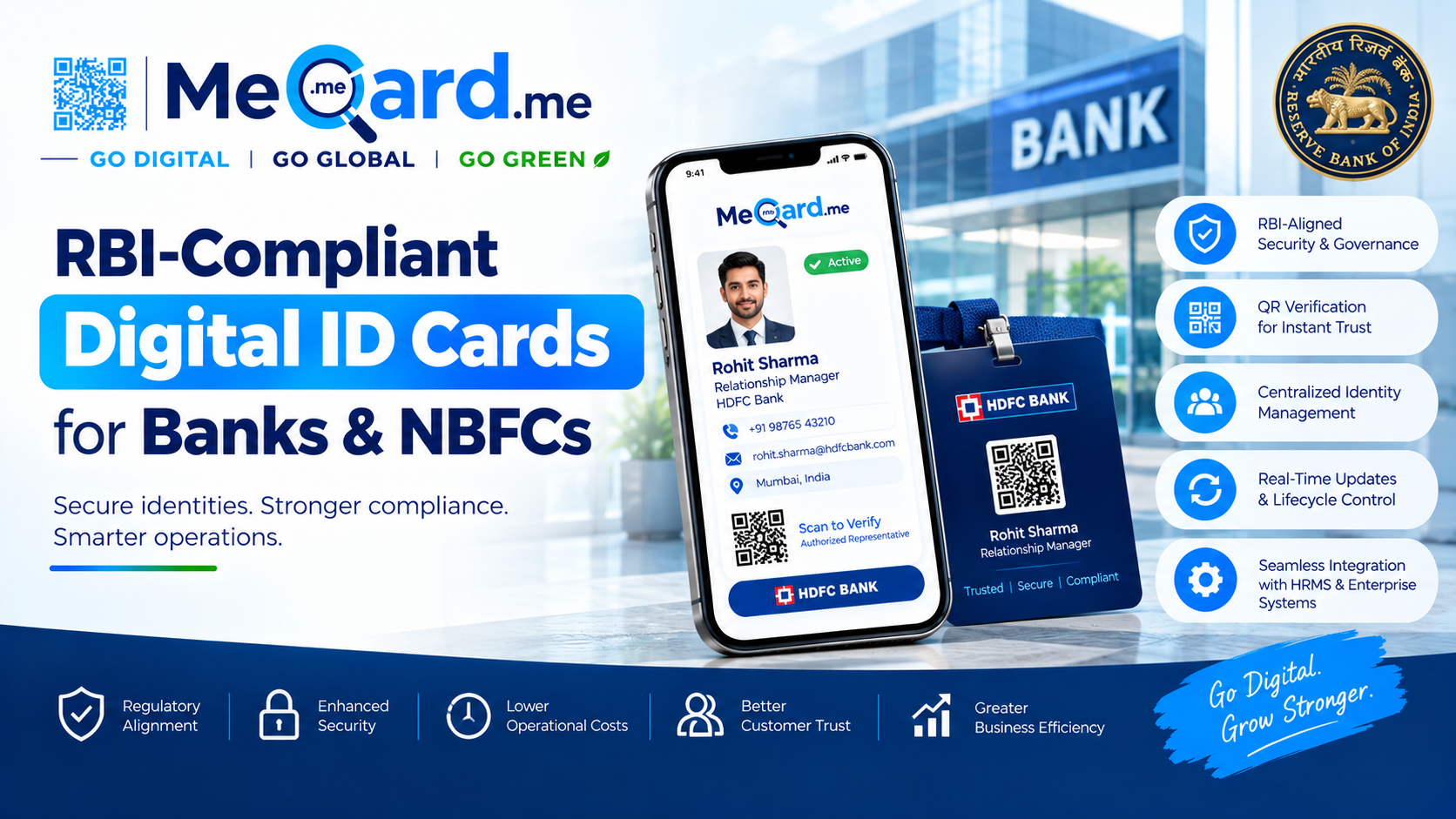
India's banking and financial services ecosystem is becoming increasingly digital. Customer onboarding, KYC, payments, lending, collections, branch operations and employee workflows are all moving toward technology-driven processes.
Yet one critical part of financial operations often remains dependent on a traditional physical card: employee and field-agent identity management.
Banks and NBFCs have thousands of relationship managers, branch employees, loan officers, collection agents, recovery executives, contractors and third-party representatives interacting with customers every day. A physical ID card can establish basic identity, but it cannot easily tell a customer whether the person is currently authorized, whether their role has changed, or whether the identity is still active.
This is where Digital ID Cards for Banks and NBFCs can become part of a broader digital identity and governance strategy.
MeCard provides Digital Business Cards and Employee ID Card solutions for banking and financial organizations, combining QR-based verification, centralized administration, real-time profile management and controlled digital identities.
The term RBI-compliant Digital ID Card needs to be understood carefully.
The Reserve Bank of India does not prescribe a universal format or certification called an “RBI-certified digital employee ID card.” Instead, banks and applicable NBFCs operate within broader regulatory expectations covering areas such as information security, access control, technology governance, auditability, risk management and protection of information.
RBI's IT governance framework addresses areas including access controls, audit trails, information-security risk management and technology-related controls. RBI has also consolidated IT governance, business continuity and information-systems audit requirements into its 2023 Master Direction.
Similarly, RBI's KYC framework applies to regulated entities and addresses customer identification and due-diligence processes. The KYC Direction was amended again in June 2025.
Therefore, an RBI-aligned Digital ID strategy should not simply mean putting an employee photograph and QR code onto a smartphone.
It should support the organization's broader requirements for identity verification, access control, lifecycle management, information security and governance.
This distinction is particularly important for banks and NBFCs.
Customer KYC is concerned with identifying and conducting due diligence on customers under applicable regulatory requirements.
A Digital Employee ID, on the other hand, establishes an individual's organizational identity and affiliation.
For example, a Digital ID may establish that a person is:
A Digital ID therefore should not be presented as a replacement for customer KYC. Instead, it can become part of the institution's employee, agent and organizational identity-management infrastructure.
A physical ID card is relatively simple to issue, but managing thousands of identities across branches and field operations can become difficult.
Consider an NBFC with a large collection network.
An agent may change territory, change designation, move to another agency or leave the organization completely. If the physical card remains with that individual, the organization may have limited control over how that card is subsequently presented.
The same problem exists when employee information changes.
A new designation, mobile number, branch, department or reporting structure may require a new physical card.
This creates additional printing, approval, distribution and replacement processes.
A Digital ID changes the underlying model.
Instead of simply issuing a card, organizations can manage an employee's or agent's digital identity throughout its lifecycle.
A financial institution should evaluate Digital ID technology as an identity-management platform rather than simply as a digital replacement for plastic cards.
One of the most useful capabilities is QR-based verification.
An employee or authorized field representative can present a Digital ID containing a QR code. A customer or authorized person can scan the code and access the configured digital profile.
MeCard's banking and finance solution supports QR-based employee verification, allowing customers to access official employee information and organizational details.
This can be particularly relevant for customer-facing employees such as relationship managers, loan officers, collection agents and field executives.
Large financial institutions may have thousands of employees and third-party personnel distributed across branches and cities.
Managing these identities individually creates unnecessary administrative complexity.
A centralized dashboard can allow authorized administrators to create, update, monitor and manage Digital IDs from one location.
MeCard's banking solution is designed around centralized management of employee profiles, Digital Cards and branch information with real-time updates.
Employee information is not static.
An employee can change:
With physical cards, each change may require a new card.
With a centrally managed Digital ID, approved information can be updated digitally without requiring the employee to wait for a replacement physical card.
This is particularly useful for organizations with geographically distributed teams.
One of the most important capabilities of a Digital ID system is identity lifecycle control.
When an employee or field agent leaves an organization, their identity should no longer appear as an active organizational identity.
MeCard's Digital ID solution supports revocation of employee IDs and allows organizations to remotely manage issued identities.
For NBFCs and financial institutions with large outsourced or field-based teams, this can provide an additional layer of operational control.
The collection and recovery ecosystem represents one of the strongest use cases for Digital ID technology.
Collection agents frequently interact directly with borrowers outside traditional branch environments.
The borrower may need to determine:
A physical ID card may answer the first two questions visually, but it does not necessarily provide a dynamic verification mechanism.
MeCard's Digital ID solution for collection and recovery teams uses QR-based verification to connect the agent's identity with a digital profile. Administrators can also manage active, inactive and blocked agents centrally.
This changes the interaction from:
“Here is my ID card.”
to:
“Here is my verified digital identity.”
For organizations managing large field teams, that distinction can be operationally significant.
A bank does not have a single type of employee identity.
A branch manager, relationship manager, collection agent, auditor, contractor and senior executive may require different information and permissions.
A Digital ID platform should therefore support appropriate role-based administration.
For example, an institution may configure different identity profiles for:
Official designation, branch information, contact details and organizational information.
Professional profile, contact options, branch information and relevant customer communication channels.
Identity information, authorization details and verification functionality.
Limited organizational information with controlled validity periods.
Executive profile, corporate information, professional contact details and networking capabilities.
MeCard's banking solution includes role-based access controls alongside centralized administration and secure identity management capabilities.
The real value of Digital Identity emerges when it connects with the systems already used by the organization.
A typical employee lifecycle could look like:
Employee joins → HR record created → Digital ID issued → Employee becomes active → Role/branch changes → Digital ID updated → Employee exits → Digital ID revoked
This creates a connection between HR lifecycle management and organizational identity management.
MeCard's enterprise offering supports integrations including Active Directory and HRMS, enabling organizations to connect employee identity management with existing enterprise workflows.
For large banks and NBFCs, this can reduce duplicate data entry and improve consistency between employee records and Digital ID information.
For financial institutions, digital convenience cannot be separated from information security.
A Digital ID platform should therefore be evaluated for its:
RBI's IT governance framework makes technology governance and controls an important part of the regulated entity's operating environment.
MeCard's banking and finance solution describes capabilities including encrypted QR verification, role-based access, secure cloud storage, audit logs, secure backups and centralized administration.
Financial institutions should nevertheless evaluate these capabilities against their own security architecture, regulatory obligations, internal policies and vendor-risk requirements before deployment.
Field teams may not always operate in locations with reliable internet connectivity.
Collection executives, sales teams, loan officers and other field personnel may need to display their identity while working away from a branch or corporate office.
MeCard's Digital ID solution supports mobile display of IDs without requiring an internet connection simply to display the card.
This makes the model more practical for geographically distributed teams.
Banks and NBFCs also manage people who are not permanent employees.
These can include:
Issuing permanent physical IDs to every temporary user can create unnecessary administrative work.
A Digital ID system can instead support temporary identities with defined validity periods.
MeCard supports temporary Digital IDs with automatic expiration, allowing organizations to control how long temporary identities remain valid.
This can be useful for branch offices, corporate offices, audits, contractors, events and other temporary access scenarios.
Digital identity is not limited to employee verification.
Banking professionals also need a modern way to exchange professional contact information.
Relationship managers, wealth managers, branch managers, financial advisors and senior executives frequently meet customers and business stakeholders.
MeCard combines Digital Business Cards with its broader Digital Identity ecosystem, enabling professionals to share their profiles through QR codes, NFC, WhatsApp, email and other digital channels.
This means one organization can use digital identity technology for both:
without treating them as completely separate digital experiences.
Before deploying a Digital ID platform, banks and NBFCs should evaluate the entire identity lifecycle.
The institution should define who can create identities, who approves them, what information is displayed, how roles are assigned, how identity changes are processed and what happens when an employee or agent exits.
Security teams should evaluate authentication, administrative access, auditability, data handling and vendor controls.
HR and operations teams should consider employee onboarding, transfers, role changes and exits.
Compliance teams should map the implementation against applicable regulatory and internal requirements.
IT teams should assess integration with HRMS, Active Directory and other relevant systems.
The objective should be to create an enterprise-controlled identity ecosystem, not simply a digital version of an existing plastic card.
MeCard is positioned as a digital identity and Digital Business Card platform for modern enterprises, with dedicated capabilities for banking and financial services.
Its banking solution supports Digital Business Cards, Employee ID Cards, QR verification, centralized branch management and secure digital identity management.
Its Digital ID platform adds capabilities such as remote issuance, QR verification, temporary IDs, offline mobile display, internal-system integration and identity revocation.
For field-intensive financial organizations, MeCard also provides Digital ID management for collection and recovery teams, including QR-based verification and centralized control over active and inactive identities.
This allows MeCard to address several identity requirements within one broader ecosystem:
Employee Identity + Field-Agent Identity + Digital Business Cards + QR Verification + Centralized Management
Digital transformation in financial services should not stop at customer-facing applications.
The people representing a financial institution also form part of its digital trust ecosystem.
When a customer interacts with a relationship manager, loan officer, collection agent or branch representative, that individual's identity can influence the customer's confidence in the interaction.
Digital IDs can help organizations move toward an identity model that is:
The future is therefore not simply about replacing a plastic employee card with an app.
It is about creating a secure and governed digital identity infrastructure that connects employees, field teams, HR systems, administrators and customers.
For banks and NBFCs, Digital ID Cards can become an important component of modern employee and field-agent identity management.
However, “RBI-compliant” should not be interpreted as meaning that RBI certifies a particular Digital ID product or format. RBI compliance depends on how a regulated entity implements technology, security, access controls, governance, identity processes and other applicable requirements.
The RBI KYC framework governs customer identification and due diligence, while its broader IT governance framework addresses technology and information-security controls relevant to regulated entities.
MeCard provides the technology layer for organizations looking to modernize this area through Digital Employee IDs, QR-based verification, centralized identity management, real-time updates, temporary IDs, identity revocation and enterprise integrations.
For banks and NBFCs, the opportunity is bigger than going paperless. It is about moving from static identity cards to dynamic, verifiable and centrally governed digital identities.
MeCard — Digital Business Card and Identity Card Solution for Modern Enterprises.
RBI does not prescribe a universal format or certification called an RBI-certified digital employee ID card. Financial institutions should evaluate Digital ID implementations against applicable regulatory, information-security, governance and internal requirements.
No. Customer KYC relates to customer identification and due diligence. A Digital Employee ID establishes an individual's organizational identity and affiliation.
Yes. Digital IDs can provide collection and recovery agents with digitally accessible identity information and QR-based verification capabilities.
A centrally managed Digital ID can allow authorized administrators to update approved employee information digitally, reducing dependency on physical card replacement.
Digital identity platforms can support lifecycle controls such as deactivation and revocation, allowing organizations to manage the status of issued identities.
Yes. Temporary Digital IDs can be configured with defined validity periods and can be useful for contractors, vendors, temporary workers, interns and other third-party personnel.
Enterprise Digital ID platforms can integrate with HRMS, Active Directory and other organizational systems to connect employee lifecycle events with digital identity management.
Yes. Mobile Digital IDs are particularly useful for field teams such as collection agents, loan officers, sales representatives and other customer-facing personnel.
Phone: +91 77770 01366 / +91 77770 01369
Email: contact@mecard.me
Website: www.mecard.me