
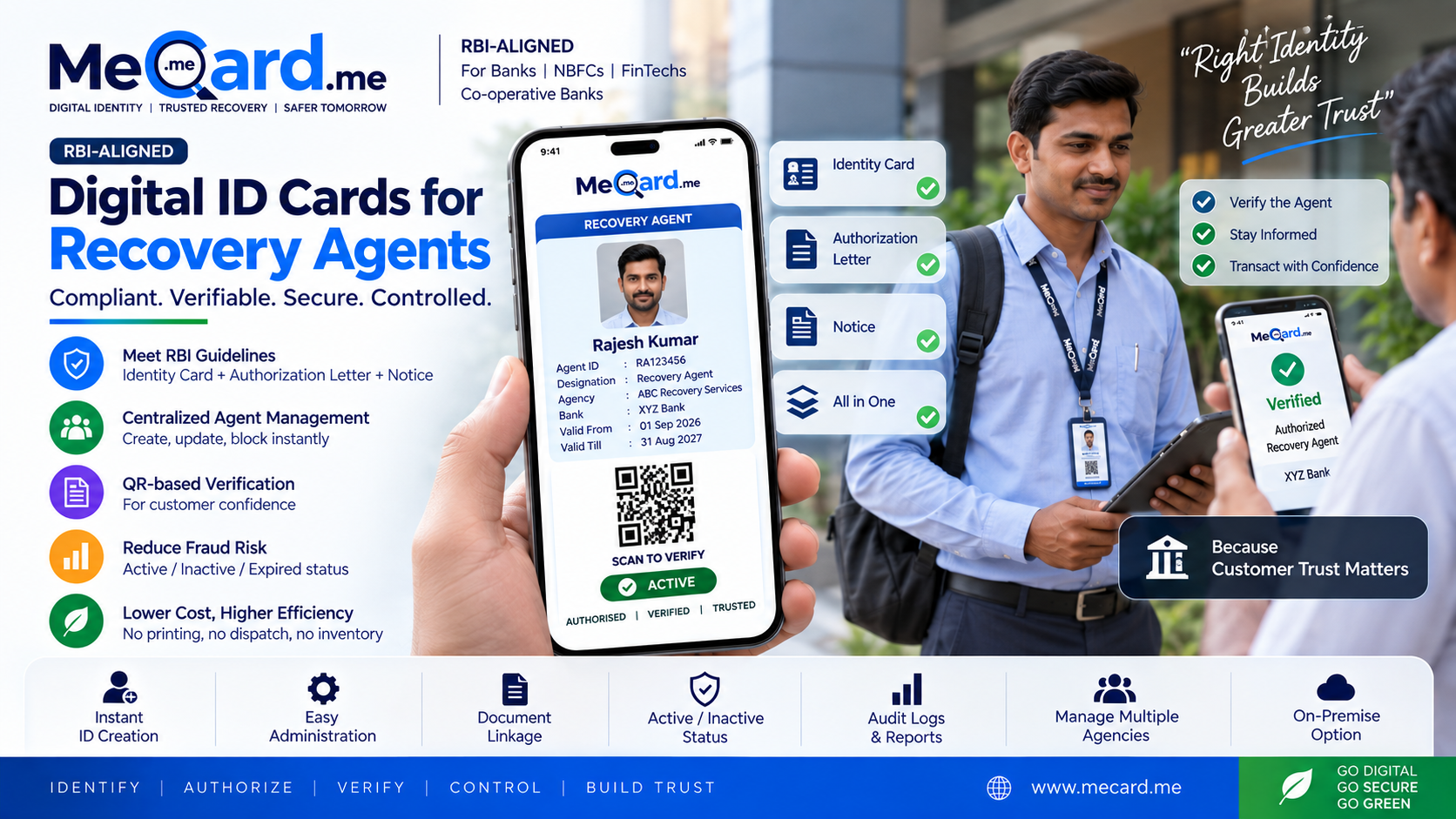
Every recovery visit starts with one simple question from the customer: "Who are you, and who sent you?" MeCard Digital ID answers that question in three seconds, with a QR code instead of a laminated card that anyone could photocopy.
Banks, NBFCs and recovery agencies across India rely on field agents to collect overdue payments. The Reserve Bank of India has made one requirement unmistakably clear for this process: every Recovery Agent must carry an Identity Card issued by the bank or the recovery agency, along with the notice and authorization letter for that specific visit.
That single line in the RBI guideline carries real weight. It protects the customer from impersonation and fraud, and it protects the bank's reputation in the field. This article breaks down what the RBI guideline actually requires, and how MeCard turns that requirement into a digital identity card that is instantly issued, instantly verified, and instantly blocked when needed.
The relevant provision, commonly referenced as Clause 2(iii) of the RBI's Fair Practices Code for recovery agents, sets out three documents that a recovery agent should carry during a field visit:
The guideline is equally clear about what happens when a bank changes its recovery agency mid-process. The new agent stepping into the case must also carry a fresh notice, authorization letter and identity card, so the customer is never left guessing whether the person at the door is genuinely authorized.
A Recovery Agent must carry an Identity Card issued by the Bank or Recovery Agency during every field visit, along with the notice and authorization letter for that case.
Underneath the paperwork, the purpose is straightforward: identification, authorization and transparency. The RBI also places direct accountability on the bank — it holds banks responsible for the conduct of their recovery agents, which is exactly why identity and authorization cannot be left to a printed card sitting in someone's wallet.
Read strictly, the guideline is short. Read functionally, it asks for a system, not just a card. Here is how each line of the requirement translates into something a bank actually needs to operate:
| RBI Requirement | What It Means in Practice | What the System Should Enable |
|---|---|---|
| Agent identification | Agent should carry an Identity Card | A unique identity for every agent, checkable on the spot |
| Issuing authority | ID issued by the bank or agency | Bank or agency-controlled ID issuance |
| Field verification | ID should be carried and shown | Agent can display the ID instantly, on a phone |
| Authorization | Agent carries an authorization letter | Authorization details linked to the agent profile |
| Notice | Agent carries a copy of the notice | Digital access to the relevant notice |
| Agency change | New agent needs a fresh ID and documents | Old ID disabled, new ID issued in minutes |
| Ongoing accountability | Bank is responsible for agent conduct | Central records, status tracking and audit trail |
Nothing in this list is exotic. It is what any bank already tries to do with paper — the difference is speed, and how quickly the bank can react when something changes.
MeCard is a digital identity platform built for exactly this kind of field-verification use case. Instead of a printed card that takes days to reissue, MeCard gives every recovery agent a digital ID card that lives on their phone and carries a unique, scannable QR code.
One distinction is worth stating plainly, since it matters when presenting this to a compliance team: the RBI circular does not name QR codes, mobile apps or "digital ID" as a requirement. It asks for identification, authorization and accountability. MeCard is a way to deliver those three outcomes faster and with better control — it is a technology choice that supports the rule, not a rule by itself.
Rather than a generic employee badge, a MeCard Recovery Agent ID is built specifically for field collection work, so a customer can check the essentials in seconds.
This is the part that actually protects the customer. Scanning the code opens a verification page controlled by the bank, not a screenshot that anyone can forward.
Recovery Agent Verification
Agent: Rajesh Kumar
Agent ID: RA123456
Agency: ABC Recovery Services
Bank: XYZ Bank
Status: ACTIVE
Validity: Until 31 August 2027
Authorized for Recovery Activity
Depending on what a bank wants to expose, the verification page can also show the agency's contact number, an authorization reference, the assigned area, and a grievance contact — which lines up with the RBI's expectation that notices carry relevant recovery-agency phone numbers and that borrowers know how to raise a complaint.
Ask any bank's operations team what worries them most about physical ID cards, and the answer is usually the same: what happens between an agent leaving the company and the card actually being collected. That gap is where most identity risk lives.
The old, paper-based process usually looks like this:
With MeCard, the same lifecycle looks like this:
The moment an agent's access is revoked, the same QR code that once displayed a valid profile now shows a clear, unambiguous status:
Recovery Agent Verification
Status: ❌ INACTIVE
This Recovery Agent ID is no longer active. Please contact the bank or recovery agency for verification.
No card to physically retrieve. No delay between an exit and a revoked identity. That single feature does more for a bank's risk posture than almost anything else in this list.
The RBI guideline directly addresses what should happen when a bank switches its recovery agency mid-case: the new agent must show up with a fresh notice, authorization letter and identity card, so the customer is never dealing with an unverified stranger.
MeCard makes that switch a two-step action rather than a paperwork cycle. The outgoing agent's ID is blocked, and the incoming agent's ID goes live, both from the same admin dashboard, both reflected instantly on the customer-facing verification page.
For a bank, NBFC or recovery agency, MeCard sits between agent onboarding and field verification:
This structure also supports the guideline's expectation around due diligence — that banks verify the antecedents of the individuals a recovery agency deploys before those individuals ever meet a customer.
Beyond recovery agents, MeCard also supports Employee Digital ID Cards, Visitor Passes, Membership Cards and Health or Emergency Cards — making it a broader digital identity platform rather than a single-purpose tool.
The RBI guideline on Recovery Agent Identity Cards is not a technology mandate — it is a trust mandate. It asks banks to make sure every agent who knocks on a customer's door can be identified, authorized and held accountable. MeCard simply makes that trust easier to deliver, with a digital ID that is issued in minutes, verified with a QR scan, and blocked the moment it needs to be.
For banks, NBFCs and recovery agencies that want to stay aligned with RBI expectations while removing the operational drag of physical cards, MeCard Digital ID offers a practical, field-ready way to get there.
Yes. Under the Fair Practices Code for recovery agents, RBI expects every agent to carry an Identity Card issued by the bank or the recovery agency, along with the notice and authorization letter for that visit.
The guideline focuses on identification, authorization and accountability rather than a specific format. A MeCard Digital ID delivers the same identification purpose, with the added benefit of QR verification and instant status checks that a printed card cannot offer.
With MeCard, the bank or agency can block the agent's digital ID immediately. The QR code then shows an "Inactive" status, so the identity cannot be misused after the agent's exit.
The outgoing agency's agent ID is blocked, and the new agency's agent ID is issued and activated, both from the same dashboard — matching the RBI's expectation that a new agent carries fresh identification when the agency changes.
Yes. Scanning the QR code on a MeCard Recovery Agent ID opens a verification page showing the agent's name, agent code, agency, bank, and current active or inactive status.
No. MeCard also supports Employee Digital ID Cards, Visitor Passes, Membership Cards, Insurance Cards and Emergency Cards, making it a broader digital identity platform for banks, NBFCs and other enterprises.
MeCard can link the authorization letter and notice to the agent's digital profile for easy access, but banks should continue following their existing process for issuing these documents alongside the digital ID.
Phone: +91 77770 01366 / +91 77770 01369
Email: contact@mecard.me
Website: www.mecard.me