
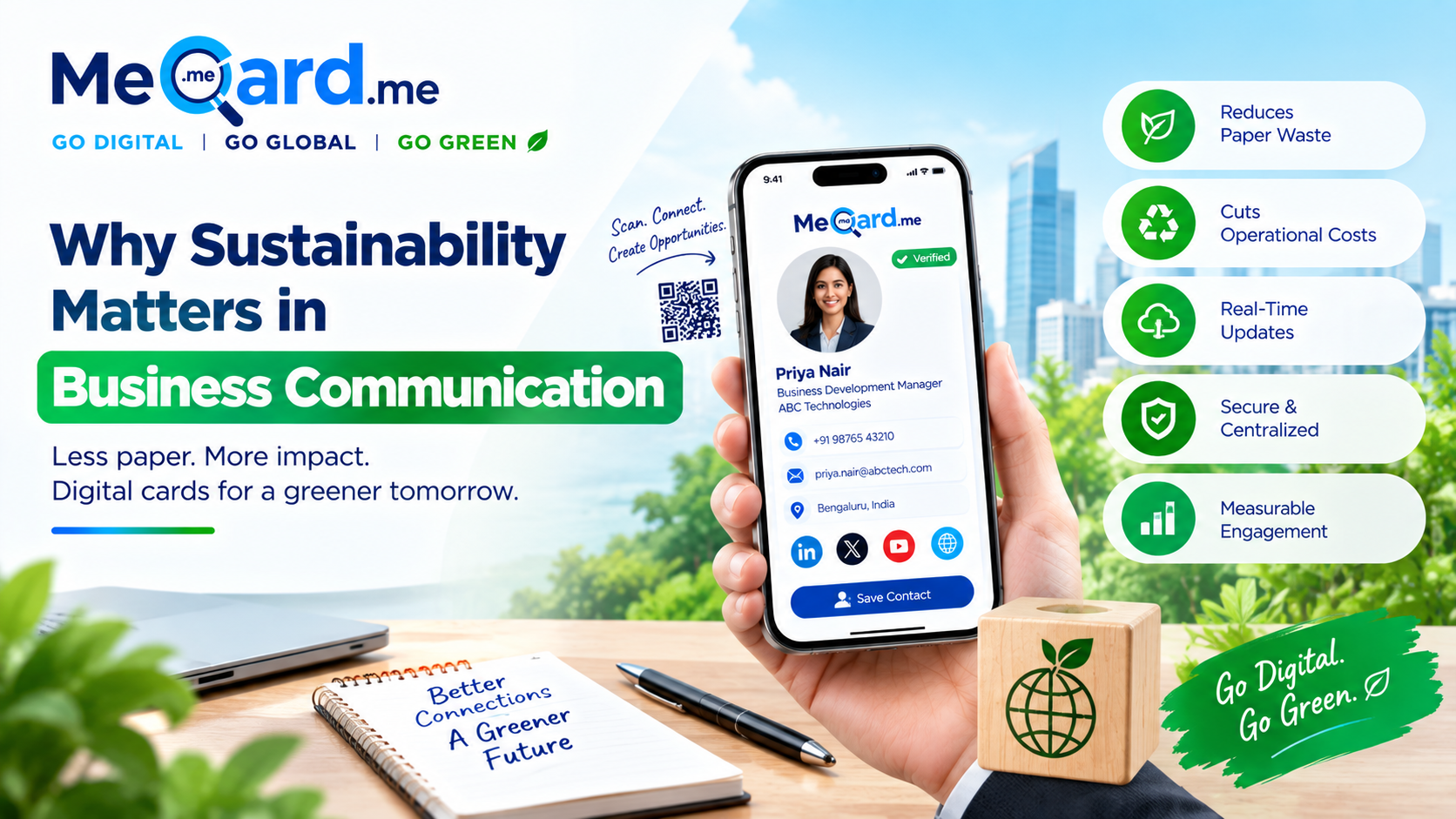
Sustainability is no longer limited to manufacturing, energy consumption, supply chains, or waste management. For modern organizations, sustainability is increasingly becoming part of everyday business decisions—including the way companies communicate, network, and represent their professional identity.
One of the simplest examples is the traditional business card.
For decades, companies have printed thousands of cards for employees, sales teams, executives, consultants, event representatives, and business development professionals. But every employee change, designation update, rebranding exercise, or contact-detail change can create another round of printing.
As organizations look for practical ways to reduce unnecessary physical resources, Digital Business Cards provide a simple opportunity to make professional communication more sustainable.
MeCard.me brings this idea together through its digital identity ecosystem, enabling organizations to replace traditional paper-based networking with QR- and NFC-enabled digital profiles.
When organizations discuss sustainability, attention often goes toward major initiatives such as renewable energy, responsible sourcing, carbon reduction, and waste management.
But sustainability can also come from hundreds of smaller operational decisions.
How much paper does an organization consume?
How often are printed materials replaced?
How much physical promotional material is distributed at events?
How many business cards become obsolete when employees change roles?
How much material is discarded after conferences and exhibitions?
These questions demonstrate why business communication can also be considered within a company's broader sustainability strategy.
MeCard itself positions Digital Business Cards as an environmentally friendly alternative to traditional paper cards and promotes the message “Go Digital. Go Global. Go Green.”
A traditional business card appears small and insignificant.
One employee may need only a few hundred cards per year.
But consider an organization with hundreds or thousands of employees.
Sales teams need cards.
Business Development teams need cards.
HR representatives need cards.
Executives need cards.
Branch employees need cards.
Event teams need cards.
Every employee may also require replacement cards when information changes.
A new designation can make existing cards outdated.
A new phone number can make them outdated.
A new office location can make them outdated.
A company rebrand can make thousands of cards obsolete at once.
The result is a recurring cycle:
Print → Distribute → Update → Reprint → Discard
Digital Cards change that cycle by making professional information updateable without requiring another physical print run.
MeCard's platform supports real-time profile updates, allowing information such as phone numbers, websites, office locations, and social profiles to be changed digitally.
The most direct sustainability benefit is simple: less dependence on paper-based networking materials.
Instead of carrying hundreds of printed cards to a conference, a professional can share one Digital Card through a QR code or digital link.
Instead of ordering new cards after every designation change, the digital profile can be updated.
Instead of maintaining large inventories of printed cards across offices, organizations can centrally manage digital identities.
MeCard's platform supports QR codes, NFC, direct links, WhatsApp, email, SMS and social platforms for sharing digital professional identities.
This makes digital communication more convenient while reducing the need for repeated physical production.
There is another sustainability issue that is often overlooked: obsolete printed material.
Imagine a company has 500 employees and each employee receives a batch of printed cards.
Six months later:
The remaining inventory may no longer accurately represent the organization's workforce.
The organization then needs another round of printing.
Digital Cards approach the problem differently.
The employee's professional identity exists digitally and can be updated when the information changes.
For enterprise organizations, MeCard provides centralized card management and real-time updates, helping organizations maintain current digital profiles without repeatedly producing physical cards.
One reason physical business cards have remained popular is their role in professional branding.
A business card is often the first tangible representation of a company.
Moving to digital communication does not mean losing that branding experience.
A Digital Card can still contain:
MeCard's Digital Business Card ecosystem supports rich digital profiles that can include professional and company information alongside interactive content.
This means sustainability can become part of the brand experience rather than something separate from it.
Today's business communication is increasingly distributed.
Employees may work from home.
Sales teams may travel between cities.
Executives may operate across countries.
Business Development teams may attend international conferences.
Customer meetings may happen entirely online.
In such an environment, physical business cards are not always the most practical way to communicate professional identity.
A Digital Card can be shared through a QR code during a physical meeting or through a link during a virtual conversation.
The same professional identity can move between:
Office → Conference → WhatsApp → LinkedIn → Email → Video Meeting
MeCard supports multiple digital sharing channels, making Digital Cards relevant across both physical and remote business interactions.
For large organizations, the sustainability opportunity extends beyond visiting cards.
Businesses increasingly use different physical cards and documents to represent employees, members, visitors, contractors, and other stakeholders.
This creates multiple production, replacement, distribution, and disposal processes.
A broader digital identity ecosystem can help organizations reduce dependence on physical identity materials.
MeCard provides solutions extending beyond Digital Business Cards to include Digital ID Cards, membership cards, visitor passes, emergency QR cards and other digital identity use cases.
This makes sustainability part of a wider digital transformation strategy.
Environmental, Social and Governance initiatives increasingly require organizations to examine how sustainability is incorporated into everyday operations.
Replacing every physical process with a digital one is neither necessary nor automatically sustainable. Organizations still need to consider factors such as data infrastructure, device usage, accessibility, security, and the lifecycle of digital services.
However, where physical materials are repeatedly produced, replaced, and discarded, digitization can be a practical way to reduce material dependency.
Digital Business Cards represent one such opportunity.
For organizations already investing in digital transformation, moving professional networking from paper to digital can connect three objectives:
Modernize how employees communicate and network.
Reduce repetitive printing and manual replacement processes.
Reduce dependence on physical networking materials.
MeCard positions its Digital Card ecosystem around this combination of digital transformation and sustainability.
Conferences and exhibitions can generate significant amounts of printed material.
Business cards are exchanged.
Brochures are distributed.
Product information is printed.
Promotional material is handed out.
Much of this material may have a short useful life.
Digital Cards provide another approach.
A booth representative can display a QR code.
A visitor can scan it.
The visitor receives the representative's Digital Card.
The profile can then provide access to company information, product pages, presentations, videos, enquiry forms, and other resources.
This reduces the need to make every piece of information physically available.
More importantly, the information remains updateable after the event.
Traditional business communication often has a short physical lifecycle.
A card is exchanged and placed into a wallet, notebook, drawer, or bag.
A Digital Card can remain accessible through a smartphone or digital link.
The recipient can revisit the profile later.
The organization can update the information.
The professional can continue sharing the same identity across future conversations.
MeCard also provides analytics capabilities that can give organizations visibility into profile visits, QR activity, and engagement.
This introduces another dimension to sustainable communication: better use of the communication asset itself.
Instead of repeatedly producing new physical materials, organizations can maintain one evolving digital professional identity.
Sustainability and efficiency often overlap.
Reducing unnecessary physical materials can also reduce associated operational work.
Organizations may otherwise need to manage:
Digital Cards can simplify many of these activities by moving professional identity management into a centralized digital environment.
MeCard's enterprise capabilities include centralized management, customized templates, employee card management, real-time updates and enterprise integrations such as Active Directory and HRMS.
For large organizations, this can make sustainability part of an operational improvement rather than a separate initiative.
The future of business communication is becoming increasingly digital.
People expect information to be accessible through smartphones.
Business relationships increasingly develop across digital channels.
Organizations want real-time information.
Sales teams want measurable engagement.
HR teams need centralized identity management.
Marketing teams want consistent branding.
And sustainability teams increasingly look at how everyday operations can reduce unnecessary resource consumption.
Digital Cards sit at the intersection of these requirements.
They can make professional identity:
MeCard is positioned as a Digital Business Card and Identity Card solution for modern enterprises.
Its platform combines QR and NFC sharing, digital profiles, real-time updates, analytics, centralized administration and broader digital identity capabilities.
For an individual professional, that can mean replacing a stack of printed cards with one digital identity.
For an enterprise, it can mean creating a centralized system for managing professional identities across employees and teams.
For sustainability-focused organizations, it can provide a practical way to reduce dependence on repeatedly printed networking materials.
The result is not simply a paperless business card.
It is a more connected approach to professional communication.
Sustainability does not always require a dramatic transformation.
Sometimes it begins with questioning something that businesses have been doing for decades.
Do we still need to print thousands of business cards?
Do we need to reprint them every time an employee changes their designation?
Do prospects need another piece of paper, or would a digital profile be more useful?
Can our professional identity remain current without producing another physical card?
For many organizations, Digital Cards provide a practical answer.
MeCard's approach brings together professional networking, digital identity, enterprise management and sustainability under one ecosystem.
The shift can be summarized simply:
Less Printing. Less Waste. More Connectivity. More Flexibility.
And that is why sustainability matters in business communication.
Sustainability is becoming a part of how modern organizations think about everyday operations—not just large environmental initiatives.
Traditional business cards may seem insignificant individually, but repeated printing, replacement and disposal across large organizations create a recurring physical-material requirement.
Digital Business Cards offer a practical alternative.
With QR and NFC sharing, real-time updates, digital profiles, analytics and centralized enterprise management, MeCard helps organizations move professional communication from static printed materials toward connected digital identities.
The goal is not simply to eliminate paper.
It is to create a smarter, more connected and more sustainable way of doing business.
Go Digital. Go Global. Go Green.
Digital Business Cards can reduce dependence on repeatedly printed networking materials. Instead of printing new cards whenever information changes, organizations can update digital profiles electronically.
Digital solutions can reduce the need for physical materials, but they are not automatically impact-free. Organizations should also consider factors such as data infrastructure, device usage, accessibility, security and the lifecycle of digital services.
Yes. Professionals can share their Digital Cards through QR codes, NFC, links, WhatsApp, email, SMS and social platforms instead of relying entirely on printed business cards.
With a centrally managed Digital Card, the employee's approved designation and other profile information can be updated digitally without requiring previously shared cards to be physically reprinted.
Yes. QR codes and digital links can be displayed at exhibition booths, presentations, event badges and other networking touchpoints. Visitors can access the representative's digital profile directly.
Digital Cards can support specific operational sustainability objectives by reducing dependence on repeatedly produced physical networking materials. Organizations should evaluate the initiative as part of their broader ESG and digital-transformation strategy.
Yes. Enterprise Digital Card platforms can provide centralized administration, employee card management, templates, permissions, real-time updates and integrations with systems such as HRMS and Active Directory.
Digital Card platforms can provide metrics such as profile visits, QR activity and engagement, helping organizations understand how their digital professional identities are being accessed.
Phone: +91 77770 01366 / +91 77770 01369
Email: contact@mecard.me
Website: www.mecard.me