
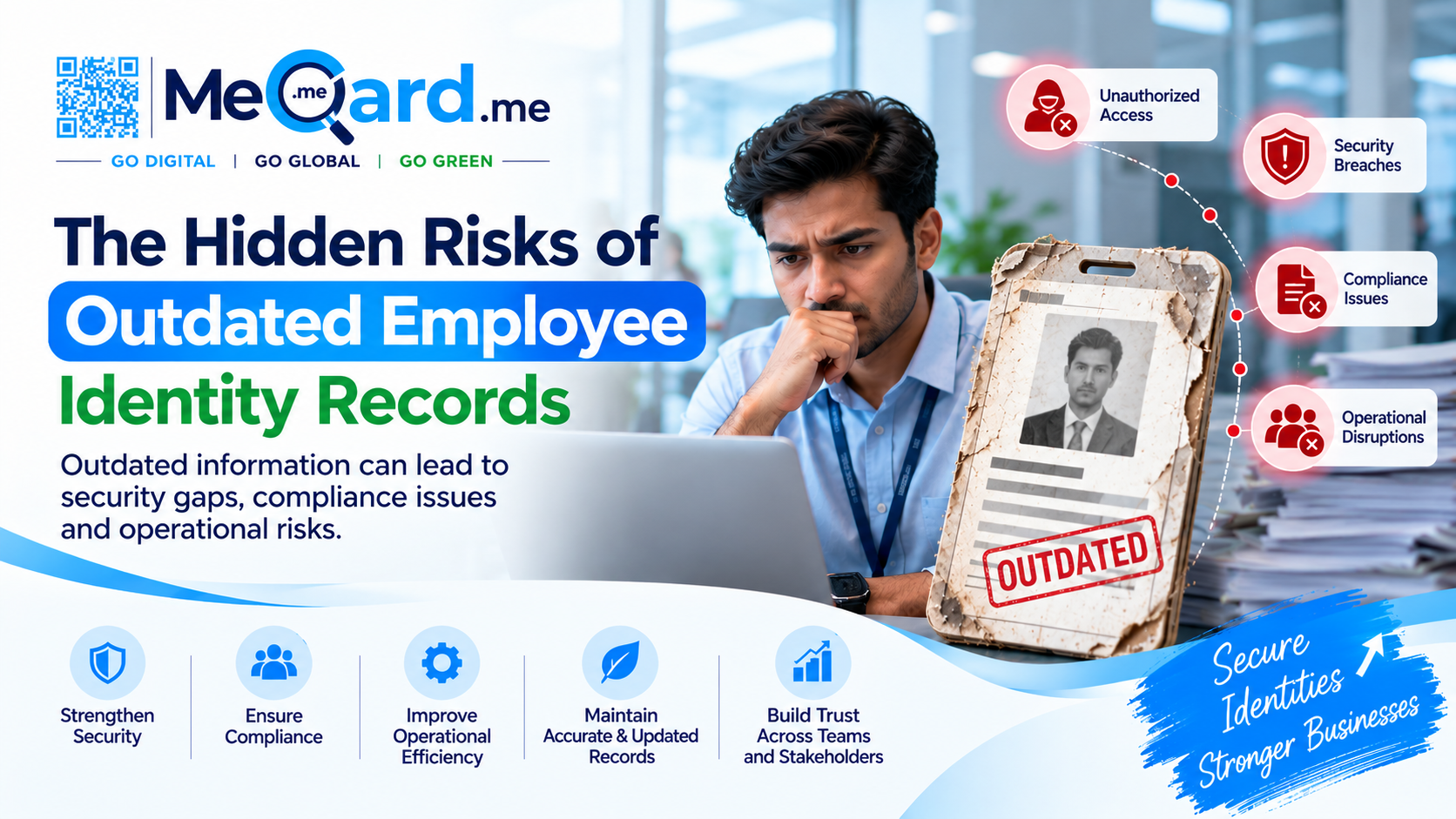
An employee gets promoted. Another moves to a different department. A third leaves the organization. Someone changes their phone number, branch, or reporting manager.
These are routine changes in every growing business. But what happens when the organization's employee identity records do not reflect them?
The former employee's ID may still appear valid. A digital profile may display an outdated designation. A contractor's identity record may remain active after their assignment ends. A customer may receive contact information that no longer belongs to the person representing the organization.
Individually, these issues may seem like administrative oversights. Across hundreds or thousands of employees, however, they can create challenges for security, customer trust, operational efficiency, and identity governance.
Outdated employee identity records are not simply a data maintenance problem. They can become an organizational risk.
As enterprises adopt digital workflows and manage increasingly distributed workforces, maintaining accurate employee identities requires more than updating spreadsheets or printing replacement cards. It requires a structured approach to employee identity management.
Outdated employee identity records are employee details or credentials that no longer accurately reflect a person's current identity, employment status, designation, responsibilities, or organizational affiliation.
These records may exist across HR systems, employee databases, printed ID cards, digital profiles, internal directories, contractor records, and other business systems. For example, a physical ID may remain in circulation long after an employee's departure because the information was never updated, synchronized, or deactivated when circumstances changed.
One of the most important risks arises when an employee leaves an organization but their identity credentials are not properly deactivated or withdrawn. A physical ID card cannot automatically communicate that its holder is no longer employed.
The risk can extend to former contractors, temporary workers, and field representatives. If an outdated credential remains in circulation, a third party may assume the individual still represents the organization, creating significant liability and security gaps.
Employee identity is often part of the customer's experience. Whether it is a banking representative or a service engineer, customers expect the information presented to be accurate and credible.
If an ID displays an outdated designation or obsolete contact information, the customer may question whether the person is genuine. Inconsistent identity information can make legitimate verification more difficult and create opportunities for impersonation.
Many organizations maintain employee information across multiple systems—HR, IT, Administration, and external vendors. When these processes operate independently, an updated designation in the HR system may not appear on a printed ID card or in the internal directory.
Centralized identity management helps organizations maintain a more consistent view of employee credentials and reduces dependence on disconnected manual processes.
An employee's designation communicates their professional role and authority. When a designation changes but identity records remain outdated, other people may misunderstand the employee's current position, leading to confusion during customer meetings, vendor interactions, and internal approvals.
Physical employee ID management involves a repetitive cycle of collecting data, printing, and distribution. For large organizations, this creates a recurring administrative burden. Digital identity solutions can reduce dependence on repeated physical printing and make identity updates easier to manage in real-time.
Contractors and outsourced staff represent the organization but aren't permanent employees. Their records need to reflect assignment duration and authorization status. Without a structured digital workflow, these credentials can remain active indefinitely after an assignment ends.
When records are scattered across spreadsheets and emails, established what was recorded at a specific point in time becomes difficult during audits. Digital platforms support administrative visibility through centralized management and activity logs.
Incorrect contact details or outdated organizational information can spread through internal directories and customer communication channels. Organizations benefit from defining a clear process for identifying changes and ensuring relevant identity records are refreshed.
The first step is establishing a reliable source of employee information. Next, identity updates should be connected to key workforce events (joining, promotion, transfer, and exit). Finally, organizations should implement centralized administration to improve visibility over active and retired credentials.
MeCard provides a digital identity management approach that helps organizations move beyond static, print-based ID cards.
MeCard provides centralized card management so HR and Administration teams can maintain oversight of all digital identities from a single platform.
Digital profiles can be updated instantly without reprinting physical cards, reducing the risk of employees sharing outdated information.
MeCard supports QR-based verification, allowing stakeholders to scan a code and access a live, authorized employee profile.
When an employee leaves, MeCard allows for instant revocation of digital credentials, significantly reducing the risk of unauthorized representation.
Outdated identity records are a risk that increases with organizational growth. A modern approach combines accurate source data with defined management policies and digital tools that reflect the real-time status of the workforce.
1. What are outdated employee identity records?
Records containing information that no longer reflects an employee's current role, branch, or affiliation.
2. Why are outdated employee ID cards a risk?
They create confusion and can be misused for unauthorized representation after an employee leaves the company.
3. Can digital employee ID cards be updated without reprinting?
Yes. Digital platforms allow real-time updates to the profile information without requiring a new physical card.
4. How does MeCard help manage employee identity?
Through centralized administration, real-time updates, QR-based verification, and instant ID revocation.
Eliminate the risks of outdated records and manual processes.
Explore MeCard's enterprise solutions for centralized digital identity, QR-based verification, and real-time lifecycle management.
MeCard — The smart choice for modern enterprise identity.
Phone: +91 77770 01366 / +91 77770 01369
Email: contact@mecard.me
Website: www.mecard.me