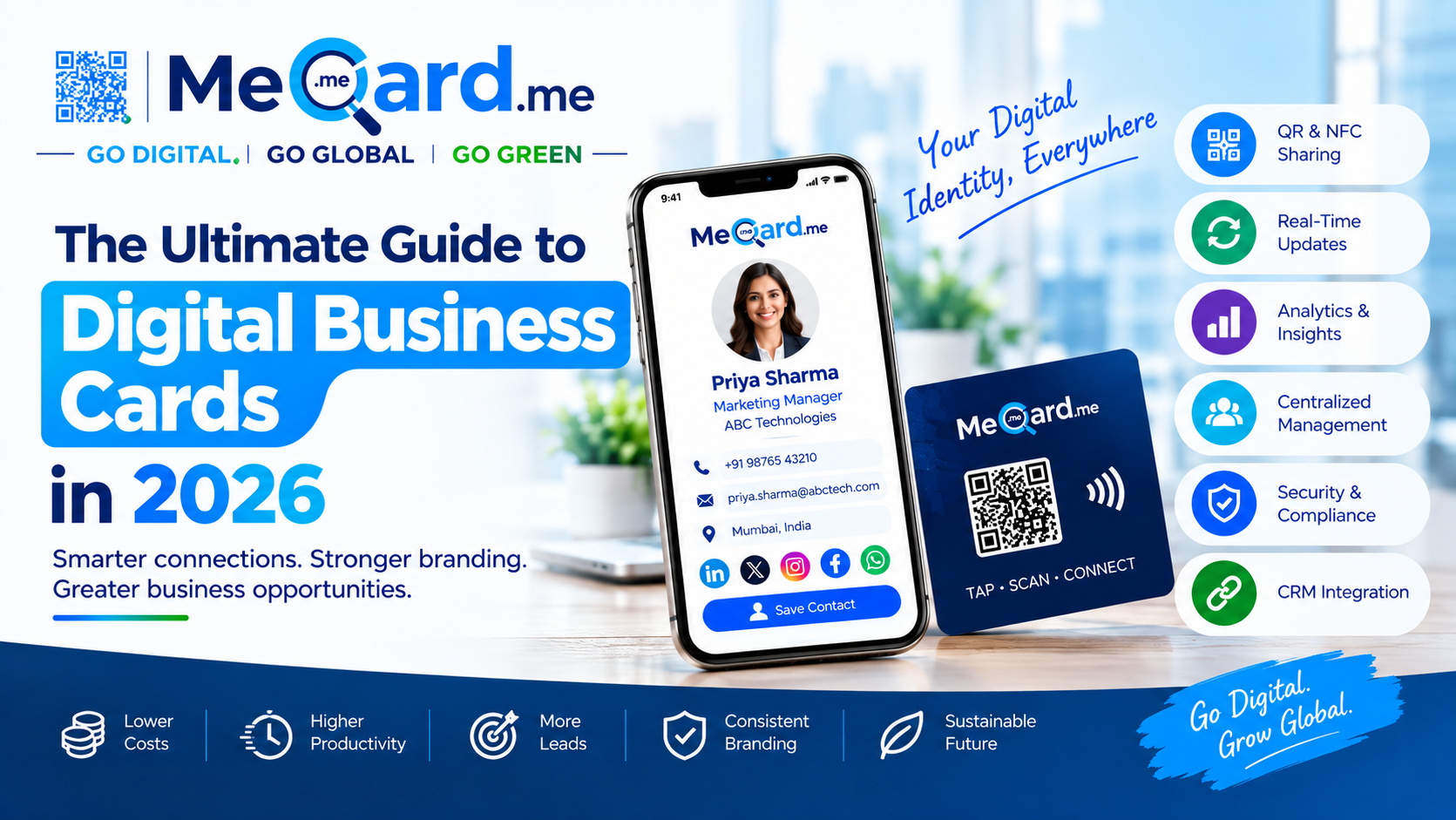
Everything individuals, sales professionals, HR teams and enterprises need to know about Digital Business Cards, digital identity, QR/NFC sharing, analytics and enterprise management.
The traditional business card has remained almost unchanged for decades. Name, designation, company, phone number, email address—and perhaps a website.
But the way businesses communicate has changed dramatically.
Professionals now connect through smartphones, QR codes, WhatsApp, LinkedIn, NFC, websites, video meetings, and digital platforms. Employees work across offices, cities, and countries. Sales teams attend conferences with hundreds of prospects. Executives need to maintain a consistent professional identity across multiple channels.
In this environment, a paper business card can become more of a limitation than a solution.
Digital Business Cards are transforming the traditional exchange of contact information into a connected digital identity experience.
In 2026, the conversation is no longer simply about replacing paper cards. It is about creating professional identities that are accessible, updateable, measurable, scalable, and connected to the wider business ecosystem.
For individuals, sales professionals, HR teams, startups, and enterprises, understanding how Digital Business Cards work—and what to look for in a platform—is becoming increasingly important.
A Digital Business Card is an online professional profile that allows an individual or organization to share contact and business information digitally.
Instead of handing someone a physical card, a professional can share their identity through a QR code, NFC tap, direct link, WhatsApp, email, SMS, or social media.
A Digital Business Card can contain much more information than a traditional card, including:
The major difference is that the information exists digitally and can be updated without requiring a completely new physical card.
Platforms such as MeCard also extend this concept into QR/NFC-enabled identity, centralized employee management, analytics, CRM connectivity, and broader enterprise digital identity capabilities.
The modern workplace is increasingly digital.
Employees may work remotely or across multiple branches. Sales professionals may interact with prospects through both physical and digital channels. Organizations may have hundreds or thousands of employees whose designations, contact details, departments, and locations change regularly.
Traditional cards create friction in these situations.
A printed card becomes outdated when an employee changes their phone number or designation. A rebrand may require thousands of cards to be redesigned and printed. When an employee leaves the organization, previously distributed cards remain in circulation.
A digital identity can address many of these challenges.
An organization can update information centrally, distribute cards digitally, manage employee access, and measure engagement. MeCard's enterprise platform, for example, supports centralized card management, employee permissions, real-time updates, analytics, bulk onboarding, and enterprise integrations.
This makes Digital Business Cards increasingly relevant not only for networking but also for identity management, sales enablement, branding, employee onboarding, and business communication.
The process is relatively simple.
An organization or professional creates a digital profile containing relevant business and contact information.
The platform generates a digital link and, where supported, a QR code or NFC-enabled sharing option.
During a meeting, conference, client interaction, or networking event, the professional shares their digital identity.
The recipient scans the QR code, taps an NFC-enabled card or device, clicks the shared link, or accesses the profile through a communication channel such as WhatsApp or email.
The recipient can then view the professional profile, save contact details, access company information, visit social profiles, explore products or services, or take an action such as sending an enquiry.
The important difference is that the recipient does not necessarily need to install an application simply to access the shared profile.
This makes digital sharing convenient across different professional environments.
The difference is not simply physical versus digital. It is about what happens after the exchange.
| Traditional Business Card | Digital Business Card |
|---|---|
| Printed information | Online information |
| Difficult to update | Can be updated digitally |
| Requires reprinting | No physical reprinting |
| Limited information | Rich digital content |
| No meaningful engagement tracking | Analytics can provide engagement insights |
| Physical distribution | QR, NFC, link and digital sharing |
| Difficult to manage at scale | Centralized management possible |
| Becomes outdated | Information can remain current |
| Primarily contact-focused | Can support networking, marketing and lead generation |
For an individual professional, the difference may simply mean convenience.
For an enterprise, however, the difference can become significantly larger.
Not every Digital Business Card platform provides the same capabilities.
If you are selecting a platform for professional or enterprise use, the following features deserve particular attention.
QR codes have become one of the simplest ways to connect physical interactions with digital experiences.
A professional can display a QR code on a phone, presentation, desk, event badge, brochure, or physical card.
The recipient simply scans the code to access the digital profile.
A strong Digital Business Card platform should make QR creation and sharing simple while keeping the underlying profile easy to update.
NFC provides another convenient way to share a digital identity.
Instead of scanning a QR code, a compatible smartphone can access the digital profile through a tap.
This can be particularly useful for executives, sales professionals, conferences, exhibitions, and face-to-face networking.
MeCard supports both QR and NFC-based sharing, giving professionals multiple ways to exchange their digital identity.
This is one of the biggest advantages of digital cards.
Imagine a sales executive changes their designation from Sales Manager to Regional Sales Head.
With a traditional card, new cards need to be printed and distributed.
With a digital card, the approved profile can be updated digitally.
The same applies to phone numbers, email addresses, office locations, websites, social profiles, and other information.
MeCard's enterprise platform specifically supports real-time updates to professional information.
Centralized management becomes extremely important when an organization has dozens, hundreds, or thousands of employees.
Instead of asking every employee to create and manage their own digital card, administrators can manage employee identities through a central dashboard.
Organizations can create, update, activate, block, retire, and manage cards according to their internal processes.
MeCard provides centralized card management, employee access permissions, bulk card issuing, and organization-wide administration capabilities.
One of the biggest limitations of paper business cards is that businesses rarely know what happens after a card is exchanged.
Was the contact saved? Was the website visited? Was the profile viewed? Did the prospect engage with the shared information?
Digital platforms can provide greater visibility into these interactions.
MeCard's Digital Business Card capabilities include analytics around QR scans, profile visits, and engagement activity, allowing organizations to move from simply distributing cards toward measuring digital networking activity.
For sales organizations, a Digital Business Card can become more valuable when it connects with existing business systems.
CRM integration can help connect professional networking with lead management and customer relationship workflows.
Instead of treating a card exchange as an isolated interaction, organizations can potentially connect that interaction to their broader sales process.
MeCard's enterprise offering includes CRM integration capabilities alongside centralized management and analytics.
Large organizations already maintain employee information within HRMS and identity systems.
Manually recreating employee information in another platform can create unnecessary administrative work.
Enterprise Digital Business Card platforms can integrate with systems such as HRMS and Active Directory to support employee identity management.
MeCard's Enterprise offering includes Active Directory and HRMS integration.
A Digital Business Card is also a brand touchpoint.
If ten employees from the same organization use ten different designs, the company may present an inconsistent professional image.
Enterprise platforms should therefore allow organizations to establish standardized templates, logos, colors, layouts, and approved information structures.
MeCard provides customized card templates as part of its Enterprise offering.
Unlike a traditional card, a digital profile can contain interactive content.
Organizations can use digital profiles to present videos, presentations, product information, websites, portfolios, social profiles, and other resources.
This turns the business card from a static contact document into a digital micro-profile for the professional or organization.
Sales professionals exchange business information constantly.
Conferences, exhibitions, client meetings, cold visits, networking events, demonstrations, and referrals can all generate new connections.
A Digital Business Card can make these interactions more actionable.
Instead of simply providing a phone number and email address, a sales professional can provide access to company information, product pages, brochures, social profiles, enquiry options, booking links, and other sales resources.
Analytics can also help organizations understand how digital identities are being used.
This creates a shift from:
“I gave the prospect my business card.”
to:
“The prospect interacted with my digital business profile.”
That difference matters because measurable interactions can become part of a broader sales and marketing process.
HR departments have a different challenge. They need to manage employee identity at scale.
New employees join. Employees change departments. Designations change. Employees relocate. People leave the organization.
A centralized Digital Business Card platform can help HR and administration teams manage these changes more efficiently.
For example, a new employee can receive a branded digital profile as part of onboarding. When their role changes, the profile can be updated. When they leave, the organization's digital identity can be deactivated according to internal processes.
MeCard positions its platform for HR use cases through centralized management, employee permissions, bulk card creation, analytics, customized templates, and enterprise integrations.
Executives frequently represent the organization at high-value meetings, investor discussions, conferences, industry events, and networking forums.
Their professional identity needs to be easy to share while maintaining corporate consistency.
A Digital Business Card can combine executive contact information with company details, website links, social profiles, media, and other relevant resources.
For senior management, the value is not merely convenience.
It is about ensuring that every professional interaction creates a consistent and accessible digital connection with the organization.
MeCard supports executive use cases through QR/NFC sharing, customized templates, centralized administration, analytics, and enterprise-level identity management.
The traditional business card was designed for physical interaction.
Modern teams increasingly operate across physical and digital environments.
A remote employee may meet a client over Zoom and share a digital profile through chat.
A hybrid employee may meet a prospect at an event and use QR or NFC.
A sales executive may connect with a prospect through LinkedIn and send a digital profile.
This flexibility makes Digital Business Cards particularly relevant to distributed organizations.
The identity remains accessible regardless of whether the interaction happens in an office, conference room, airport, event hall, or virtual meeting.
Corporate identity is not limited to websites and advertising.
Employees represent the brand every time they communicate with customers.
Their email signature, presentation, LinkedIn profile, business card, and professional introduction all contribute to the overall brand experience.
Centralized Digital Business Cards allow organizations to bring greater consistency to this touchpoint.
Instead of allowing employees to independently create their own profiles, companies can establish approved templates and information structures.
This makes the Digital Business Card part of a broader corporate identity management strategy.
Traditional business cards require paper, printing, logistics, storage, and repeated production whenever information changes.
For a large organization, these recurring activities can become significant over time.
Digital cards reduce dependence on printed networking materials and support a broader paperless communication strategy.
The sustainability argument alone should not determine a technology investment, but it can become an additional benefit when combined with lower administrative effort, easier updates, and digital accessibility.
A modern Digital Business Card can function as more than a contact profile.
It can act as a small digital landing page.
Consider a sales professional meeting a prospect at an industry conference.
The prospect scans the QR code and sees:
The interaction has now moved beyond exchanging contact details.
The Digital Business Card has become part of the customer journey.
This is particularly powerful when analytics and CRM integration are available.
Enterprises should not select a Digital Business Card platform purely because it looks attractive.
Security and governance should be evaluated as part of the buying decision.
Organizations should consider how employee information is stored, who can access it, how administrators manage permissions, how identities are deactivated, what integrations are available, and what security documentation the provider can offer.
For larger organizations, features such as role-based access, centralized administration, identity lifecycle management, auditability, and integration with existing enterprise systems become increasingly important.
MeCard's Enterprise offering includes access to its SOC 2 report, while its broader platform includes administrative controls, employee permissions, centralized management, and enterprise integrations.
Organizations should still conduct their own security, privacy, legal, and compliance assessment based on their specific requirements before deployment.
The right platform depends on the size and requirements of your organization.
An individual professional may primarily need a simple profile, QR code, contact sharing, social links, and an easy update mechanism.
A small business may require branding, analytics, multiple employees, and centralized administration.
A sales organization may prioritize lead capture, analytics, CRM integration, and multiple sharing methods.
A large enterprise may require centralized administration, bulk onboarding, role-based permissions, customized templates, HRMS/Active Directory integration, security controls, analytics, and scalability.
The important thing is to evaluate the platform rather than just the card design.
A visually attractive card is useful.
A scalable digital identity infrastructure is much more valuable for an enterprise.
MeCard.me approaches Digital Business Cards as part of a broader digital identity ecosystem rather than treating them simply as online replacements for paper cards.
Its platform supports Digital Business Cards, QR and NFC sharing, centralized employee management, real-time updates, analytics, CRM connectivity, and enterprise integrations.
For organizations, the platform can support different use cases across sales, HR, management, marketing, administration, and customer-facing teams.
Its Enterprise offering includes customized templates, Active Directory and HRMS integration, centralized management, dedicated customer success support, and access to its SOC 2 report.
This broader approach is important because enterprise identity is rarely limited to a single business card.
The same organization may need employee Digital Business Cards, Digital ID Cards, QR-enabled identities, visitor credentials, and other digital identity solutions.
The future therefore isn't simply about “going paperless.”
It is about building a connected digital identity infrastructure.
Digital Business Cards are likely to become increasingly integrated with the wider digital workplace.
QR codes will continue connecting physical environments with digital experiences.
NFC will make contact sharing increasingly seamless.
Analytics will make networking more measurable.
CRM integrations will connect interactions with sales workflows.
HRMS integrations will connect professional identity with employee lifecycle management.
AI and automation can further reduce manual processes around lead capture, engagement, and follow-up.
Most importantly, the Digital Business Card is likely to become less of a standalone product and more of a digital identity layer connecting people, organizations, customers, and business systems.
The Digital Business Card of 2026 is fundamentally different from the traditional visiting card.
It is not simply a digital version of a piece of paper.
It can become a professional identity, networking tool, brand touchpoint, lead-generation channel, employee-management asset, and measurable business interaction.
For individuals, it provides convenience.
For sales teams, it can support engagement and lead generation.
For HR teams, it can simplify employee identity management.
For enterprises, it can create centralized control, consistency, scalability, and connectivity.
The most important question for organizations is therefore no longer:
“Should we replace our paper business cards?”
The better question is:
“How can we turn every professional interaction into a connected digital business experience?”
That is where Digital Business Cards are heading in 2026—and platforms such as MeCard.me are helping organizations make that transition from traditional business cards to modern digital identity ecosystems.
A Digital Business Card is an online professional profile that allows individuals and organizations to share contact details, company information, social links, websites, products and other digital resources through QR codes, NFC, links and digital channels.
A professional creates a digital profile and receives a shareable link, QR code, or NFC-enabled identity. The recipient can access the profile using a smartphone without necessarily installing an app.
A traditional business card contains static printed information and requires reprinting when details change. A Digital Business Card can be updated digitally, contain richer content, support QR and NFC sharing, and provide analytics and engagement insights.
Yes. One of the primary advantages of Digital Business Cards is that approved profile information can be updated without printing and distributing a new physical card.
Yes. QR codes provide a simple way for professionals to connect physical interactions with their digital profile.
An NFC Digital Business Card uses Near Field Communication to allow compatible smartphones to access a digital profile through a simple tap.
Yes. Enterprise platforms such as MeCard allow organizations to centrally create, update, issue, activate, block and manage employee Digital Business Cards.
Yes. A Digital Business Card can include enquiry buttons, product information, websites, brochures, booking links and other resources, helping turn a simple contact exchange into a broader digital customer interaction.
Many enterprise Digital Business Card platforms provide analytics around profile views, QR scans and engagement activity. MeCard provides analytics capabilities to help organizations understand digital card engagement.
Enterprise Digital Business Card platforms can integrate with CRM systems to connect professional networking and digital interactions with broader sales workflows.
Yes. MeCard's Enterprise offering includes HRMS and Active Directory integration capabilities for organizations that want to connect employee identity management with existing systems.
Yes. Digital Business Cards can be shared through links, QR codes, NFC, WhatsApp, email, SMS and social platforms, making them suitable for both physical and virtual interactions.
Organizations should evaluate more than card design. Important considerations include centralized management, real-time updates, analytics, QR/NFC sharing, branding, employee permissions, CRM and HRMS integrations, security, scalability and administrative controls.
Digital Business Cards are becoming an important part of modern professional networking and digital identity. Their ability to combine contact sharing, branding, analytics, lead generation, employee management and enterprise integrations makes them significantly broader than traditional paper cards.
Phone: +91 77770 01366 / +91 77770 01369
Email: contact@mecard.me
Website: www.mecard.me