A customer receives a call from a sales executive. A relationship manager visits a customer. A loan officer arrives at a borrower's workplace. A collection agent visits someone's home. A business development executive meets a prospect at an event.
Before the conversation begins, there is often an unspoken question: “How do I know this person actually represents the organization?”
That question matters more than ever. Customers today are surrounded by digital interactions, remote communication, field representatives and online transactions. They expect organizations to provide not only convenience, but also transparency about who they are interacting with.
A printed business card or physical employee ID can communicate basic information. But it does not automatically provide a dynamic way to verify whether that information is current or whether the person is still associated with the organization. This is where verified digital identity becomes important.
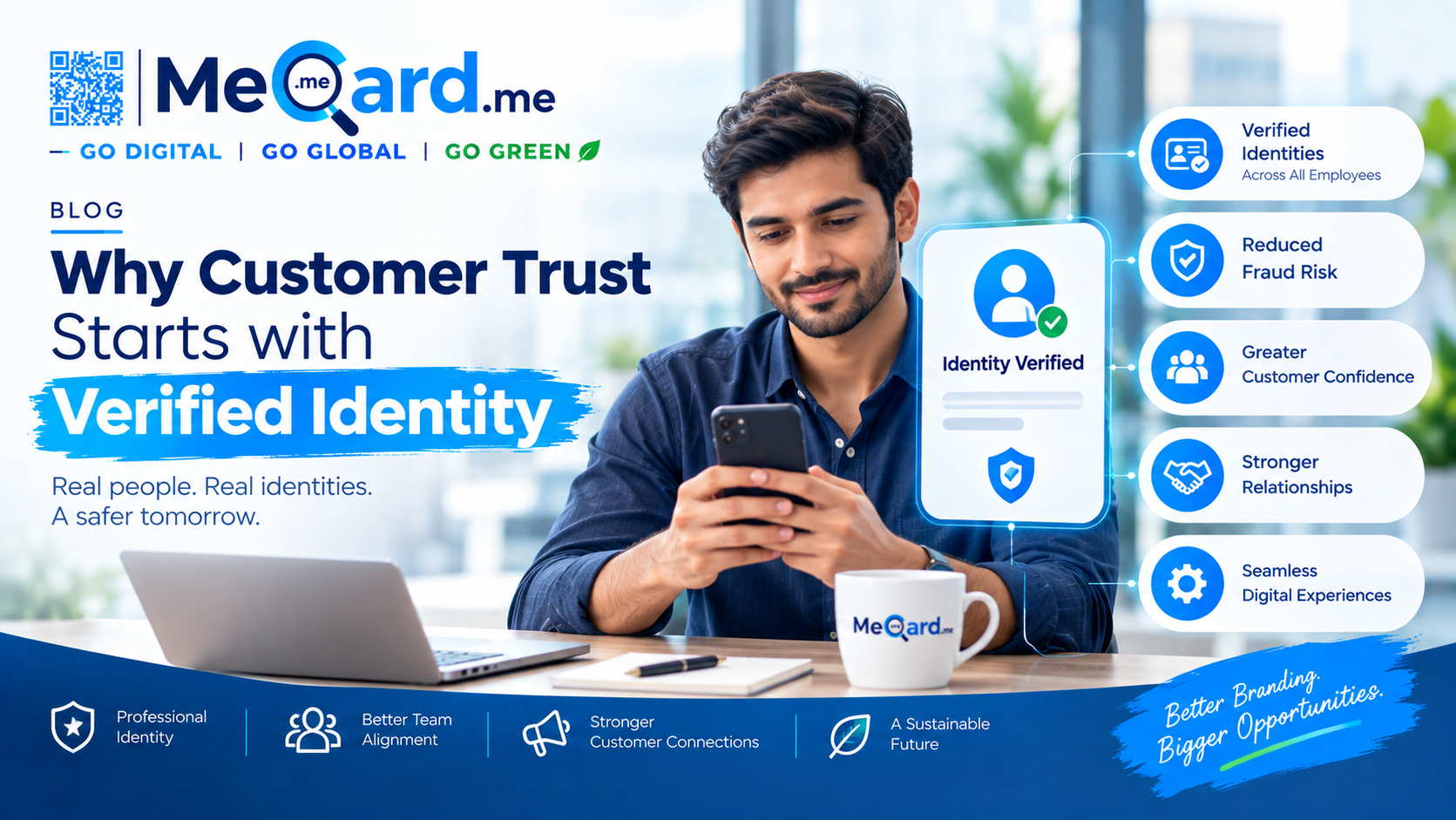
MeCard enables organizations to create Digital Business Cards and Digital IDs with QR-based verification, centralized management and real-time profile updates, helping create a more transparent identity experience between organizations and the people they serve.
Identification tells customers who someone claims to be. Verification gives them a way to check relevant information.
Trust isn't created only by a company's advertising or reputation. It is created during individual interactions. A customer may trust an organization because its employee:
These small signals can influence how comfortable a customer feels continuing a conversation. Consider two scenarios:
In the first, a field representative simply shows a laminated ID card. In the second, the representative presents a Digital ID with a QR code. The customer scans it and accesses the configured organization-controlled digital profile. The second experience introduces a verification mechanism into the interaction.
MeCard's banking and finance solution specifically describes QR verification as a way for customers to verify employee identities and access official employee and organizational information.
Physical ID cards still have a practical role in many organizations, but they have limitations. A physical card can become outdated when an employee:
The card itself does not automatically change. A customer looking at that card may have no simple way of knowing whether the information is still valid. MeCard's Digital ID platform is designed to address this challenge through remotely managed digital identities, QR verification, real-time updates and identity revocation. This creates an important shift: From static identification to dynamic identity management.
QR codes are already familiar to customers. They are used for payments, websites, and event registrations. The same familiarity can be applied to professional identity.
MeCard's QR solution connects QR codes with digital information such as Digital Business Cards, Employee Identity, company details, and other configured content. For an employee, the interaction is straightforward:
Present Digital ID → Scan QR → Access Digital Profile → Check Relevant Information → Continue Interaction
No complicated process is required from the customer's perspective. The QR code becomes a bridge between the physical interaction and the organization's digital identity system.
The need for identity verification is particularly important when employees operate outside the office. A customer walking into a company's office can verify an employee through reception or signage, but a meeting at home or a business premises has fewer immediate verification signals. This is particularly relevant to:
Verification isn't useful if the information being verified is outdated. Imagine a customer scans an employee's Digital ID and sees a designation or branch that has already changed.
The value of digital identity depends not just on creating a digital profile, but on maintaining it. MeCard supports centralized management and real-time updates for Digital Business Cards and Digital IDs, allowing organizations to treat identity as a living organizational record.
One of the most important parts of identity management is what happens when an employee leaves. With physical cards, organizations must rely on the card being returned. A centrally managed digital identity can be deactivated or revoked instantly.
MeCard's Digital ID solution supports remote management and revocation of issued IDs, creating a controlled identity lifecycle:
Employee joins → Identity created → Identity verified → Information updated → Employee exits → Identity revoked.
There is another distinction organizations should consider: Who is this person? and What are they authorized to do?
This becomes especially important in collection and recovery operations. MeCard's Digital ID solution allows the agent's identity to be linked with authorization information, while administrators can centrally manage active, inactive and blocked agents. This turns the interaction into: “Here is my organization-controlled digital identity and relevant authorization information.”
If every employee manages their identity independently, maintaining accuracy is difficult. A centralized platform provides administrators with control over:
This means the organization can manage identity at the source rather than relying entirely on employees to keep their own professional information current.
MeCard brings Digital Business Cards and Digital Identity Management into a connected ecosystem. Organizations can use the platform for:
Verified identity can give customers an additional way to confirm relevant information about the person representing an organization, particularly during field or remote interactions.
An employee presents a QR-enabled Digital ID. The customer scans the code and accesses the configured digital profile and organizational information. MeCard supports this model for employee identity and banking use cases.
Yes. MeCard supports centralized management and real-time updates to digital identity information.
Yes. MeCard supports remote management and revocation of issued Digital IDs, allowing organizations to deactivate identities instantly when required.
No. Employee or organizational identity verification is different from customer KYC. Digital identity should be implemented alongside the organization's applicable security and regulatory processes.
Connected identity. Real-time verification. Centralized control.
MeCard helps organizations bridge the gap between physical interactions and digital trust. Whether you manage a sales team, a field force, or an entire enterprise, our platform ensures your representatives are always backed by a verifiable digital identity.
Visit MeCard.me to explore our solutions for Digital Business Cards and Employee IDs.
Phone: +91 77770 01366 / +91 77770 01369
Email: contact@mecard.me