Professional networking has changed dramatically.
Business conversations now happen across boardrooms, conferences, WhatsApp, LinkedIn, video calls, client meetings, exhibitions, and hybrid workplaces. Yet many professionals and organizations still rely on a small printed card to communicate their identity.
That is where Digital Business Cards have become increasingly relevant.
A digital business card is more than a digital version of a traditional visiting card. Modern platforms can combine professional identity, contact information, social profiles, websites, multimedia, QR codes, NFC sharing, analytics, lead generation, and enterprise administration into one digital profile.
But with numerous digital card platforms available in 2026, choosing the right one can be difficult.
The question is no longer simply “Which platform creates the best-looking digital card?”
The better question is:
“Which Digital Business Card platform can support my professional networking needs today and scale with my organization tomorrow?”
A Digital Business Card platform allows professionals or organizations to create, manage, and share professional identities digitally.
Instead of printing hundreds of cards containing static information, users can create a digital profile that can be accessed through a QR code, link, NFC tap, or other digital channels.
Depending on the platform, the profile can contain contact details, company information, social media links, websites, videos, product information, appointment links, and other interactive content.
MeCard, for example, supports QR sharing, NFC technology, WhatsApp integration, instant contact saving, and digital professional profiles.
For individuals, this provides convenience.
For businesses, however, the requirements are much greater.
An enterprise may need to create hundreds or thousands of employee cards, maintain brand consistency, update information centrally, control employee permissions, track engagement, and integrate digital identities with existing systems.
That is why the platform matters more than the card itself.
A basic digital card can solve one problem: sharing contact information.
An enterprise-ready platform can solve several.
Imagine a company with 500 employees.
Employees change designations. Phone numbers change. People move between departments. New employees join. Others leave. Company branding changes. Sales teams attend events. Marketing teams need to promote campaigns. HR needs employee onboarding. Management wants analytics.
If every employee manages their own digital card independently, the organization can quickly lose control.
A centralized platform can instead provide a consistent digital identity infrastructure.
MeCard's enterprise platform provides centralized management, real-time updates, employee access controls, QR identity creation, analytics, customization, and CRM integration.
Therefore, the right platform should be evaluated based on functionality, security, scalability, integrations, management, analytics, and long-term business value.
Before comparing platforms, determine why you need a Digital Business Card.
An individual freelancer has very different requirements from a multinational organization.
A professional may simply need:
A digital profile, contact details, QR sharing, social links, and contact saving.
A sales team may additionally need:
Lead-generation links, product information, WhatsApp integration, analytics, and CRM connectivity.
An enterprise may require:
Centralized administration, employee onboarding, role-based permissions, bulk card creation, HRMS integration, security controls, analytics, and immediate deactivation.
This distinction is critical.
Choosing an enterprise platform for a single professional may create unnecessary complexity.
Choosing a basic individual tool for a 1,000-person organization can create serious management problems.
A good Digital Business Card should not force users into one sharing method.
Different networking situations require different approaches.
At a conference, QR sharing may be convenient.
During a face-to-face meeting, NFC can provide a seamless tap-to-share experience.
During a WhatsApp conversation, a direct digital link may be more practical.
On LinkedIn or email, a profile URL can make the identity accessible with one click.
MeCard supports QR codes, NFC, WhatsApp, email, SMS, social platforms, and direct links as sharing methods.
The more flexible the sharing experience, the easier it becomes for employees to adopt the platform.
One of the biggest disadvantages of traditional business cards is that information becomes outdated.
An employee changes their designation.
The organization changes its office address.
A salesperson gets a new phone number.
A company updates its website.
A printed card cannot automatically reflect these changes.
A digital profile can.
MeCard's enterprise solution allows organizations to centrally update job titles, contact information, and links in real time.
This is particularly important for large organizations where printing and distributing replacement cards can become an ongoing administrative process.
This is one of the most important criteria for businesses.
Ask:
Can administrators create employee cards?
Can they update them?
Can they block or retire cards?
Can they manage employees in bulk?
Can employees update their information only when authorized?
Can management maintain a consistent company template?
MeCard provides a business dashboard that allows administrators to create, issue, manage, and block cards while controlling employee access permissions.
For a small company, this may simply improve administration.
For a large organization, it can become essential for brand governance and identity management.
QR codes have become one of the simplest ways to connect physical and digital experiences.
A QR code can be placed on:
Employee IDs.
Business cards.
Conference badges.
Marketing materials.
Product packaging.
Office displays.
Email signatures.
Presentation slides.
When scanned, the recipient can access the individual's digital profile.
However, don't simply ask whether a platform offers a QR code.
Ask whether the QR code is dynamic, customizable, trackable, and connected to the digital profile.
MeCard supports unique QR identities for companies and employees and allows QR codes to be used across different physical touchpoints.
QR codes are highly versatile, but NFC adds another dimension to digital networking.
An NFC-enabled card can allow a compatible smartphone to access a professional profile through a simple tap.
This can be particularly useful for executives, sales professionals, consultants, exhibitors, and professionals attending networking events.
MeCard combines QR-based sharing with NFC technology, giving users multiple ways to exchange their professional identity.
The important consideration is not whether NFC is trendy. It is whether the platform gives your employees multiple convenient ways to share their identity.
A Digital Business Card represents your organization. That means design consistency matters.
Imagine a company where 300 employees use different logos, colors, layouts, descriptions, and contact structures.
Even if every card technically works, the organization can appear fragmented.
A business-focused platform should allow organizations to establish standardized templates while still providing appropriate employee-level information.
MeCard's enterprise offering includes customized card templates and centralized administration.
For larger organizations, this turns Digital Business Cards into more than networking tools.
They become part of the company's digital brand identity system.
A modern Digital Business Card should not be restricted to name, phone number, email address, and website.
The best platforms allow businesses to create richer digital experiences.
Depending on your requirements, a professional profile could include company information, social profiles, videos, product catalogs, presentations, portfolios, enquiry links, WhatsApp connections, booking links, and other relevant resources.
This turns the card from a simple contact-sharing mechanism into a digital business profile.
For sales teams, this can make the first interaction significantly more valuable.
Traditional business cards provide almost no visibility after they are exchanged.
You don't know whether the recipient visited your website.
You don't know whether they clicked your LinkedIn profile.
You don't know which employee's networking activity generates the most engagement.
Digital platforms can introduce measurable engagement.
MeCard's enterprise offering includes analytics capabilities for tracking card activity and engagement.
For sales and marketing teams, this can provide useful insight into how digital identities contribute to customer interactions.
The value therefore shifts from:
“I gave someone my business card.”
to:
“I created a measurable digital touchpoint with a potential customer.”
A Digital Business Card should ideally fit into your existing technology ecosystem.
If your sales team already uses a CRM, manually transferring contacts from networking events into the CRM creates unnecessary work.
A more mature platform can connect digital identity and lead information with existing business processes.
MeCard's enterprise offering includes CRM integration for syncing card and lead data with the CRM environment.
For organizations heavily dependent on sales pipelines and customer relationship management, this can be an important selection criterion.
For enterprise organizations, employee information is often already maintained in HRMS, Active Directory, or other organizational systems.
The ideal Digital Business Card platform should minimize duplicate data entry.
MeCard's Enterprise plan includes integration with Active Directory and HRMS.
This can help connect employee lifecycle management with professional digital identity.
For example:
Employee joins → employee record is created → Digital Business Card is issued → employee information changes → card is updated → employee leaves → identity is retired.
This is significantly more scalable than manually managing hundreds of individual profiles.
Digital identity contains professional and organizational information. Therefore, security should not be treated as an optional feature.
When evaluating a platform, organizations should investigate:
How data is stored.
Who can access employee information.
What administrative controls exist.
How employee permissions are managed.
How identities can be deactivated.
What security certifications or reports are available.
What integrations are supported.
What happens when an employee leaves.
MeCard's current enterprise offering includes access to its SOC 2 report, while its broader site also lists ISO 9001:2015 and ISO/IEC 27001:2013 certifications.
Organizations should independently review the current documentation and determine whether the platform's controls meet their specific security and compliance requirements.
A platform may work perfectly for 10 employees but become difficult to manage at 1,000.
Ask how the platform handles:
Bulk employee creation.
Centralized administration.
Multiple departments.
Multiple locations.
Employee permissions.
Large-scale updates.
Analytics.
Integrations.
Identity deactivation.
Enterprise support.
MeCard offers plans ranging from individual users to business accounts and an Enterprise offering designed for organizations with 100+ users, including customized templates and Active Directory/HRMS integration.
The important point is to select a platform based on where your organization is going, not only where it is today.
Even the most powerful platform will fail if employees don't want to use it.
The experience should be simple.
Creating a profile should not require extensive technical knowledge.
Sharing should take seconds.
The recipient should not face unnecessary friction.
The digital card should load quickly on mobile devices.
QR and NFC interactions should feel intuitive.
This matters because Digital Business Cards succeed through adoption.
If employees find the platform complicated, organizations may continue relying on traditional cards even after purchasing a digital solution.
Price is important, but the cheapest platform is not necessarily the most cost-effective.
Instead of asking only:
“How much does one digital card cost?”
consider:
How much does employee administration cost?
How much time is spent updating employee information?
How much does replacing physical cards cost?
How much does onboarding cost?
Can the platform integrate with existing systems?
Does it provide analytics?
Does it support centralized management?
Does it scale without creating administrative complexity?
MeCard currently offers individual and business plans as well as an Enterprise offering, with enterprise functionality including customized templates, Active Directory and HRMS integration, and dedicated customer-success support.
The correct comparison is therefore total business value rather than subscription price alone.
Before selecting a platform in 2026, businesses should evaluate whether it provides the capabilities they actually need.
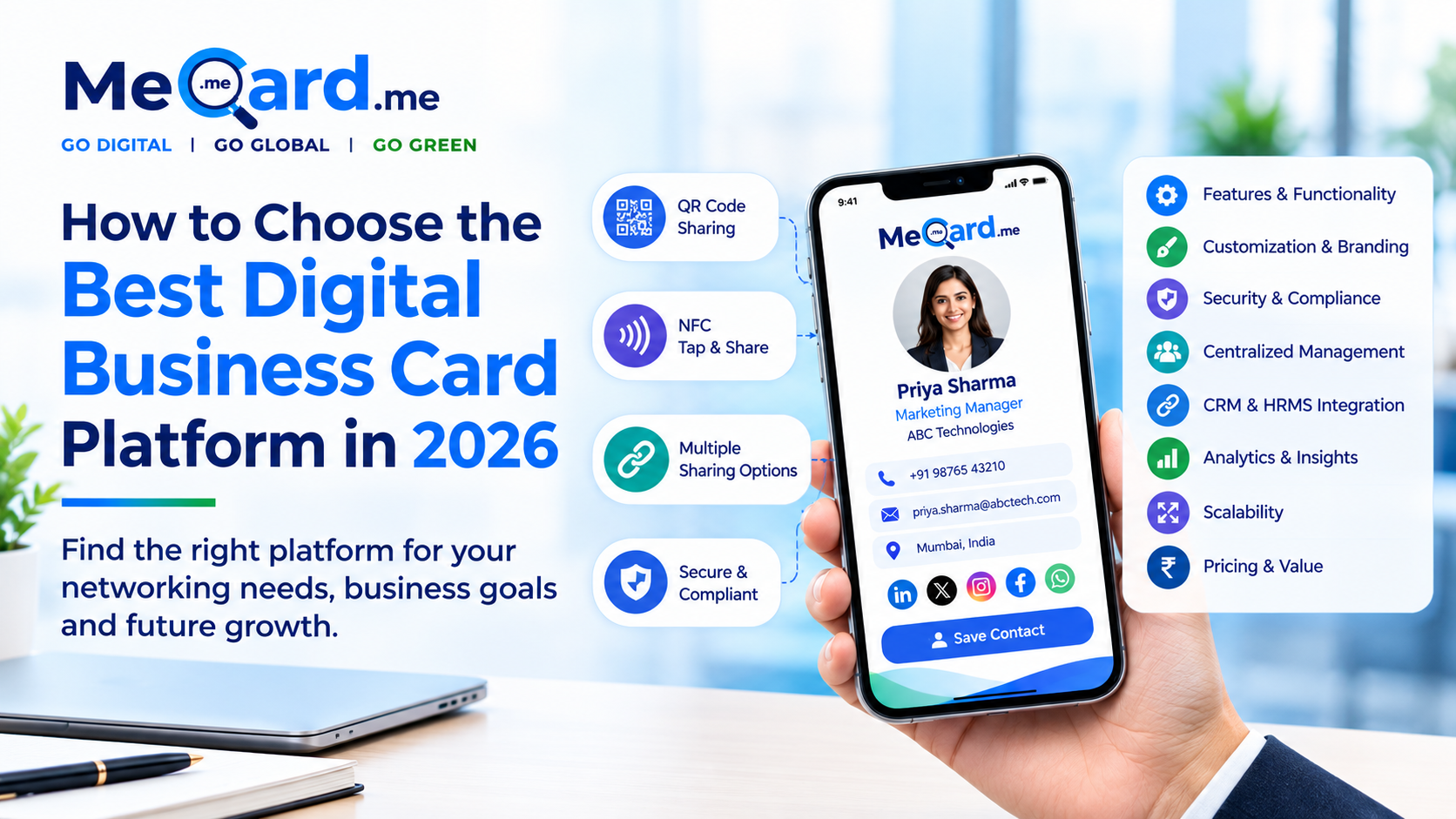
A strong platform should ideally support QR sharing, NFC, real-time updates, customization, centralized administration, employee permissions, analytics, security controls, integrations, scalability, and multiple sharing channels.
For enterprise deployments, CRM integration, HRMS/Active Directory integration, bulk employee management, role-based controls, and identity lifecycle management become particularly important.
The platform should also provide a user experience that employees and customers can adopt without unnecessary complexity.
For organizations looking beyond a simple digital visiting card, MeCard positions its platform as a broader digital identity ecosystem.
Its Digital Business Card solution supports QR codes, NFC, contact saving, WhatsApp integration, social profiles, and digital professional information.
For businesses, the platform adds centralized management, employee cards, analytics, QR identities, access permissions, and company-level administration.
At the enterprise level, MeCard provides customized templates, centralized card management, real-time updates, CRM integration, Active Directory and HRMS integration, and enterprise support capabilities.
This makes MeCard relevant not only for individual professionals but also for sales teams, HR departments, executives, startups, SMEs, and large enterprises seeking a centralized digital identity platform.
Digital Business Cards are becoming more than replacements for paper visiting cards.
They are evolving into digital identity touchpoints that connect people, organizations, websites, social platforms, sales resources, customer interactions, and business systems.
QR codes make identity instantly accessible.
NFC makes sharing more seamless.
Analytics make networking measurable.
Centralized administration makes enterprise management possible.
Integrations connect digital identity with existing business infrastructure.
And real-time updates ensure that the information representing an organization remains current.
This shift reflects a broader movement toward contactless and digitally connected business communication in 2026.
There is no single Digital Business Card platform that is automatically best for every user.
The right choice depends on your organization's size, objectives, security requirements, networking model, integrations, budget, and future growth.
For an individual professional, simplicity and sharing may be the highest priorities.
For a sales team, analytics and lead generation may matter more.
For an enterprise, centralized management, security, customization, integrations, employee permissions, scalability, and lifecycle management become critical.
The best Digital Business Card platform in 2026 is therefore not simply the one with the most attractive card design.
It is the platform that can turn professional identity into a secure, manageable, measurable, and scalable digital business asset.
For businesses looking for that broader approach, MeCard provides Digital Business Card, QR, NFC, Digital ID, centralized enterprise management, analytics, and integration capabilities within a single digital card ecosystem, making it a strong option for organizations moving beyond traditional paper-based networking.
In 2026, the business card is no longer just something you hand to someone.
It is becoming part of your digital identity—and the platform behind it matters.
Phone: +91 77770 01366 / +91 77770 01369
Email: contact@mecard.me
Website: www.mecard.me