Global organizations no longer operate within a single market, language, or communication environment. Employees collaborate across countries, sales teams meet international clients, and executives participate in global conferences where the first interaction can happen in seconds.
In this environment, the traditional business card has a major limitation: it usually communicates in only one language and contains static information.
A digital card can change that.
A well-designed, multi-language Digital Business Card can help organizations create more inclusive communication, strengthen international branding, improve customer experience, and make professional identity easier to access across markets.
For enterprises expanding globally, multilingual digital identity is becoming more than a convenience. It can become an important part of how the organization presents itself.
Language influences how customers understand information, interact with brands, and build trust.
Imagine a sales executive from an Indian company meeting a potential customer in Japan, Germany, France, or the Middle East. The executive can share a digital profile instantly through a QR code, NFC tap, WhatsApp, email, or direct link. But if the profile is available only in English, the recipient may still have to interpret important information themselves.
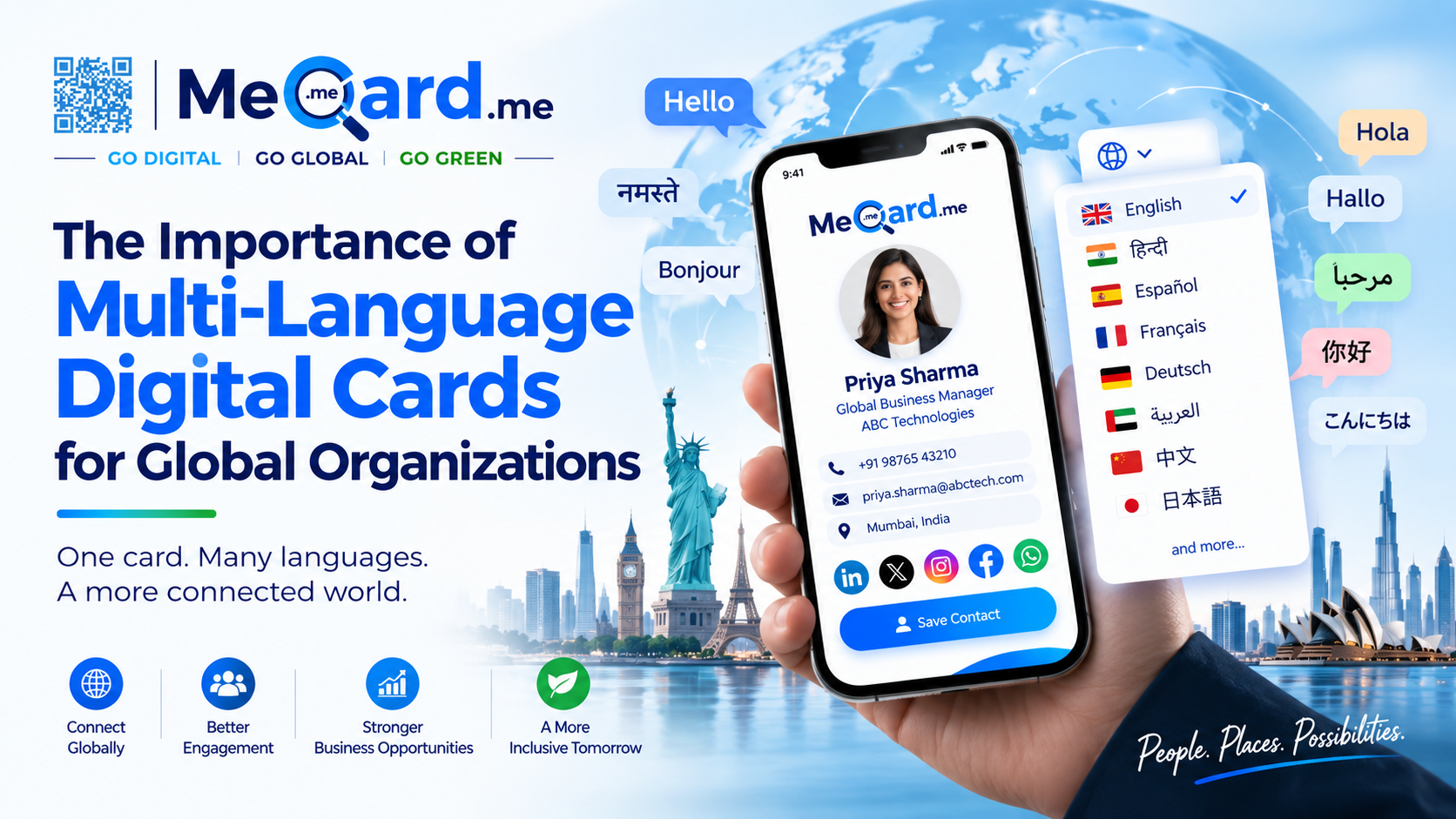
A multi-language digital card can make the experience more accessible by presenting relevant professional information in the recipient's preferred language.
This can include the employee's designation, company information, products or services, contact details, website links, location, appointment options, marketing content, and other relevant information.
The objective isn't simply to translate every word.
The objective is to make the digital identity of the organization easier to understand and engage with across markets.
A multi-language digital card is a digital professional identity that can present relevant business and contact information in more than one language.
Instead of creating completely separate physical business cards for every market, an organization can use a digital profile that provides localized information while maintaining consistent corporate branding.
For example, a global organization could have an employee's core corporate identity available in English while also providing localized versions for customers in Hindi, Arabic, French, German, Spanish, Japanese, or other relevant languages.
The underlying identity remains consistent, while the communication experience can be adapted to the audience.
This approach becomes particularly valuable for multinational corporations, global sales teams, international consultants, exporters, financial institutions, technology companies, hospitality businesses, healthcare organizations, and organizations operating across regional markets.
Traditional visiting cards were designed for a much simpler business environment.
An employee typically received a fixed number of cards containing their name, designation, phone number, email address, company address, and logo.
But global organizations face constant change.
Employees move between departments. Job titles change. Offices relocate. Phone numbers change. Companies launch new products. Websites are redesigned. Employees travel across countries. Marketing messages change from one market to another.
With physical cards, every change creates another printing requirement.
Language creates another problem.
An organization operating across five countries may need multiple versions of the same business card. This creates additional design, printing, inventory, distribution, and administrative requirements.
Digital cards remove much of this friction because the underlying information can be updated without reprinting the card. MeCard, for example, states that digital business card information such as phone numbers, email addresses, websites, office locations, and social links can be updated in real time.
The first benefit is straightforward: better accessibility.
When a potential customer can access professional information in a familiar language, the interaction becomes easier.
Consider an international sales meeting.
Instead of receiving a paper card and manually searching for the company online, a customer can scan a QR code and immediately access the employee's digital profile.
The profile can provide the information required to continue the conversation, including contact details, social profiles, company information, product links, location, and other digital resources.
MeCard's Digital Business Card platform already supports QR sharing, NFC, social media integration, direct links, WhatsApp, email, SMS, and other digital sharing methods.
Adding a multilingual experience to this model can make the same digital interaction more useful across international markets.
One of the biggest challenges for multinational organizations is balancing global brand consistency with local relevance.
A company wants every employee to represent the same corporate identity.
At the same time, customers in different markets may expect localized communication.
Digital cards provide an opportunity to combine both.
The organization's logo, brand colors, design language, employee identity, corporate messaging, and approved information can remain standardized, while selected content can be presented for different audiences.
This is particularly important for large enterprises where hundreds or thousands of employees may represent the organization.
MeCard's enterprise platform is designed around centralized administration, customization, real-time updates, CRM integration, multi-platform access, security, and scalability.
This centralized approach can help organizations maintain greater control over their digital identity as teams expand across regions.
Sales teams are among the biggest beneficiaries of multilingual digital cards.
A salesperson may interact with customers from several countries during a single conference or business trip.
Instead of carrying different printed cards, the salesperson can use one digital identity that can be accessed digitally and adapted to different audiences.
The interaction can start through a QR scan or NFC tap and continue through a digital profile containing relevant contact information, product pages, social profiles, brochures, appointment options, or lead-generation actions.
This transforms the business card from a simple contact-exchange tool into a digital sales touchpoint.
MeCard also provides QR scan and engagement analytics, allowing organizations to track profile visits, QR views, engagement activity, and scan notifications.
That creates another advantage for global organizations: networking can become measurable.
International exhibitions, conferences, trade shows, and business summits bring together people from different countries and industries.
At these events, employees may exchange dozens or hundreds of contacts.
A multilingual digital card can make these interactions more meaningful.
A visitor scans the QR code, opens the employee's profile, understands the company information in a familiar language, saves the contact, and continues the conversation digitally.
This is considerably more flexible than distributing different physical cards based on the nationality of every visitor.
For organizations participating in multiple international events, digital cards can therefore become part of their broader event and lead-generation strategy.
Globalization doesn't mean everyone communicates in the same language.
Organizations increasingly operate with multilingual employees, customers, suppliers, partners, distributors, contractors, and stakeholders.
A digital identity strategy that recognizes this reality can create a more inclusive professional experience.
The same principle can extend beyond Digital Business Cards.
A broader digital card ecosystem can include employee identity cards, visitor passes, membership cards, health cards, insurance cards, and other digital credentials.
MeCard positions its platform as a broader digital card and identity ecosystem rather than only a networking product.
Its platform includes Digital Business Cards, Digital ID Cards, Visitor Passes, Membership Cards, Health and Insurance Cards, Parking QR Tags, and other digital identity solutions.
This creates opportunities for organizations to think about multilingual digital identity across multiple business processes.
Trust is particularly important when entering new markets.
Customers want to understand:
A professional digital profile can bring these answers together.
When relevant information is presented clearly and in an accessible language, the customer experience becomes more transparent.
For international organizations, this can help reduce communication barriers during the early stages of a business relationship.
Consider a company operating across 10 countries.
With traditional business cards, it may require different designs, languages, contact information, office addresses, and print batches.
Now consider employee movement between regions.
An employee transfers from Singapore to Dubai. Their office address changes. Their regional responsibility changes. Their designation changes.
A physical-card system requires new printing and distribution.
A digital card can be updated centrally.
MeCard's enterprise solution specifically emphasizes centralized management and real-time updates, allowing organizations to manage large numbers of digital cards from an administrative dashboard.
This can significantly simplify identity management for geographically distributed teams.
Language is only one part of the global networking challenge.
Accessibility also matters.
A digital card needs to be easy to share.
MeCard supports QR-code sharing and NFC tap technology, allowing users to exchange digital contact information without relying on physical paper cards.
QR codes are particularly useful at conferences, exhibitions, presentations, offices, packaging, marketing materials, and digital screens.
NFC can make face-to-face networking even faster by allowing compatible devices to access a digital profile through a tap.
Together, these technologies make digital identity more practical for international business environments.
A digital card can also become a miniature marketing platform.
Instead of simply showing a phone number and email address, the profile can connect visitors to:
MeCard supports adding company information, product catalogs, portfolio links, payment links, websites, social profiles, and other information to digital business card profiles.
For global organizations, localized versions of these resources can make the digital profile even more useful.
For example, a customer in Germany could be directed toward German-language product information, while a customer in Japan could receive localized resources.
One of the strongest advantages of digital cards over traditional cards is measurement.
A physical visiting card can tell you that contact information was exchanged. It cannot easily tell you whether the recipient visited the website, viewed the profile, engaged with content, or returned later.
Digital platforms can provide significantly more visibility.
MeCard's Digital Business Card platform includes QR scan and card analytics, including QR views, profile visits, engagement activity, and scan notifications.
For a multinational organization, this data can potentially be analyzed by region, event, employee, campaign, or market.
That allows organizations to ask better questions:
This moves digital cards from being merely a networking tool toward becoming a measurable business asset.
For organizations looking to build a scalable digital card ecosystem, MeCard provides several capabilities that align with global enterprise requirements.
Its enterprise offering includes customizable digital cards, centralized management, real-time updates, CRM integration, security controls, multi-platform access, and scalability.
MeCard also supports QR and NFC-based sharing, allowing digital profiles to be accessed across physical and digital networking environments.
Its broader platform extends beyond Digital Business Cards into Digital IDs, Visitor Passes, Membership Cards, Health and Insurance Cards, and other digital identity use cases.
MeCard's published content also identifies multi-language support as one of its platform capabilities, reinforcing its positioning for organizations with broader geographic and communication requirements.
For enterprises, the larger opportunity is therefore not simply replacing paper business cards. It is creating a centralized digital identity infrastructure that can support employees, customers, partners, and other stakeholders across markets.
Global business communication is becoming increasingly mobile, connected, and personalized.
Employees may work from different countries. Customers may discover companies through QR codes. Sales meetings may happen through hybrid events. Business relationships may begin through LinkedIn, WhatsApp, email, or a conference.
Professional identity needs to work across all these environments.
A multi-language Digital Business Card provides a practical way to bridge language and geographic barriers while maintaining a consistent corporate identity.
For global organizations, the value goes beyond translation.
It is about accessibility, consistency, customer experience, scalability, analytics, and operational efficiency.
The organizations that treat digital cards as part of their broader digital identity strategy can create a more connected experience for employees and customers across markets.
The business card is evolving from a static piece of printed paper into a dynamic digital identity.
For organizations operating across multiple countries, languages, and cultures, that evolution becomes even more important.
Multi-language Digital Cards can help organizations communicate more effectively with international audiences, maintain consistent branding, simplify employee identity management, support global sales teams, improve event networking, and create measurable digital engagement.
With QR and NFC sharing, real-time updates, analytics, centralized management, CRM integration, and scalable enterprise capabilities, MeCard provides a foundation for organizations looking to modernize professional identity and networking.
For a global organization, going digital is only the first step. The next step is making that digital identity accessible to everyone, everywhere, in the language they understand.
Phone: +91 77770 01366 / +91 77770 01369
Email: contact@mecard.me
Website: www.mecard.me