
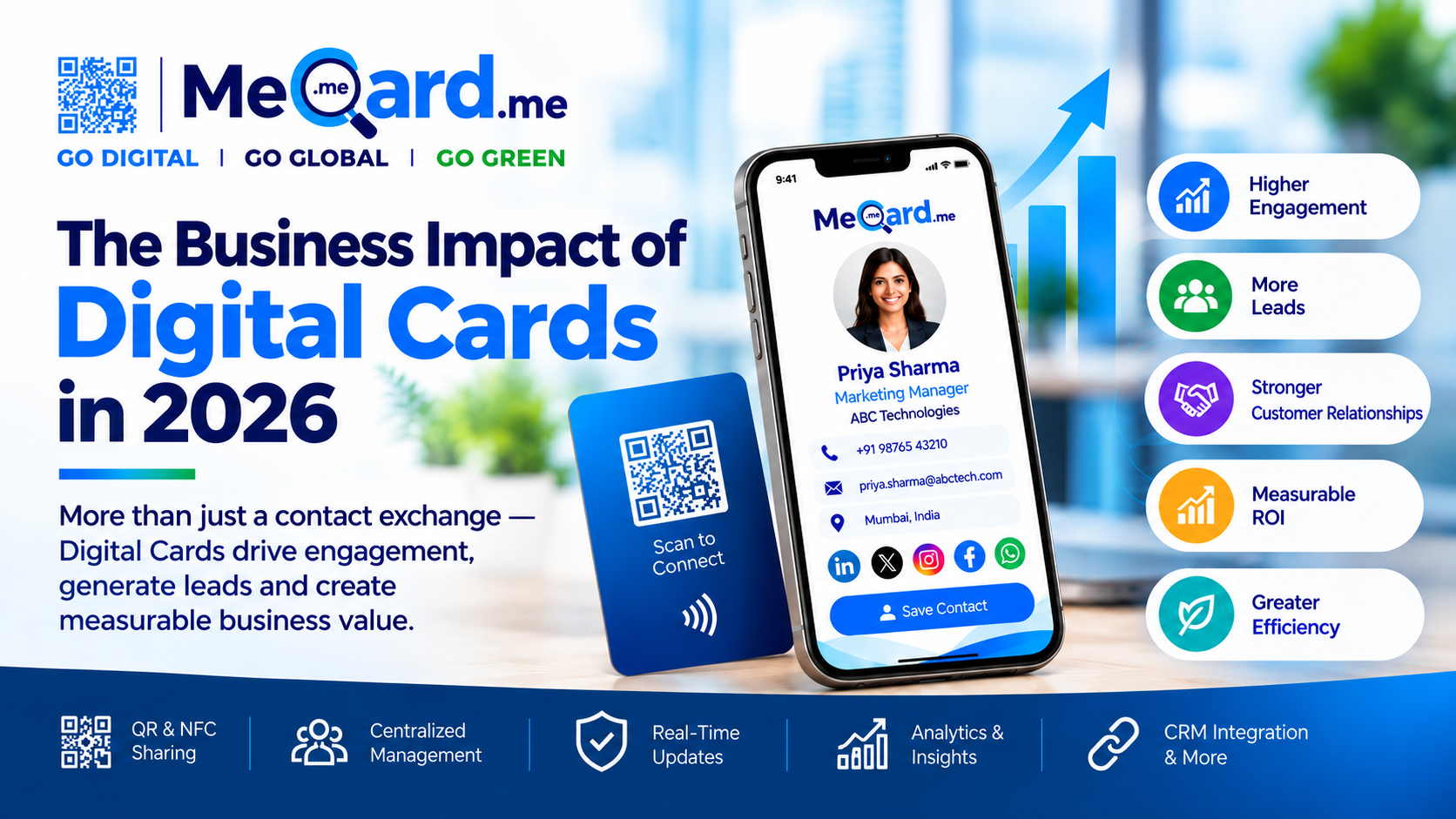
For decades, business cards have been one of the simplest tools used to initiate professional relationships.
A sales executive meets a prospect, a business card is exchanged, and the conversation continues later.
But there has always been one major problem: businesses could not measure what happened after the card was exchanged.
Was the card saved? Did the prospect visit the company's website? Did they click LinkedIn? Did they contact the salesperson? Did the interaction eventually become a qualified lead?
Traditional business cards provide almost no answers.
In 2026, Digital Business Cards are changing that model.
Modern digital card platforms can connect professional identity with QR codes, NFC, websites, social profiles, lead-generation resources, analytics, and customer engagement. MeCard, for example, provides QR and NFC sharing, real-time profile updates, card analytics, centralized business management, and multiple digital identity solutions.
This means organizations can begin treating digital networking as a measurable business activity rather than an untracked networking expense.
Businesses already measure almost everything else.
Marketing teams track website traffic. Sales teams monitor pipeline activity. Advertising teams measure conversions. Customer-success teams measure engagement. HR teams track employee performance.
Yet professional networking has traditionally remained difficult to quantify.
A salesperson might distribute 200 business cards at a trade exhibition, but the organization may never know how many recipients actually followed up.
Digital Cards introduce a new possibility.
Every interaction can become a measurable digital touchpoint.
Instead of simply asking: “How many cards did our employees distribute?”
organizations can begin asking: “What business activity did those digital interactions generate?”
That shift is what makes Digital Cards strategically important in 2026.
The first step is understanding that there is no single metric that determines the success of a Digital Business Card strategy.
The right measurement framework should follow the complete journey:
Card Share → Profile Visit → Engagement → Lead → Follow-Up → Opportunity → Revenue
This allows businesses to move beyond vanity metrics and evaluate actual business impact.
The simplest metric is how often a Digital Business Card is viewed.
Suppose a company's sales team has 100 employees with digital profiles. During one quarter, their profiles generate 10,000 visits. That immediately provides information that traditional cards cannot provide.
Businesses can compare activity across employees, departments, locations, campaigns, and events.
MeCard's business platform provides analytics around card activity and allows organizations to monitor digital-card usage through its centralized dashboard.
However, views alone should not be treated as business success. A thousand profile visits with no meaningful engagement may be less valuable than 100 visits that generate qualified leads.
QR codes are becoming one of the most practical bridges between physical and digital networking.
A QR code can appear on an employee ID, presentation, exhibition badge, printed material, product brochure, email signature, or physical card.
When someone scans it, the interaction can lead directly to a digital profile.
Tracking QR scans allows organizations to understand which touchpoints are generating engagement.
For example, a company could compare:
Trade-show QR scans vs. conference QR scans vs. employee-card scans vs. marketing-campaign scans.
MeCard supports QR-based digital identities and provides scan and engagement analytics for Digital Business Cards.
This makes QR activity an important KPI for organizations running events and offline-to-online campaigns.
A profile visit is only the beginning.
What does the visitor actually do?
They may:
These interactions provide a much stronger indication of business value.
A modern Digital Business Card can therefore function as a miniature digital landing page for every employee.
Instead of simply displaying a phone number and email address, it can provide multiple paths for continuing the business relationship.
One of the most useful metrics is how frequently recipients save a professional contact.
Imagine two employees each receive 500 profile visits. Employee A generates 50 saved contacts. Employee B generates 200.
The difference can reveal something about networking effectiveness, audience quality, messaging, or professional engagement.
A business could calculate:
Contact-Save Rate = Contacts Saved ÷ Profile Visits × 100
Over time, this can help sales and business-development teams understand which networking activities are generating stronger relationships.
This is where Digital Cards can become significantly more valuable.
A Digital Business Card can contain enquiry forms, WhatsApp links, booking links, product information, service pages, brochures, and other conversion opportunities.
Instead of ending the interaction when someone receives a card, the digital profile can encourage the prospect to take another action.
MeCard describes its platform as supporting lead capture, customer engagement, follow-ups, and AI-powered automation.
This changes the role of the business card from a contact-sharing tool into a potential lead-generation touchpoint.
Generating leads is important, but qualified opportunities matter more.
Suppose a sales team generates 1,000 Digital Card interactions in a quarter.
Those interactions generate 200 enquiries. Of those enquiries, 50 become qualified opportunities.
The organization can now begin measuring the business impact of its networking activity.
A useful metric is:
Lead-to-Opportunity Rate = Qualified Opportunities ÷ Digital Card Leads × 100
This helps businesses determine whether Digital Card interactions are attracting the right audience.
The ultimate question for many businesses is:
Did Digital Card engagement contribute to revenue?
If a Digital Card interaction can be connected to a CRM record, businesses can potentially follow the customer journey from initial networking interaction through sales qualification and eventual conversion.
MeCard's enterprise ecosystem includes CRM integration capabilities and lead/contact management features designed to connect digital identity with business workflows.
This creates the possibility of measuring:
Digital Card interaction → Lead → Opportunity → Customer
That is a much stronger measurement model than simply counting the number of cards distributed.
Digital Cards can also be evaluated from a marketing-efficiency perspective.
Suppose an organization spends ₹1,00,000 on a networking campaign and generates 100 qualified leads.
The cost per qualified lead is:
₹1,000 per lead
Now compare that with another campaign that uses Digital Cards and generates 250 qualified leads from the same overall investment.
The business can begin evaluating which approach produces better efficiency.
This is particularly useful for exhibitions, conferences, sales campaigns, and corporate networking events.
Business impact isn't limited to revenue.
There can also be operational savings.
Traditional business cards require:
When an employee changes their phone number, designation, department, or office location, the physical card can become outdated.
Digital profiles can be updated without printing new cards. MeCard specifically supports real-time updates to phone numbers, email addresses, websites, office locations, and social profiles.
Organizations can therefore calculate:
Annual Printing Cost + Replacement Cost + Distribution Cost + Administrative Cost
and compare that against the cost of digital identity management.
One of the more interesting opportunities for enterprises is measuring networking activity at the employee level.
Consider a sales organization with 500 representatives.
Management can potentially analyze:
MeCard's enterprise platform includes analytics intended to help organizations evaluate card usage, sales activity, branches, and employee performance.
This can transform Digital Cards from a simple communication tool into an additional source of business intelligence.
Digital Cards can also be used in marketing campaigns.
For example, an organization participating in an industry exhibition could create a dedicated QR code or digital experience for the event.
After the event, the organization can evaluate:
This makes networking events more measurable.
Instead of saying: “We distributed 2,000 business cards.”
the marketing team can report: “The event generated 1,200 digital interactions, 350 qualified contacts, and 45 sales opportunities.”
That is a significantly more valuable business report.
Not every Digital Card interaction immediately becomes a lead.
Some visitors may interact with the company's website, LinkedIn page, product catalogue, or social channels without submitting an enquiry.
These interactions still matter.
A Digital Business Card can function as a controlled corporate touchpoint where every employee profile reinforces the company's branding.
MeCard supports company branding, social links, websites, customizable profiles, and centralized management across teams.
This creates another measurement opportunity:
How much digital engagement is being generated through employee identities?
Different departments can have different networking objectives.
Sales teams may focus on lead generation. HR may focus on recruitment. Senior management may focus on investor and partner relationships. Marketing may focus on campaign engagement. Customer-success teams may focus on customer accessibility.
Therefore, organizations should not necessarily use the same KPI for every employee.
A role-specific Digital Card strategy can make measurement more meaningful.
MeCard's designation-based access approach allows organizations to create Digital Business Cards based on employee roles and responsibilities, enabling different information and resources to be presented to different audiences.
This creates an opportunity to measure performance according to business function.
The most important calculation is ultimately ROI.
A simplified Digital Card ROI formula can be:
Digital Card ROI = (Financial Benefits − Digital Card Investment) ÷ Digital Card Investment × 100
Financial benefits can include:
The challenge is correctly attributing revenue.
Digital Cards should not automatically receive credit for every sale that follows a networking interaction.
Instead, organizations should establish clear attribution rules and connect Digital Card engagement with CRM and sales data wherever possible.
For larger organizations, a dedicated dashboard can bring everything together.
A useful dashboard could display:
This creates a much clearer picture of how Digital Cards contribute to the business.
The biggest shift happening in 2026 is that Digital Business Cards are no longer limited to contact exchange.
They can become data-generating business assets.
A traditional card answers one question:
“How can I contact this person?”
A modern Digital Card can answer much more:
That is the difference between digitizing a card and digitizing the networking process.
MeCard combines Digital Business Cards with centralized enterprise management, QR and NFC sharing, real-time updates, analytics, and digital identity capabilities.
Its Digital Business Card platform provides QR scan analytics, profile visits, engagement activity, and notifications, giving businesses greater visibility into how their digital identities are being used.
For larger organizations, the platform extends beyond individual profiles with centralized administration, employee permissions, QR identities, analytics, and broader digital identity management.
This allows businesses to approach Digital Cards as part of a broader digital identity and business networking infrastructure, rather than treating them as simply a replacement for printed visiting cards.
Business networking is entering a more measurable era.
Marketing teams can no longer afford to evaluate networking solely through the number of cards distributed.
Sales teams need visibility into the quality of interactions. HR teams need efficient employee identity management. Management needs measurable business outcomes. And employees need simple ways to share professional information across physical and digital environments.
Digital Cards bring these requirements together.
Together, these capabilities can transform networking into a measurable component of the broader customer journey. MeCard's platform is designed around this combination of digital identity, networking, analytics, and centralized management.
The real value of Digital Business Cards in 2026 is not simply that they eliminate paper.
Their greater value lies in their ability to make professional identity and networking measurable.
Businesses can track profile views, QR scans, contact saves, engagement, leads, opportunities, conversions, employee networking activity, and operational savings.
More importantly, these metrics can connect networking with the broader business ecosystem.
The business card is no longer necessarily the end of a conversation. It can become the beginning of a measurable digital customer journey.
For organizations looking to make that transition, MeCard provides a strong enterprise-oriented Digital Business Card and digital identity platform combining QR, NFC, real-time updates, analytics, centralized management, and business integrations.
In 2026, the question is no longer:
“How many business cards did we distribute?”
The more valuable question is:
“How much business did our professional connections create?”
Phone: +91 77770 01366 / +91 77770 01369
Email: contact@mecard.me
Website: www.mecard.me