For decades, the business card has been one of the simplest tools used to introduce a company and its employees.
A name. A designation. A phone number. An email address. A logo.
But modern organizations operate very differently.
Employees work across locations. Sales teams meet prospects through multiple channels. Companies constantly update their branding. HR teams onboard and offboard employees. Customers expect instant digital communication. And management increasingly wants measurable data from every customer interaction.
This creates an important question:
Is your company's traditional business card still keeping up with the way your organization operates?
If your organization is experiencing several of the signs below, it may be time to consider Digital Business Cards and a centralized digital card platform.
This may sound like a small operational problem, but for organizations with large sales, business development, field, or relationship-management teams, it can become a recurring administrative burden.
Employees attend conferences, client meetings, exhibitions, networking events, branch visits, and sales meetings. Physical cards need to be ordered, printed, stored, distributed, and replenished.
When an employee runs out of cards at the wrong time, an important networking opportunity can become less convenient.
Digital Cards remove the dependence on physical inventory.
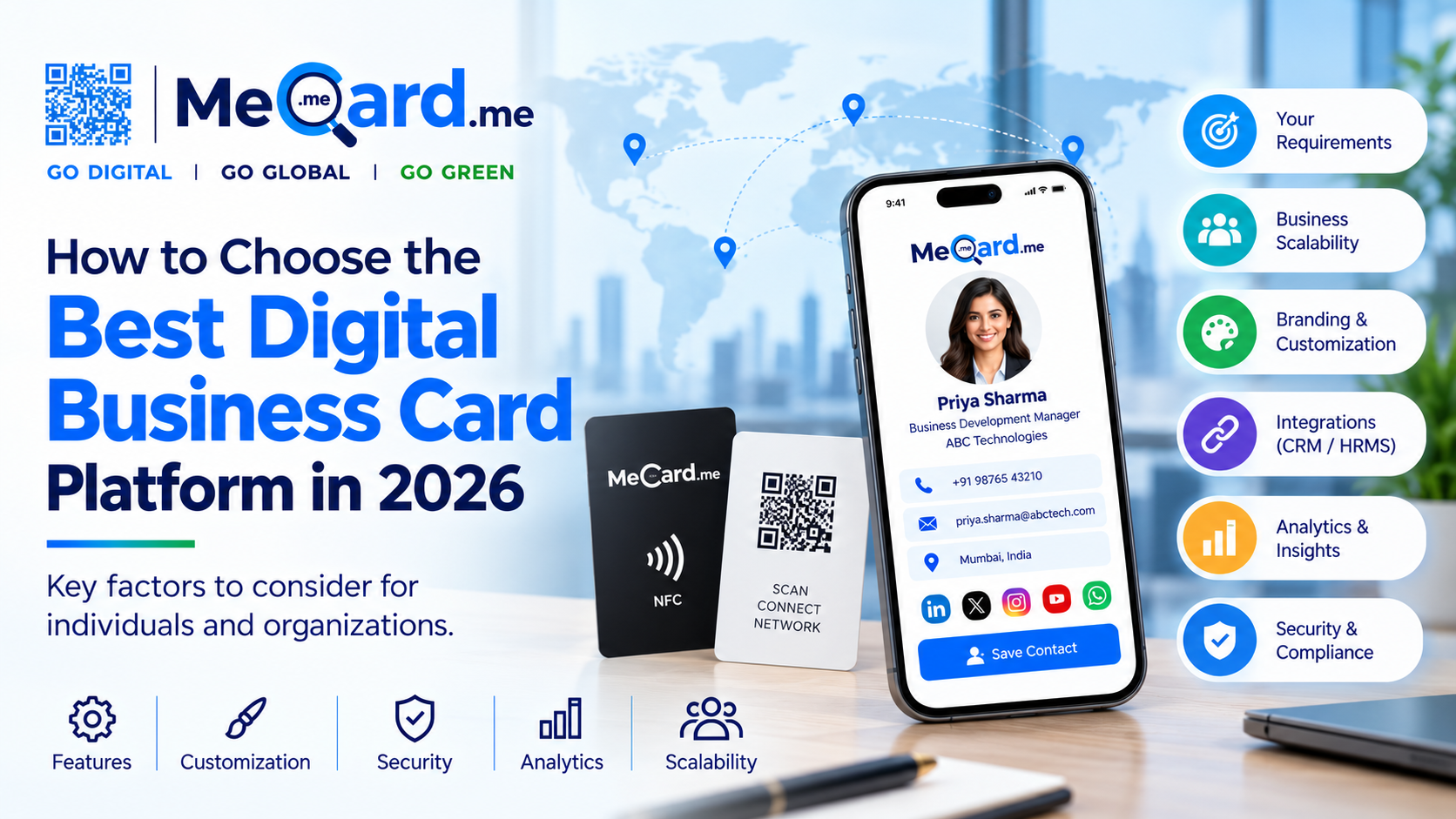
Employees can share their professional identity through a QR code, NFC, link, WhatsApp, email, or other digital channels. MeCard supports QR-code sharing, NFC technology, WhatsApp integration, direct links, and instant contact saving.
If your company is constantly printing and distributing business cards, digital cards can significantly simplify the process.
Employees get promoted.
Phone numbers change.
Departments change.
Office locations change.
People move into new roles.
Yet the physical business cards already distributed to customers remain unchanged.
This creates a frustrating situation: the organization may have dozens or hundreds of customers holding outdated information.
A Digital Business Card solves this differently.
Instead of replacing the physical card, the information behind the digital profile can be updated.
MeCard's platform allows phone numbers, email addresses, websites, office locations, and social links to be updated in real time.
That means the same digital identity can remain useful even as the employee's professional information changes.
If your employees frequently receive new business cards because their information changes, that's a strong signal that your organization needs a more dynamic solution.
Imagine meeting five employees from the same organization.
One has an old business card. Another uses a different logo. Someone else has a different font. Another employee has an outdated company description.
The result is not just inconsistent design. It can weaken the perception of corporate professionalism.
For larger organizations, maintaining consistent branding across hundreds or thousands of employees becomes increasingly difficult when everyone depends on independently printed cards.
A centralized Digital Card platform can help standardize the experience.
MeCard's enterprise platform provides centralized management and customizable card templates so organizations can maintain consistent corporate identity across employee profiles.
If maintaining consistent employee branding has become difficult, centralized Digital Cards can help bring control back to the organization.
HR and administration teams already manage employee onboarding, transfers, promotions, department changes, and exits.
If business cards are managed manually on top of these processes, even simple employee changes can create additional administrative work.
Consider a new employee joining the sales department.
The company may need to collect their information, design the card, send it for printing, receive the cards, distribute them, and repeat the process whenever information changes.
Digital identity can shorten this process.
MeCard supports centralized employee card creation, bulk data management, employee access permissions, and enterprise integrations such as Active Directory and HRMS on its Enterprise offering.
This can make Digital Cards particularly relevant for organizations with large or frequently changing workforces.
If HR or administration is still manually coordinating business cards for every employee, your organization may have outgrown the traditional process.
This is one of the biggest limitations of traditional business cards.
An employee gives a prospect a card.
And then what?
Did the prospect visit the company website? Did they view the employee's profile? Did they click a link? Did they engage with the company's information? Did the interaction eventually produce a lead?
Traditional cards provide almost no visibility.
Digital Cards can create measurable touchpoints.
MeCard provides QR and card analytics that can include QR views, profile visits, engagement activity, and scan notifications.
This allows organizations to move from simply exchanging contact information toward understanding how professional networking generates engagement.
If your sales and marketing teams want measurable networking data, traditional business cards are becoming increasingly limited.
Sales teams often meet potential customers at conferences, exhibitions, networking events, meetings, and client visits.
But once a physical business card is exchanged, connecting that interaction to the broader sales funnel can be difficult.
A Digital Business Card can provide a digital bridge between the initial introduction and the next business action.
The profile can include company information, product pages, websites, enquiry options, social profiles, appointment links, and other resources.
MeCard's Digital Business Card platform supports rich digital profiles and analytics designed to turn networking interactions into measurable digital touchpoints.
For sales organizations, this creates an opportunity to connect networking with lead-generation workflows.
If your company spends heavily on events and networking but cannot easily measure what happens after the initial contact, Digital Cards are worth considering.
Managing professional identity becomes more complicated as an organization grows.
A company may have:
Using physical cards across all these groups creates additional complexity.
A centralized digital system can provide a common identity framework while allowing relevant information to differ by employee, department, role, or location.
MeCard describes its enterprise platform as capable of managing and updating thousands of cards through a centralized dashboard while supporting teams and regions at scale.
If your organization has expanded beyond a single location, centralized Digital Card management can become much more valuable.
This is an often-overlooked problem.
An employee leaves the organization.
But customers may still have that employee's physical business card.
They may call the old number. They may email the former employee. They may assume that person still represents the company.
With centrally managed digital identity, organizations can deactivate an employee's digital profile when their association with the organization ends.
MeCard's enterprise approach supports creating, updating, and retiring digital cards through centralized administration.
This can be particularly important for sales teams, collection teams, field employees, relationship managers, and other customer-facing roles.
If employee exits regularly create identity or contact-management challenges, your company should consider centrally managed Digital Cards.
The cost of a business card is rarely just the printing price.
There are design changes, reprints, delivery, storage, distribution, outdated inventory, and disposal.
Multiply that across hundreds or thousands of employees and the operational cost becomes more significant.
Digital Cards reduce the organization's dependence on physical printing.
Instead of ordering new cards every time information changes, organizations can update digital profiles centrally.
MeCard positions its enterprise Digital Card platform as a paperless alternative that can reduce the need for constant reprints while supporting digital identity management.
For organizations with sustainability objectives, this can also contribute to broader paper-reduction initiatives.
If your company is actively looking for ways to reduce printing and paper-based processes, Digital Cards are a natural place to start.
Perhaps the strongest sign is that your organization is thinking beyond business cards.
Modern organizations increasingly need different forms of digital identity.
An employee may require a Digital ID.
A sales executive needs a Digital Business Card.
A visitor needs a Visitor Pass.
A member may require a Membership Card.
A customer may need an Insurance or Health Card.
A parking facility may use QR-based access.
Managing these as completely separate systems can create unnecessary complexity.
MeCard positions its platform as a broader Digital Card ecosystem supporting Digital Business Cards, Employee ID Cards, Visitor Passes, Membership Cards, Emergency Cards, Health and Insurance Cards, Parking QR Tags, and other digital identity use cases.
This changes the conversation from:
"How do we replace our business cards?"
to:
"How do we modernize our organization's digital identity?"
The value of Digital Cards goes beyond replacing paper.
A well-designed enterprise Digital Card strategy can help organizations create a more connected professional identity.
MeCard combines these capabilities through features such as centralized management, real-time updates, QR and NFC sharing, analytics, CRM integration, and enterprise scalability.
You don't necessarily need to wait until your current business-card process becomes a major problem.
The stronger question is whether your organization is already experiencing the limitations of a physical-first networking system.
If your company is growing, managing distributed teams, frequently updating employee information, attending events, generating leads through networking, or trying to standardize corporate identity, Digital Cards can become more than a convenience.
They can become part of your digital transformation strategy.
The future of corporate networking is not simply about replacing paper.
It is about creating professional identities that are connected, dynamic, measurable, and centrally manageable.
A business card can introduce an employee.
A Digital Card can continue the relationship.
It can connect the recipient to the employee's contact information, company website, social channels, products, services, appointments, enquiry forms, and other digital resources.
And with analytics, organizations can begin understanding what happens after the introduction.
That is where the real business value begins.
The traditional business card served businesses well for decades.
But organizations today operate in a faster, more connected, more measurable environment.
If your company is dealing with outdated employee information, inconsistent branding, excessive printing, manual HR processes, limited networking visibility, distributed teams, or disconnected customer interactions, these are strong indicators that it may be time to move toward Digital Cards.
MeCard provides an enterprise-oriented platform that combines Digital Business Cards with QR and NFC sharing, real-time updates, centralized administration, analytics, CRM integration, and broader digital identity solutions.
Your business card may be small, but the way your organization introduces itself can have a much bigger impact.
The question is no longer whether companies can digitize their business cards. The question is whether your company's professional identity is ready for the digital workplace.
Phone: +91 77770 01366 / +91 77770 01369
Email: contact@mecard.me
Website: www.mecard.me